Showing posts sorted by relevance for query Leonardo DiCaprio. Sort by date Show all posts

Thursday, January 9, 2014

Gutter Balls: Martin Scorsese's The Wolf of Wall Street

Leonardo DiCaprio as Jordan Belfort in The Wolf of Wall Street.

Martin Scorsese’s three-hour, head-crushing The Wolf of Wall Street stars Leonardo DiCaprio as Jordan Belfort, a stockbroker who loses his job with a big Wall Street firm after the 1987 crash and re-invents himself as a dealer in penny stocks, making a fortune (and soon setting up his own firm) by pitching shares of virtually worthless businesses to strangers on the phone. There is a real Jordan Belfort; the screenplay, by Terence Winter, takes it title and many of its characters and events from Belfort’s autobiography, which describes his rapid rise in the 1990s, his party-hearty lifestyle, and his eventual arrest for stock fraud. At the end of the movie, he has remade himself, yet again, as a motivational speaker. It’s easy to imagine a worse outcome for a guy like this, but when DiCaprio is standing in front of a roomful of shmucks, half-heartedly inviting them to show them what they’ve got and handing around a pen to use as a prop, he has the same dead-eyed, cast-out-of-Eden look as Ray Liotta’s Henry Hill at the end of GoodFelllas.

Sunday, November 13, 2011

Profile of a Demagogue: J. Edgar Hoover for the Moviegoing Masses

Armie Hammer and Leonardo DiCaprio in Clint Eastwood's J. Edgar

It seems like a case of The Good, the Bad and the Really Awful Timing. Of all the weeks for Clint Eastwood to announce he’s supporting Herman Cain, this one began with the Republican presidential hopeful’s sexual harassment scandal and ended with the filmmaker’s debut of J. Edgar. Leonardo DiCaprio stars as the late Federal Bureau of Investigation director, J. Edgar Hoover, still as controversial a figure four decades after his death as the former CEO of Godfather’s Pizza now running for the Oval Office. Both are examples of how powerful men can survive criticism of their misdeeds in a society that rewards ruthlessness. The question remains, though, has Eastwood created a smart work of art while demonstrating stupid political calculations?

Monday, October 30, 2023

Killers of the Flower Moon: Martin Scorsese’s Hobbled Epic

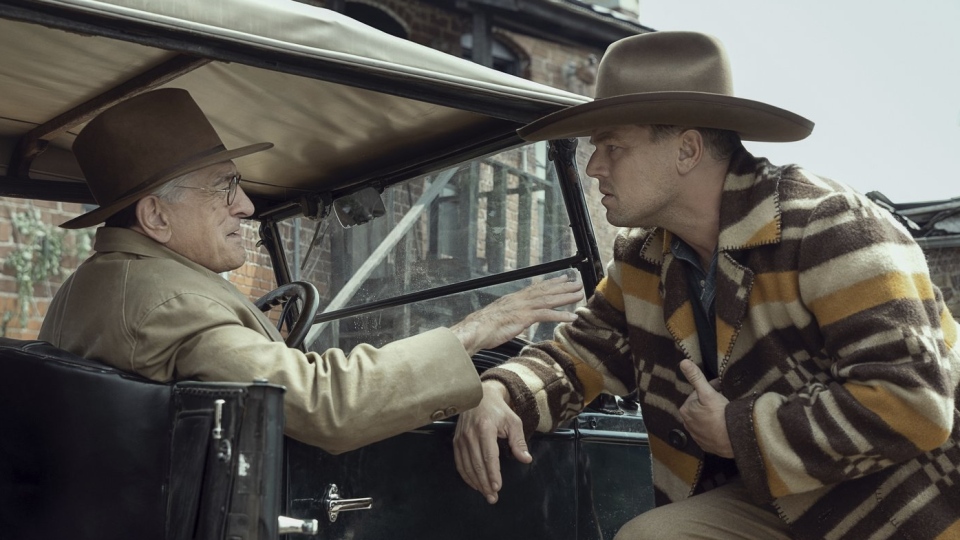
Robert De Niro and Leonardo DiCaprio in Killers of the Flower Moon.

Killers of the Flower Moon is great around the edges. Martin Scorsese’s movie, adapted from David Grann’s jaw-dropping 2017 account of the serial murders of Osage Indians in Oklahoma in the 1920s that enabled white men to secure their “headrights” – the legacy, shared equally among the community, of land rich in oil – is three and a half hours long and cost $200 million, and God knows you can see the money on the screen. The film, shot by Rodrigo Prieto, with production design by Jack Fisk and costumes by Jacqueline West, looks magnificent. The period reconstructions are dazzling and capture a cross-hatched culture, rich in visual irony, where natives, professing a faith that mixes Catholicism with the religion of their ancestors, dress in a combination of traditional garb and the flamboyant style of wealthy white men while they tool around in chauffeured Pierce Arrow roadsters and fly private airplanes. The opening scenes are lively and exciting, a circus-like montage of oil strikes and auctions and raucous general celebration that spills out of barrooms and restaurants into the streets of Fairfax, the Osage reservation town that has grown out of the oil boom. This is some of Scorsese’s best filmmaking – visually dense, outré, darkly funny. We barely have a chance to process the omnipresence of white men who have intermarried with the Osage women before it all turns sinister. The natives are dying in staggering numbers, some the victims in unsolved murders, others expiring from suspicious illnesses.

Saturday, June 15, 2013

Back to High School: The Great Gatsby

Leonardo DiCaprio in The Great Gatsby

Baz Luhrmann’s The Great Gatsby bears little resemblance to the slender masterpiece on which it is based – F. Scott Fitzgerald’s now iconic 1925 novel – but that probably won’t come as much of a surprise to anyone who has followed this director’s career. While his critics see him as a sort of Andrew Lloyd Webber of movies whose histrionic period pieces (Moulin Rouge!Romeo + Juliet) put one in mind, to borrow a phrase from Pauline Kael, of “a dog with the broken bones of a cat sticking out,” few of Luhrmann’s fans would likely contest that characterization. To them, Luhrmann’s movies are carnival sensations, romances to excess that celebrate the hysterical pace of the modern age in brazen, trashy style (and anyone who doesn’t like their cats grafted messily onto dogs is just a purist, patrician snob). There’s a faint odor of schoolyard allegiance that clings to the debate around Baz Luhrmann, and it never fails to make me feel like the teenager who chooses to stay home with a book while all her friends go out to a rave.

Thursday, September 12, 2019

A Flaccid Fairy Tale: Quentin Tarantino’s Once Upon a Time… in Hollywood

Brad Pitt and Leonardo DiCaprio in Once Upon a Time... in Hollywood.

The following contains spoilers.
 
Quentin Tarantino’s ninth film, Once Upon a Time...  in Hollywood, is a noted departure from his norm. It’s devoid of most of his worst habits, like the repetitive use of racial epithets for sheer shock value, which African American filmmaker Spike Lee has properly called him out on, as well as the mucho macho posturing of his male characters, which has always been a tiresome feature of his films. Those motifs certainly permeated his last two mediocre features, Django Unchained (2012) and The Hateful Eight (2015). By comparison to those, this movie is actually quite an amiable effort on his part and a bit more ambitious than some of the season’s other films, such as the vapid Danny Boyle/Richard Curtis alternate-history comedy Yesterday and Jim Jarmusch’s one-note deadpan zombie flick The Dead Don’t Die. But its wispy story line is not thought through and ultimately it’s a slight movie that fades away once the credits have finished running.

Wednesday, February 17, 2016

Endurance: Alejandro G. Iñárritu's The Revenant

Leonardo DiCaprio in Alejandro G. Iñárritu's The Revenant. (Photo: Kimberley French/20th Century Fox)

In Francois Truffaut's probing essay, "What Do Critics Dream About?" which opens his book of movie reviews, The Films in My Life, he writes, "I demand that a film express either the joy of making cinema or the agony of making cinema. I am not at all interested in anything in between; I am not interested in all those films that do not pulse." Of course, Truffaut (as both movie director and critic) is talking about the kind of visionary work where artists who break the bounds of convention risk not only alienating an audience, but also their own sanity in order to make their movie "pulse." That would include Erich von Stroheim's 1924 epic tale of avarice (Greed), Abel Gance's thrillingly lunatic Napoleon (1927), Orson Welles' groundbreaking Citizen Kane (1941), Bertolucci's equally inspired and crippling 1900 (1976), Martin Scorsese's ambitious musical, New York, New York (1977), Francis Coppola's metaphoric dirge Apocalypse Now (1979), Michael Cimino's amorphous western Heaven's Gate (1980), Werner Herzog's lunatic Fitzcarraldo (1982) and Terrence Malick's madly idiosyncratic The Tree of Life (2011). Whether any of these films achieve the artistic heights their directors intended is not the point. They were clearly movies perfumed in the joy or agony of their creator's need (or megalomanical desire) to stretch the art form  and if they didn't always work, they often made better films possible in those they inspired. But when it comes to Alejandro G. Iñárritu's epic adventure The Revenant, which has been piling up awards and accolades for its own daring, perhaps another category should be considered: the job of making cinema. For unlike the previously mentioned work, Iñárritu conceives his films (21 Grams, Babel, Biutiful and Birdman) as highly controlled endurance tests where the risks become self-consciously employed and (despite the director's enormous skill) the material turns into a mountain of familiar dramatic clichés. Based in part on Michael Punke's novel, which draws on the experiences of the fur trapper and frontiersman Hugh Glass, The Revenant is an epic and artful tale of revenge and redemption, but the motor running this mystical journey is fueled by the same blood lust that powers most commercial exploitation action films.

Friday, February 19, 2010

Scorsese's Labyrinth: Shutter Island

 
Martin Scorsese’s Shutter Island is less an adaptation of author Dennis Lehane’s mystery thriller than it is a virtual funhouse of the director’s favourite film noir tropes – only there’s no fun in it. As he did in his ridiculous re-make of Cape Fear (1991), Scorsese gets so absorbed invoking the work of various film stylists - including Jacques Tourneur's I Walked With a Zombie (1943), Vincente Minnelli’s The Cobweb (1955), Don Siegel’s Invasion of the Body Snatchers (1956), Alfred Hitchcock’s Vertigo (1958) and Sam Fuller’s Shock Corridor (1963) - that he can’t find a style of his own to take us inside the drama. Working from a dense but convoluted script (by Laeta Kalogridis), Shutter Island is a cluttered labyrinth that begins as an ingenious detective story but slowly shifts into a psychological character study. However, Scorsese gets so jazzed on creating a surreal atmosphere, aided by the atonal sounds of Ligeti, Penderecki and John Adams, that he clouds the clarity of the story. If it wasn’t for the good work by many of the performers, desperately breathing life into their stock roles, the picture would sink under the weight of the director’s B-movie fetishes.

Thursday, December 27, 2012

Flamboyant Disreputability: Quentin Tarantino's Django Unchained

Jamie Foxx and Leonardo DiCaprio in Django Unchained.

Quentin Tarantino’s Django Unchained, which is set before the American Civil War and stars Jamie Foxx as a freed slave who strikes up a partnership with a dentist turned bounty hunter, Dr. Schultz (Christophe Waltz), has been called a “spaghetti Western,” both by Tarantino (when it was still in the planning stages) and by those (such as Spike Lee) who have publicly disparaged it as “disrespectful” to the memory of those who were caught under slavery’s boot heel. It says something about the disconnect between the two camps that they’re using that term at all. In the ‘60s, American film writers who described the operatically violent Westerns shot (often in Spain) by Italian directors such as Sergio Leone and Sergio Corbucci as “spaghetti Westerns” were being derisive towards a subgenre that was widely seen as decadent, shoddy, and, oh yeah, disrespectful towards the proper, legendary West of John Ford, John Wayne, and Gunsmoke.

In recent years, critics who have re-evaluated and upgraded the work of Leone and other filmmakers who worked in the genre have largely abandoned the term in favor of the more staid label “Italian Western.” As a movie addict with a voracious appetite and encyclopedic (but non-judgemental) attitude towards popular culture, Tarantino still uses it. He appreciates it for the way it instantly telegraphs the look and feel of a hallucinatory, overheated world fueled by sadism and blood revenge, with violent rituals enacted by characters in period costume accompanied by the sound of psychedelic electric guitars. Lee, a self-styled provocateur, but one who plays by the establishment’s rules – his idea of a bold gesture is a three-hour, $30 million biopic, sanctified by the onscreen presence of Nelson Mandela, depicting a controversial and divisive figure from recent American history as a black saint – hears the term “spaghetti Western” in reference to a movie with an ex-slave hero, and can’t imagine how that combination can be anything but a dance on Harriet Tubman’s grave.

Sunday, February 21, 2010

Robert Richardson's Shutter

Salvador Dali isn’t available these days to craft a surreal dream sequence, as he did for Alfred Hitchcock’s Spellbound in 1945. But director Martin Scorsese had talented contemporary artists -- among them, cinematographer Robert Richardson -- to help him fashion the freakish cerebral terrain of Shutter Island. Each of those psychological thrillers is set in a mental hospital where the lead character arrives confused and eerie conspiracies abound. But it’s the stunning Vertigo, which opened in 1958, that seems aesthetically similar to the current film by Scorsese -- who has suggested that all of his work taps into much the same “sense of obsession” evident in Hitchcock’s oeuvre.

Friday, November 27, 2015

Bridge of Spies: Phony Baloney

Tom Hanks in Steven Spielberg's Bridge of Spies.

The opening sequence of Steven Spielberg’s Bridge of Spies, where, in 1957, the slippery British-born Russian spy Rudolf Abel (Mark Rylance) manages to elude the FBI for the last time before he’s caught, is both excitingly and wittily filmed. Rylance, a much-lauded stage and recently TV star (he played Thomas Cromwell in the BBC adaptation of Wolf Hall) who hasn’t been tapped by the movies until now, turns the tension between Abel’s hyperawareness and his calm, almost languid air into a sort of music-hall routine with a whiff of melancholy. But as soon as Abel is sent to prison to await trial for espionage and James Donovan (Tom Hanks) is urged by his law firm to act as his defense attorney, the movie flattens out. How did Spielberg and the writers, Joel and Ethan Coen and Matt Charman, manage to turn the fascinating, twisty story of Abel – the Cold War spy who ended up being traded to the Soviets for both the captured pilot Francis Gary Powers (Austin Stowell) and Frederic Pryor (Will Rogers), an American economics student in Berlin arrested for suspicion of espionage – into a civics lesson? Somehow, instead of releasing the storytelling master in Spielberg – the director who could make the three-hour Munich so gripping – Bridge of Spies brings out his earnest, big-studio-era, socio-sentimental side. Janusz Kaminski’s period cinematography is gorgeous and vivifying, but the movie behind it is as glazed as Always, his 1989 remake of A Guy Named Joe, with Richard Dreyfuss in the Spencer Tracy part. And this time around he’s got Tom Hanks, who plays Jim Donovan as if he were Tracy.

Monday, January 31, 2022

The North Water: Elemental Tragedy

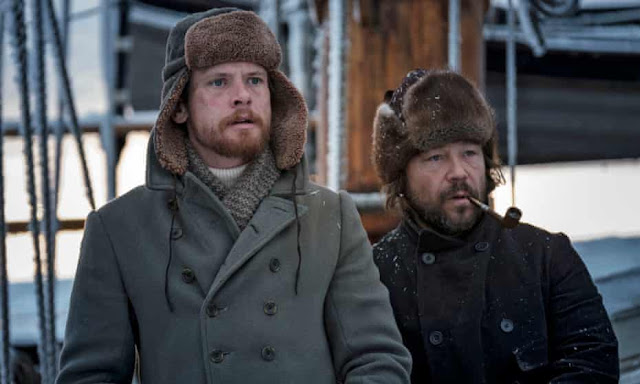
Jack O'Connell and Stephen Graham in The North Water.

Set in the 1860s on an English whaling ship that meets disaster in Arctic waters, the limited series The North Water (on AMC+) finds extraordinary beauty in a staggeringly grim narrative. The writer-director is Andrew Haigh, one of the most gifted of the current crop of British filmmakers. Haigh helmed the half-hour HBO series Looking, about a trio of gay men living in San Francisco, which culminated in a very fine TV movie; for the big screen he’s directed 45 Years with Tom Courtenay and Charlotte Rampling, about a four-and-a-half-decade marriage that is disrupted by an unexpected remnant of the husband’s past, and Lean on Pete, perhaps the most unusual film I’ve ever seen about the relationship between a boy and a horse. His taste runs to the stark; even Lean on Pete falls into that category. And The North Water, which Haigh adapted from a 2016 novel by Ian McGuire, is truly brutal. The protagonist is Patrick Sumner (Jack O’Connell), who signs on as ship’s surgeon after his military experience in India goes sour and wrecks a promising career in medicine. Sumner arrives on board haunted by nightmares as well carrying an opium jones, yet he turns out to be the most salvageable of the main characters. Both the captain, Brownlee (Stephen Graham), and the first mate, Cavendish (Sam Spruell), are privy to the scheme of the ship’s owner, Baxter (Courtenay), to take the ship, The Volunteer, into ice-bound northern waters with the aim of destroying it for the insurance. And Cavendish’s companion, Henry Drax (Colin Farrell), is a sadistic brute who rapes and kills the ship’s cabin boy (Stephen McMillan) and then frames a fellow sailor for his murder.

Wednesday, February 8, 2017

Piety: Martin Scorsese's Silence

Adam Driver and Andrew Garfield in Silence.

No question: Martin Scorsese's religious epic, Silence, is aptly named. Unlike his last feature, The Wolf of Wall Street (2013), with its frenetic, speed-freak pacing, or the pilot of the HBO series, Vinyl, where the editing rhythms were so percussive that they became assaulting, Scorsese's new picture unfolds with a quiet and solemn reverence, as if we were in church, and the atmosphere is hushed. Silence has a lulling seductiveness going for it (the cinematography by Rodrigo Prieto is both lush and vibrant), so it's clear that the asceticism of Shūsaku Endō’s 1966 novel has drawn the director – once again – into a sojourn in search of spiritual values and truths, but the drama itself turns out to be no more substantial than in The Wolf of Wall Street. If the sensational highs of sex, cocaine and larceny were the driving force of that picture, rather than an attempt to bring the audience to a dramatic understanding of how Jordan Belfort (Leonardo DiCaprio) swindled his way to the top of Wall Street, the piety of religious faith becomes the drug of Silence, substituting for a rendering of spiritual belief. Scorsese may be aiming for the formalist poetry of Robert Bresson's Diary of a Country Priest (1951), where a man of God gets tested by those who reject him, but the result is actually closer to Carl Dreyer's Ordet (1955) where spirituality is reduced to pedantic dogma.

Sunday, April 15, 2012

James Cameron and Titanic: Bigger, Not Better

Leo & Kate in James Cameron's Titanic 
This year marks the 100th and 15th anniversary of Titanic – 100 for the ship’s tragic sinking, and 15 for James Cameron’s sinking tragedy. Fifteen years ago, I was one of those teenage girls screaming “Leo!” and lining up at the multiplex to see the movie for the eighth time. Now, slightly more mature and discerning (albeit still with a soft spot for Leonardo DiCaprio), I thought I’d screen the film again. Despite winning eleven Academy Awards, Titanic is still a movie most people won’t admit that they enjoy. Even I was dreading the moment when the cashier at the movie store opened the DVD case and announced “Titanic” to the rest of the queue.

I persevered and brought home the three and a half hour epic. It turns out 15 years does a lot to change perspective. At 15, I thought Rose (Kate Winslet) did the noble and courageous thing by choosing Jack and his charisma over fiancé Cal and his millions. At 30, I question if choosing personal happiness over family responsibility is an act of cowardice, not courage. Although the movie is peppered with clever moments (flippant references to Picasso and Freud are chuckle-worthy), what struck me were the copious resources poured into the making of this film. Perhaps it is fitting that Cameron’s blockbuster came with a record 200-million-dollar price tag. After all, Titanic the ship cost an unprecedented $7.5 million to build back in 1912.

Wednesday, January 17, 2018

Poker Face: Molly's Game

Jessica Chastain (left) in Molly's Game. (Photo: Michael Gibson)

As Molly Bloom in screenwriter Aaron Sorkin's directing debut, Molly's Game, Jessica Chastain is something of an enigma. Playing a real-life high-stakes entrepreneur who ran exclusive poker games in New York and Los Angeles for over a decade until she was arrested by the FBI, Chastain (Zero Dark Thirty, A Most Violent Year) turns opaqueness into an acting style. Her glamourous deadpan tells us little about the restless hunger that propelled Bloom into hosting a motley collection of players – including Hollywood celebrities (like Leonardo DiCaprio, Ben Affleck and Tobey Maguire), business tycoons, gambling addicts and Russian mobsters (which would lead to federal charges against her). Chastain dons a poker face like her clients, but it reveals even less about what's going on with her than the faces of the card sharps at her table bluffing their way to a kill. In Molly's Game, the motivating force – what is hidden behind all her risky moves – is missing in the performance. It's missing in the movie, too, because Sorkin can't identify with the low cunning it takes to pull off what Bloom accomplished. He has higher ideals in his head and they've clouded his thinking.

Sunday, April 15, 2012

Remembering A Night to Remember


Adapted by novelist Eric Ambler from Walter Lord’s non-fiction account of the sinking of the Titanic and directed by Roy Ward Baker, A Night to Remember – now available in a newly remastered DVD print from Criterion – is a small classic of understated English filmmaking. It has an enormous cast, and the crowd scenes are impressively staged (and, in the moments when the passengers who haven’t been hoisted onto the inadequate number of lifeboats begin to panic, tense and frightening), but Baker manages to retain a feeling of intimacy. He works modestly, focusing as much as possible on individual characters and details. In the 1997 Titanic, James Cameron took three hours plus to tell a preposterously fictionalized version of the story – almost twice as long as it took the ocean liner to sink. Baker’s film is two-thirds the length of Cameron’s, most of it in real time, and he doesn’t make things up. He doesn’t need to, since the truth is far more dramatic and moving than anything Cameron could devise.

Friday, August 6, 2010

Bummers in the Summer: Salt & Inception

Since I’m no longer reviewing movies regularly, it’s taking more time for me to catch up with new releases. In the past, I used to see things at pre-release press screenings before all the marketing hype (and their corollary reviews) kicked in. So before going to see Phillip Noyce’s hit espionage thriller Salt, I was already inundated with laudatory comments claiming Angelina Jolie as the top female action star in Hollywood history. Judging from the picture’s huge financial success at the box office, you can’t argue with the figures. But the questions left unasked are: Is anyone truly buying her performance, or even this movie?

Sunday, April 15, 2012

Family History: Titanic Memories

Thomas Burden at 27 years old (over ball), David Churchill's Grandfather

The job awaited him in America. He had already said his good-byes to all his mates in the local pub. Two or three young lasses quietly mourned the fact they were losing “another one” to America. Belfast didn’t hold much future for a Catholic, not in March 1912, so his decision had been made. His brother, Paddy, understood; his sister, Teresa, or Teesie as he called her, didn’t. His Da, James? He’d passed away some time ago. His Ma, Ellen, was resigned, though deeply saddened. 

As the date to sail in April crept closer, his Ma took ill. At first, he thought it was a cold, but then it got worse. He knew he’d never see her again, so after a couple of nights’ reflection, he cashed in his ticket. He would not have been able to live with himself if she passed while he travelled, or shortly after he arrived. He was still disappointed, because the ship was to be on her maiden voyage. He had even occasionally gone down to the Harland and Wolfe shipyards to watch her, and her sister ship Olympic, being built. He’d heard that even in steerage accommodations were acceptable, and the food was far better than he’d been eating recently. He would wait until his Ma was well before he booked again. In the meantime, he went to the telegraph office and sent a message to his prospective employer in Traverse City, Michigan that he would be delayed, he hoped, for no more than a month. 

So, on April 10th, the ship sailed without him. The next day, his Ma showed improvement, and by the 13th, she was well on the road to recovery. He thought nothing about the ship; all that mattered was that his Ma had recovered. On the afternoon of the 13th, he went to the ticket office and booked on a ship that was scheduled to sail in early May: the Lusitania. A good ship, he heard, just not new. He went to the pub that evening, and Mass the next day with his family. He was home and asleep early on the night of the 14th. 

He went to the telegraph office the next morning to let his American employer know when he would be arriving. The office was in an uproar with crowds of people outside. “She went down,” he heard one man say to another. “She’s gone,” said another. “Alfred was on board,” a woman behind him said before she broke into tears. He turned and asked another man outside the telegraph office what had happened. “The Titanic. She’s hit an iceberg and sunk. Over half of the passengers went with her.” Numbness hit his limbs and he felt himself wobble slightly. Another man grabbed his arm or he would have fallen. The man eased him onto a nearby stoop. “Ya all right, mate?” he asked. “I … I was supposed to be on that ship,” he said. 

Passenger Record from the Lusitania
That is Thomas Joseph Burden’s story. He is my grandfather – my mother’s father. Indeed he did have tickets in steerage on the Titanic. His mom did get sick and he cancelled his tickets and came over, finally, a month later on the Lusitania, about three years before it was sunk by a torpedo. Talk about the luck of the Irish. He never spoke much about it. All we knew was the basics: he had a job offer as a newspaper printer in Traverse City, Michigan; had tickets on the Titanic; his mother took sick so he cancelled; he came to America a month later on the Lusitania. So, what you read above is extrapolated from what little we knew. I believe the whole story, because a few years ago I dug through the Ellis Island electronic archives and indeed I did find his name in their records as an immigrant to the US on the Lusitania (see image). I was able to prove beyond a shadow of a doubt the Lusitania part of the story, so I have no reason to doubt the Titanic part.

Friday, December 30, 2011

Movies and Time: Christian Marclay's The Clock

For those of us unrepentant film addicts who can track the passage of our lives by the movies we’ve seen, Christian Marclay’s The Clock provides a unique sort of enchantment. Marclay, a California-born visual artist and composer, has assembled a twenty-four-hour film made up of film (and some TV) clips about time. Most of them actually mark the time: the first time I caught a section of it, at the Los Angeles County Museum of Art last July, my watch read 3:09 p.m. as I stepped into the projection room and as soon as I’d settled myself on one of the couches, I heard a voice from screen bemoaning the lateness of the 3:10 train to Yuma. Many of the scenes  some are as short as a single shot  contain images of clocks and watches, but Marclay’s day-long montage considers time in every conceivable form and interpretation.

Saturday, March 10, 2018

Romantic Comedy at the End of the Millennium: The Last, Brief Golden Age

James Stewart and Margaret Sullavan in The Shop Around the Corner (1940).  

Why is it so difficult for Hollywood to make decent romantic comedies in the twenty-first century? Every year brings a handful, but by my count there have been only five in the last decade worth looking at: Ghost Town and Vicky Cristina Barcelona in 2008, Letters to Juliet in 2010, Top Five in 2014 and – a special case – Joss Whedon’s adaptation of Shakespeare’s Much Ado About Nothing (with a contemporary setting) in 2013. And you could put David Fincher's 2011 adaptation of The Girl with the Dragon Tattoo on that list, too, since it’s a murder mystery that only gets solved (as Kevin Courrier argued convincingly on this website) when the two protagonists, a brilliant journalist with an analog background and an IT whiz, pool their intellectual resources (while becoming lovers). As Whedon’s movie reminds us, Much Ado is the granddaddy of modern American romantic comedy. It pioneered the structure – a hero and heroine begin as adversaries but, by passing a series of tests and proving they’re open to compromise and change, they gradually earn each other’s love – that Hollywood adopted in the 1930s and that proved hardy and resilient through the rest of the twentieth century. It was the ideal solution to the issues posed by Hollywood’s self-censorship code (the Production Code, known popularly as the Hays Code), which bore down on American filmmakers in 1934 and held sway for roughly the next twenty-five years. The romantic-comedy structure enabled writers and directors to make movies that were sexy and witty, even though the narratives were forced to banish actual sex. Audiences loved smart entertainments like It Happened One Night (the first of these), My Man Godfrey, The Awful Truth, My Favorite Wife, Easy Living, The Moon’s Our Home, Bringing Up Baby, The Shop Around the Corner, His Girl Friday and The Lady Eve. And they responded to the form itself, which was a dramatic metaphor for the process of falling in love.