Showing posts sorted by date for query Andrew Scott. Sort by relevance Show all posts

Sunday, September 7, 2025

Summer Musicals

Mary Antonini as Reno Sweeney and the cast of Anything Goes. (Photo: David Cooper.)

This article includes reviews of musicals at the Shaw Festival and the Stratford Shakespeare Festival as well as at Ogunquit Playhouse in Maine.

Anything Goes opened on Broadway in 1934 and proved to be Cole Porter’s biggest hit until Kiss Me, Kate nearly a decade and a half later; it ran for 420 performances, hefty for the time. But it just escaped turning into a fiasco because the book Guy Bolton and P.G. Wodehouse, writing from different cities, cobbled together was so scattershot that the producer, Vinton Freedley, asked the director, Howard Lindsay, to rewrite it. With the collaboration of Russel Crouse he did so in three weeks, while the show was in tryouts out of town, and that’s the version audiences saw whenever it was produced over the next half-century. Lewis Milestone made a sweet movie of it in 1936 with Bing Crosby and Ethel Merman, (the leading lady of the Broadway production), though I suspect even many Porter devotees don’t know it. (The 1956 M-G-M movie with Crosby, Donald O’Connor and Mitzi Gaynor, has nothing in common with the show except the title and, in the opening section, a shipboard setting.) There was only one major revival, off-Broadway in 1962, which cut a few of the songs and interpolated others from the Porter archive, like “It’s De-Lovely” from Red, Hot and Blue (which has become a permanent addition) and “Take Me Back to Manhattan” from The New Yorkers. When it finally returned to Broadway in 1987, with Patti LuPone in the Merman role, Crouse’s son Timothy and John Weidman rewrote it, staying faithful to the spirit of the original but making their own emendations to the score. This is the Anything Goes that Kathleen Marshall directed triumphantly in a 2011 Broadway revival starring Sutton Foster and Joel Grey, and it’s the one graced by an ebullient production at the Shaw Festival this season (in their Festival Theatre) directed and choreographed by Kimberley Rampersad.

Tuesday, May 20, 2025

The Extraordinary Adam Guettel: The Light in the Piazza at The Huntington and Floyd Collins on Broadway

Emily Skinner in The Huntington Theatre's The Light in the Piazza. (Photo: Julieta Cervantes.)

The new Huntington Theatre mounting of The Light in the Piazza is the fourth production I’ve seen of this show, and except for Bartlett Sher’s spectacular original staging, at Lincoln Center in 2005, it’s the best. I think that Piazza, with its first-rate Craig Lucas book derived from Elizabeth Spencer’s 1960 novel and its soaring impressionistic score by Adam Guettel, is the greatest musical written in the twenty-first century. (Yes, I love Hamilton.) It’s an unconventional romantic musical in which the leap of faith made by the wife of a North Carolina tobacco executive named Margaret Johnson, who brings her daughter Clara to Florence on vacation in 1953, is a symbol for all of our attempts to find happiness in love, even though we know that the effort is reckless because as often as not it ends in shambles. One of the elements that make the play unusual is that though the lovers are Clara and a young Florentine named Fabrizio Naccarelli, the son of a shopkeeper, who fall in love at first sight. Margaret is the protagonist, and it’s finally she who has to overcome personal obstacles, not her daughter. She has been Clara’s protector since, at twelve, the girl was kicked in the head by a pony, apparently halting her emotional development. So when she and Fabrizio become entranced with each other, Margaret – encouraged via long distance by her husband Roy back home in Winston-Salem – attempts to stop it before the humiliating moment when the Naccarellis figure out something is wrong. But no one in the Naccarelli family is put off by Clara’s childlike nature, or even by her explosion when Fabrizio’s flirtatious sister-in-law, Franca, gets too close to him at a family get-together. The Naccarellis find her refreshingly old-fashioned; even Franca, whose attention-getting behavior is a response to her husband’s sexual duplicitousness, defends her; she thinks that Clara is right to fight for her man she loves and even wishes she had done so. Margaret has to confront the fact that the greater block to her approving Clara’s union with Fabrizio is the fact that her own marriage has been a disappointment, that she long ago ceased to believe in love.

Monday, October 14, 2024

My Best Friend’s Wedding and Stereophonic: Too Much Music and Not Enough

Matt Doyle and Krystal Joy Brown in My Best Friend's Wedding. (Photo: Nile Scott Studios)

The notion of a jukebox stage musical based on the 1997 romantic comedy My Best Friend’s Wedding, featuring the songs of Burt Bacharach and Hal David and directed and choreographed by Kathleen Marshall (who has helmed ace Broadway revivals of Kiss Me, Kate, Wonderful Town and Anything Goes), sounded promising. (The movie uses Bacharach-David tunes in key moments.) But the show, which is premiering at Ogunquit Playhouse in Maine, is both synthetic and clunky. The movie, written by Ron Bass and directed by P.J. Hogan, is an unconventional romantic comedy in which the heroine, Julianne, a magazine food critic, plays every dirty trick she can think of to stop her best friend and one-time lover Michael from walking down the aisle with Kimmy, the woman he’s fallen head over heels in love with, but her schemes keep backfiring. It’s a tricky proposition, because we fall in love with Kimmy too, yet Julianne is the heroine and the movie won’t work if we end up disliking her. The movie pulls it off because Julia Roberts, in a wonderful comic-neurotic performance, plays Julianne.

Monday, May 27, 2024

Toni Stone, Mother Play, Uncle Vanya: Deserting the Audience

Stanley Andrew Jackson and Jennifer Mogbock in Toni Stone. (Photo: T. Charles Erickson)

The titular protagonist of Toni Stone, currently playing in the Huntington Theatre’s revered space in Boston’s Back Bay, is the first woman who played baseball regularly in a professional league. She played for three Negro leagues in the forties and fifties, culminating in a season with the Indianapolis Clowns of the Negro American League, where she replaced Hank Aaron, who had been picked up by the Milkwaukee Braves. It’s an appealing story for the stage and especially for contemporary audiences. But the playwright, Lydia R. Diamond, hasn’t worked out how to dramatize it.

Thursday, January 25, 2024

Year-End Movies IV: Monster and All of Us Strangers

Hinata Hiiragi and Soya Kurokawa in Monster.

The movies of the Japanese director Hirokazu Kore-eda are not just different from those of other filmmakers; they’re also often unlike each other. He seems to trod a new path each time out, and his narrative strategies are always fresh. His pictures aren’t even always in Japanese: his last, Broker, which was one of the best films of 2022, was shot in South Korea with Korean actors, and its predecessor, The Truth, was set in Paris and featured Isabelle Huppert and Juliette Binoche as mother and daughter and Ethan Hawke as Binoche’s American husband. The common denominator is a focus on unconventional family units, usually involving small children. The two fifth-grade boys at the heart of his latest, Monster, Minato (Soya Kurokawa), the protagonist, and the smaller and younger-appearing Yori (Hinata Hiiragi), have each lost one parent and are being raised by the other – Yori by a hard-drinking father (Akihiro Kakuta) and Minato by his mother, Saori (Sakura Ando), who is still mourning the death of her husband and struggles to balance caring for her son with a tiring job in a laundry. 

Monday, November 27, 2023

The Turbulent Thirties: I Can Get It for You Wholesale and Spain

Judy Kuhn and Santino Fontana in I Can Get It for You Wholesale. (Photo: Sara Krulwich)

The composer-lyricist Harold Rome, who died in 1993, has been more or less forgotten, but he was one of the few Broadway songwriters who wore his leftist politics on his sleeve. He broke through in a 1937 revue called Pins and Needles that focused on the uneasy relationship between management and labor and was produced by the International Ladies’ Garment Workers’ Union, whose members performed the sketches and musical numbers. How it managed to move from a tiny studio above the Labor Stage (the former Princess Theatre) to a Broadway house is something of a mystery, but counting all three editions, it ran for more than three years and made Rome’s reputation. His career spanned more than three more decades. A few of his shows were successful: the 1946 revue Call Me Mister, about returning servicemen; Wish You Were Here (1952), an adaptation of the Arthur Kober play Having Wonderful Time, set at an adult summer camp in the Catskills; Fanny (1954), based on a trilogy of French romantic dramas by Marcel Pagnol; and Destry Rides Again (1959), with Andy Griffith and Dolores Gray taking the roles played famously by Jimmy Stewart and Marlene Dietrich in the 1939 picture, a hybrid western-romantic comedy. (Destry Rides Again was the first show I saw on Broadway, when I was eight.) Until this season the only one that has been revived in New York, to my knowledge, is Fanny, which made it onto an Encores! slate in 2010 and proved to be just as bland and unmemorable as the original cast album indicated. It would be fun for someone to mount Wish You Were Here, which contains some lovely songs; Eddie Fisher made the hit parade with his recording of the title song. But don’t get your hopes up: in the original version the director, Joshua Logan, and the designer, Jo Mielziner, flooded the orchestra pit to create a swimming pool, which made even a pre-Broadway tryout tour impossible.

After the one-of-a-kind Pins and Needles, Rome’s most interesting musical was I Can Get It for You Wholesale (1962), which Jerome Weidman culled from his 1939 novel about life in Manhattan’s garment district. If musical theatre mavens know it at all, it’s for introducing Barbra Streisand, who played the indispensable secretary of the show’s protagonist, Harry Bogen, and brought down the house with her big number, “Miss Marmelstein.” (Bogen was played by Elliott Gould, nearly a decade before Robert Altman made him a movie star in M*A*S*H; Gould became Streisand’s first husband. And Streisand was among the singers who made the only recording of the score for Pins and Needles the same year, to honor the twenty-fifth anniversary of its premiere.) Perhaps Trip Cullman’s sharp-edged, sharp-witted production of Wholesale for Classic Stage Company, which closes December 17, will have the effect of bringing a woefully neglected musical to light. Weidman’s son John, who wrote the books for three of Stephen Sondheim’s shows – including, in this critic’s opinion, his finest, the 1975 Pacific Overtures – has reworked the original book, and never having read the original I can’t say how much he’s altered it. One change I could deduce by looking at the 1962 playbill online: he’s added an opening episode with real punch that dramatizes Harry’s first bitter experience of the tough (and anti-Semitic) New York streets, which, at about thirteen years of age, he has to navigate while delivering goods for garment manufacturers. Weidman, Cullman and the inventive choreographer, Ellenore Scott, have initiated this section with a dance number featuring the talented young dancer Victor de Paula Rocha as the young Harry and ended it with Judy Kuhn as Mrs. Bogen introducing the song “Eat a Little Something,” which didn’t appear until late in the second act in the original production. In this iteration that version of the song is a reprise, sung to Santino Fontana as the grown-up Harry.

Monday, September 13, 2021

The Courier: The Art of Benedict Cumberbatch

Merab Ninidze and Benedict Cumberbatch in The Courier.

Benedict Cumberbatch has one of his best roles in The Courier (available on Amazon Prime) as Greville Wynne, an English salesman of no great accomplishment who agrees to act as the middleman between MI6 and the CIA and a Russian bigwig named Oleg Penkovsky (Merab Ninidze) who, in the cause of world peace, offers secrets to Britain and America during the Cuban Missile Crisis of 1962. Dominic Cooke’s taut thriller, with a precise, intelligent script by Tom O’Connor, is one of those irresistible stories about a mediocrity who surprises even himself by turning out a hero. And (much as I’ve enjoyed watching him as Doctor Strange) Cumberbatch shows more sides here than any movie has permitted him since he played Alan Turing in the immensely satisfying The Imitation Game – another true-life narrative – seven years ago. It’s admittedly a quirky performance, like one of those deep-cover period-piece portraits Laurence Olivier specialized in during the late phase of his career, when he all but disappeared into his wigs and prosthetics. Cumberbatch doesn’t exactly go in for that kind of physical transformation, but his vocal delivery almost makes a fetish out of Wynne’s Britishisms – his upper-class accent, his narrow vowels and his clipped, practiced aura of professionalism – and he conveys what he’s feeling through tight smiles. Greville’s business ventures take him around the world, but his skills are limited, and he drinks a little too much. The irony of his carrying off the part of a spy is that, according to his wife Sheila (Jessie Buckley), he’s incapable of hiding anything. Some time ago she figured out that he was cheating on her – it was his single marital indiscretion – so when he begins to act secretive again, and his trips to Moscow on an alleged business project take up more and more of his time, she assumes that he’s philandering once again.

Tuesday, June 1, 2021

Oslo, Stage to Screen

Salim Dau and Jeff Wilbusch in Oslo..

Given the peculiarly insulated nature of theatre, despite its success on Broadway too few people are familiar with J.T. Rogers’s play Oslo, which dramatizes the story of the Oslo Peace Accords that came heartbreakingly close to bringing an end to the bloodshed between the Israelis and the Palestinians in 1993. (The play won the 2017 Tony Award.) So the HBO film version – directed, like the play, by Bartlett Sher – affords the opportunity for many more lovers of serious theatre to access what is, I believe, the best American play since Bruce Norris’s 2012 Clybourne Park. Oslo does, however, pose several daunting challenges to a filmmaker, especially one who is making his debut behind the camera. One can, as Rogers does in the screenplay, eliminate some of the more obvious theatrical touches, like the direct address to the audience and the elusive narrative structure of the first act: it begins with the allegedly accidental revelation of a secret and then flashes back to establish the necessity for the secret as well as the need to expose it and make the exposure look like an accident. (This trickery is highly pleasurable in the theatre, but on screen it would be more likely to clutter up the storytelling. Rogers was smart to get rid of it.) On the other hand, you can’t just place the actors in realist settings and pretend they’re speaking in realist prose. The language tends to be oratorical, in the manner of much historical drama: the characters often talk at each other, making political points, tossing gauntlets at each other and escalating to grandiloquent eruptions. This isn’t intended as a criticism – the dialogue is elegant and forceful and often quite beautiful. Either a director has to go for broke, throwing strict realism to the winds, or figure out how to make the language work on the screen so it doesn’t sound like posturing.

Monday, January 13, 2020

The Big Guns: The Irishman, Marriage Story and 1917

Joe Pesci and Robert De Niro in The Irishman. (Photo: Niko Tavernise/Netflix)

This article includes reviews of The Irishman, Marriage Story and 1917. 

The Irishman is the cinematic equivalent of a thick, expensive coffee-table book prominently displayed in Rizzoli’s for the Christmas trade. Martin Scorsese’s three-hour-and-twenty-nine-minute epic has as much prestige as one awards-season release can handle. Steven Zaillian (screenwriter of Schindler’s List, Moneyball and The Girl with the Dragon Tattoo, creator/co-writer of the TV limited series The Night Of) wrote the adaptation of Charles Brandt’s bestseller I Heard You Paint Houses, a biography of Teamsters Union official Frank “The Irishman” Sheeran, a middleman for the Bufalino crime family who, shortly before his death, told Brandt that he’d murdered Jimmy Hoffa. (Sheeran’s claim has been disputed since the 2004 publication of Brandt’s book, by the journalist Bill Tonelli in Slate and by the Harvard law professor Jack Goldsmith in The New York Review of Books.) Rodrigo Prieto, the terrific cinematographer associated with Alejandro Iñárritu and Scorsese’s collaborator on The Wolf of Wall Street and Silence, shot it, in handsome dark tones befitting a classic. The star, Robert De Niro, shares the screen with both Al Pacino (as Hoffa) and De Niro’s Raging Bull co-star Joe Pesci (as Russell Bufalino, who pulls Sheeran’s strings). The list of the cast, which also includes Harvey Keitel, Ray Romano, Bobby Cannavale and Anna Paquin, is thirty-three computer screens long on imdb.com.

Monday, December 9, 2019

Present Laughter and Pride and Prejudice: Present-Day Laughter

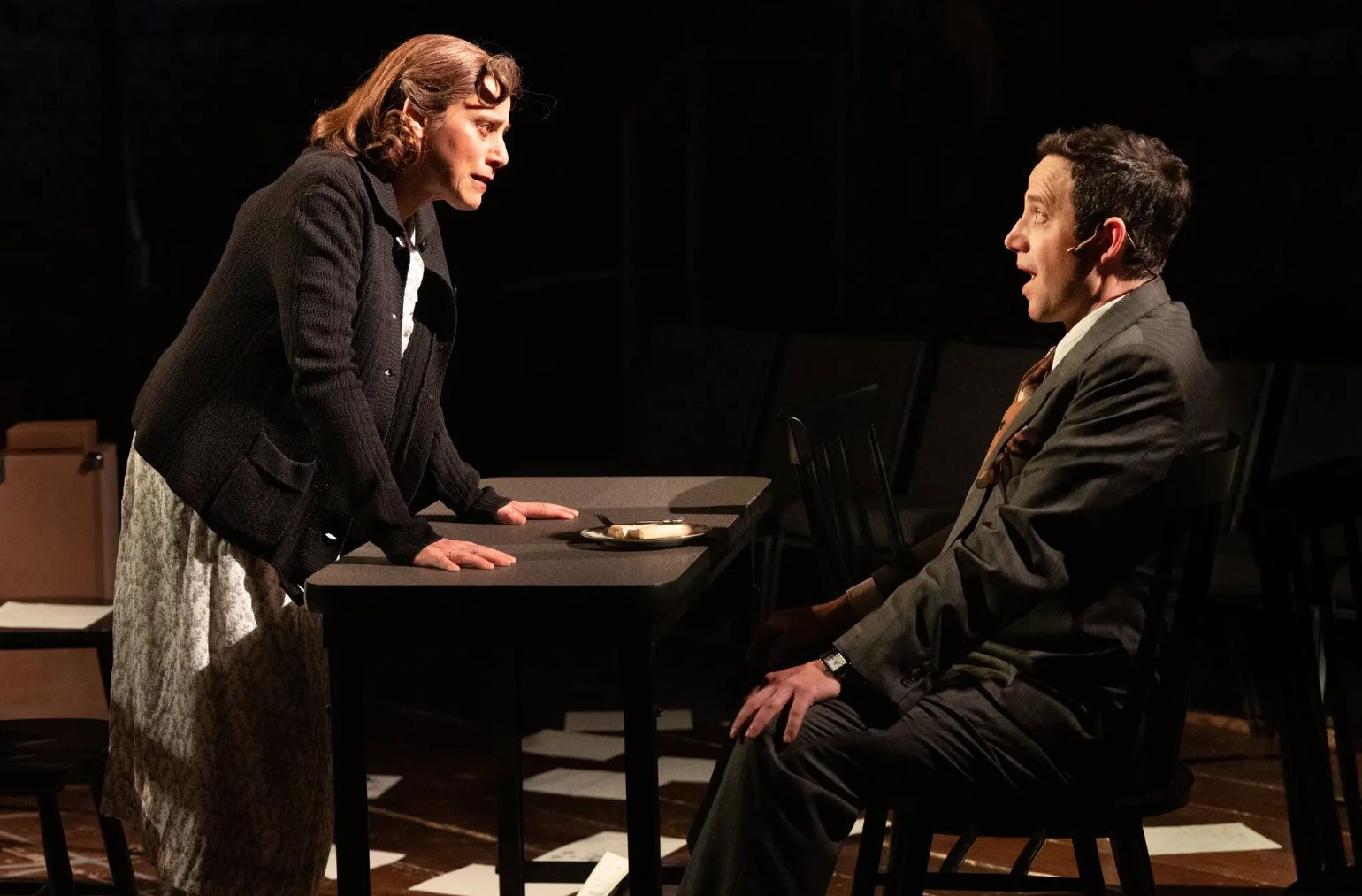
Andrew Scott and Indira Varma in Present Laughter. (Photo: Manuel Harlan)

The relentless updating of classic material continues apace with the Old Vic revival of NoĂ«l Coward’s 1942 Present Laughter (recently broadcast in the NTLive series) and Kate Hamill’s adaptation of Jane Austen’s Pride and Prejudice, currently being performed at New Haven’s Long Wharf Theatre. Present Laughter stars Andrew Scott as Garry Essendine, the narcissistic stage star Coward wrote as self-parody and starred in himself in the West End. The director, Matthew Warchus, has queered the material by making Garry explicitly bisexual and gender-switching the roles of his backer, Hugo, and his wife Joanna, still an outsider to Garry’s inner circle, who almost ruins everything by first carrying on an affair with Garry’s producer, Morris, and then seducing Garry himself. In this version, Hugo has become Helen (Suzie Toase) and Joanna is now Joe (Enzo Cilenti), so his dalliances with both Morris (Abdul Salis) and Garry are same-sex. Plus, as Garry reveals in the last act, Helen is sleeping with another woman.

Monday, October 29, 2018

Shakespeare x 2: Measure for Measure and King Lear

Petr Rykov and Anna Khalilulina in Cheek by Jowl and the Pushkin Theatre’s Measure for Measure. (Photo:Johan Persson)

The collaboration by the English company Cheek by Jowl and the Pushkin Theatre from Russia on Shakespeare’s Measure for Measure runs for an uninterrupted hour and fifty minutes, and it holds the attention. That is, until the climactic scene where first Isabella and then the Duke of Vienna expose the sexual blackmail Angelo, the Duke’s surrogate during his (supposed) absence, has attempted on Isabella, the convent novice whose brother Claudio has been sentenced to execution for fornication, according to the antiquated law Angelo has elected to reactivate. All the actors are Russian, and two of them, Anna Vardevanian as Isabella and Andrei Kuzichev, are first-rate. Their two big scenes – the one in which Isabella pleads for her brother’s life and the one in which Angelo presses his sexual attentions on her – are mesmerizing.  Cheek by Jowl’s Declan Donnellan has chosen to stage the sexual extortion as a near-rape; he’s far from the first director to do so, and given the sexual politics of this era he certainly won’t be the last. But though the staging is extremely effective, it’s mostly the intensity and variety of the two performances that make both encounters so gripping. And the slimming down of Shakespeare’s text (which mostly affects the scenes built around the madam, Mistress Overdone, played by Elmira Mirel, and her associate Pompey, played by Alexey Rakhmanov) help to shape the production so that it leads inexorably to the centerpiece Angelo-Isabella scenes.

Friday, May 18, 2018

Lean on Pete: A Boy and a Horse

Charley (Charlie Plummer) with his titular companion in Lean on Pete. (Photo: Scott Patrick Green)

Note: This review contains spoilers.

Lean on Pete belongs to a genre you wouldn’t expect Andrew Haigh, the gifted English writer-director of 45 Years and Looking, to be drawn to: that subcategory of coming-of-age movies in which the protagonist forms a strong emotional relationship with a special animal. Clarence Brown made the two classic Hollywood exemplars in the mid-forties, National Velvet and The Yearling, and Carroll Ballard directed the greatest of all of them, The Black Stallion, in 1979 (all three were adapted from beloved children’s volumes), using both National Velvet and the French filmmaker Albert Lamorisse’s incandescent short film White Mane (1953) for inspiration. Ballard made other splendid movies of this type – Fly Away Home in 1996 and Duma in 2005 – but The Black Stallion, with its dialogue-free desert-island second act and its horse-racing third act, its vibrant, painterly use of color (the film critic Pauline Kael wisely evoked the work of the American abstract expressionist Morris Louis by way of comparison), its juxtaposition of the archetypal and the elemental to explore the experience of an eight-year-old boy far beyond his ability to find verbal expression for, is indisputably the masterpiece of the genre. (Melissa Mathison, who wrote the script, also collaborated with Steven Spielberg on E.T., which substitutes a creature from another planet for the magical animal.)

Saturday, March 10, 2018

Romantic Comedy at the End of the Millennium: The Last, Brief Golden Age

James Stewart and Margaret Sullavan in The Shop Around the Corner (1940).  

Why is it so difficult for Hollywood to make decent romantic comedies in the twenty-first century? Every year brings a handful, but by my count there have been only five in the last decade worth looking at: Ghost Town and Vicky Cristina Barcelona in 2008, Letters to Juliet in 2010, Top Five in 2014 and – a special case – Joss Whedon’s adaptation of Shakespeare’s Much Ado About Nothing (with a contemporary setting) in 2013. And you could put David Fincher's 2011 adaptation of The Girl with the Dragon Tattoo on that list, too, since it’s a murder mystery that only gets solved (as Kevin Courrier argued convincingly on this website) when the two protagonists, a brilliant journalist with an analog background and an IT whiz, pool their intellectual resources (while becoming lovers). As Whedon’s movie reminds us, Much Ado is the granddaddy of modern American romantic comedy. It pioneered the structure – a hero and heroine begin as adversaries but, by passing a series of tests and proving they’re open to compromise and change, they gradually earn each other’s love – that Hollywood adopted in the 1930s and that proved hardy and resilient through the rest of the twentieth century. It was the ideal solution to the issues posed by Hollywood’s self-censorship code (the Production Code, known popularly as the Hays Code), which bore down on American filmmakers in 1934 and held sway for roughly the next twenty-five years. The romantic-comedy structure enabled writers and directors to make movies that were sexy and witty, even though the narratives were forced to banish actual sex. Audiences loved smart entertainments like It Happened One Night (the first of these), My Man Godfrey, The Awful Truth, My Favorite Wife, Easy Living, The Moon’s Our Home, Bringing Up Baby, The Shop Around the Corner, His Girl Friday and The Lady Eve. And they responded to the form itself, which was a dramatic metaphor for the process of falling in love.

Friday, February 9, 2018

All the Money in the World and Phantom Thread: Another Planet

Michelle Williams and Mark Wahlberg in All the Money in the World.

All the Money in the World, Ridley Scott’s movie about the 1973 kidnapping of sixteen-year-old John Paul Getty III – known as Paul – garnered considerable attention when, following the sexual harassment claims against Kevin Spacey, Scott replaced him with Christopher Plummer in the key role of Getty Sr., Paul’s grandfather – considered in his time to be the wealthiest man in the history of the world – and re-edited the movie at the eleventh hour. But the movie died at the box office anyway, and that’s a real shame because it’s a first-rate psychological study. In the opening voice-over, Paul (Charlie Plummer) begs us to forgive the behavior of his family because, he explains, they’re rich and the rich live on another planet. Hollywood has turned out many cautionary fables over the years that present the very rich as embodiments of the American dream gone sour. (Perhaps the latest famous example is Paul Thomas Anderson’s There Will Be Blood.) David Scarpa, who wrote the screenplay for All the Money in the World (based on John Pearson’s book, Painfully Rich: The Outrageous Fortunes and Misfortunes of the Heirs of J. Paul Getty), takes a different approach: he depicts extreme wealth, wealth beyond one’s wildest dreams, as a pathology. Plummer’s J. Paul Getty may be a supporting part – the main characters are Paul’s desperate mother, Gail Harris (Michelle Williams), who has to fight to get her ex-father-in-law to agree to pay her son’s ransom, and Fletcher Chase (Mark Wahlberg), the ex-CIA man whom Getty dispatches to negotiate with the kidnapers – but he’s at the heart of the film. And Plummer hovers over even the parts of the movie he’s not in, the way Brando hovered over The Godfather even during the many scenes when he wasn’t on screen. Plummer, who turned eighty-eight right around the time the picture was released, gives a performance that deserves to become legendary. We’ll never know what Spacey brought to the part, but when you watch Plummer you can’t imagine why Scott cast Spacey in the first place; it seems as if he’d be completely wrong for it.

Wednesday, December 6, 2017

Coal into Diamond: The Inspiring Story of Gospel Funk

The incredible Sister Rosetta Tharpe, consummate gospel singer and secret inventor of rock 'n roll, soul and visionary funk music, circa 1940.

“I feel like there is an angel inside of me that I am constantly shocking.” – Jean Cocteau

“When I’m on stage, I’m trying to do one thing: bring people joy. Just like church does. People don’t go to church to find trouble, they go there to lose it.”– James Brown
The word "gospel," of course, literally means good news. But the really good news is that gospel music morphed into the blues, blues morphed into soul, soul morphed into funk, and funk eventually morphed into both rap and hip hop. There will inevitably be another mutation in this wild musical evolutionary chain, but who knows what exotic shape it might take, especially considering the weird fact that hip hop has already become part of mainstream white pop music?

When blues music went on a blind date with gospel music and had too much rhythm and blues to think, that unlikely marriage of heaven and hell gave birth to something called soul. In some ways the parents of both these sacred and profane styles didn’t want their kids going out together, let alone settling down and starting a dance-mad family that would shake up the musical world forever. Thus we entered the fray that would become the saga of gospel funk, and saw its incredible climb to the stellar soul heights after its humble beginnings in the hot holy Southern church pews of America where fervent worship was the only spiritual dish on the community menu.

Monday, August 7, 2017

A Fresh Prince: Robert Icke’s Hamlet

Andrew Scott as Hamlet in Robert Icke's production of Hamlet. (Photo: Manuel Harlan)

Robert Icke’s new Hamlet, which began at London's Almeida Theatre (where he is artistic director) and moved to the West End in June, is elegiac, cerebral, mysterious. The designer Hildegard Bechtler’s palette is understated – blacks and whites and browns, silvers and grays. During the wedding party Claudius (Angus Wright) and Gertrude (Juliet Stevenson) dance among their guests beyond an upstage scrim that simultaneously reflects Hamlet (Andrew Scott) approaching Ophelia (Jessica Brown Findlay) downstage: as anyone who was lucky enough to see Icke’s 2015 Agamemnon (with Wright as Agamemnon) knows, he loves doubling and echoes, and throughout this production he juxtaposes the two couples, both passionate, in suggestive, surprising ways. Bob Dylan’s voice murmurs on the soundtrack, his deceptively monochromatic drone veiling delicate whorls of phrasing and depth of feeling. (The play begins and ends with “One More Cup of Coffee.”)  In this contemporary setting, Elsinore Castle is lined with video monitors; the motif of electronic visuals – the Ghost (David Rintoul) makes his first appearance on one, spotted by Horatio (Joshua Higgott) and the palace guards in the control room; Fortinbras (Nikesh Patel) communes with the king through an exterior video camera; Hamlet and Horatio shoot “The Mousetrap” so that they can review it afterwards for signs of Claudius’s guilt – is, of course, partly about the omnipresence of surveillance. Other twenty-first-century Hamlets have explored this theme (Michael Almereyda’s 2000 movie version with Ethan Hawke, to pick one particularly effective example) but Icke is more concerned with the ghostliness of digital imagery, which builds on the doubling motif to investigate the idea of meanings hidden beneath the surface of the everyday. It’s this supernal quality that especially distinguishes Icke’s from other modern approaches to the play: there are hints of surrealism and neo-romanticism.

Monday, July 24, 2017

George Bernard Shaw, Lillian Hellman and Paula Vogel: Issues

Andrew Lawrie, Sara Topham and Jim Mezon in the Shaw Festival's production of Saint Joan. (Photo: David Cooper)

This article contains reviews of Saint Joan, The Little Foxes, and Indecent.

George Bernard Shaw lays out the argument of Saint Joan with unerring precision. Joan is a French peasant, a teenager, unwavering in her Catholic devotion yet possessed of a country girl’s common sense; when she hears the voices of saints in the church bells, urging her to lead an army to throw the English out of France, she accepts them without doubt or hesitation and her no-nonsense certainty that she is doing the right thing convinces one man after another, right up to the Dauphin, whom she dreams of helping to crown King Charles VII. But as soon as she wins the war for him she finds herself mired in political turmoil that she doesn’t understand and that will end inevitably with her being burned at the stake. She has run afoul not only of the English (obviously) but of the church, represented by the Archbishop of Rheims and the Inquisition, who find in her intimate relationship with God a threat to the Catholic hierarchy. Even the Dauphin, now the monarch, is put off by her arrogance, which earlier he, like the officers she kicked into battle, found inspiring and sensible. The more she insists on being true to the simple faith that got her there in the first place, the more she damns herself in the eyes of the church, which forms an unholy alliance with its secular arm (and the English) to execute her.

Saturday, July 1, 2017

Ohhhh Canada: Critics At Large Celebrates Canada 150


Celebrating birthdays is complicated enough when you're discussing people, let alone when you start talking about a nation. For a few months, the idea of doing a special series of pieces reflecting the complicated and controversial history of our Confederation was kicked around. But these days there is no one person who is a driving force at Critics at Large to bring consensus and focus to these kinds of ambitious plans. So the notion languished passively and died on the vine. We ended up doing an ad hoc number of random pieces that became part of an informal Canada 150 series. Since my turn to write was coming up today, I had to ask myself if I wanted to do something – anything – about why Canada mattered. But I had too many ideas and none that jumped out as inspired. So while recently culling together some of my own Critics at Large writing for a summer project I've been working on, I began reading a number of other critics who said things in the heat of reviewing that touched on some fascinating aspects of what it meant for them being Canadian. In a matter of moments, I began lifting selections from those reviews dating back to our beginnings in 2010. In those works, Canada was a leitmotif that I had the urge to embroider into a motley quilt of cultural discourse. Not all our writers are included here, as some over the years had little to say about Canada, while others make repeat appearances because some idea of Canada predominated in their work in a way that looms larger than it might have when the piece was once a review. As I was the one to do the writing today, I throw down the first gauntlet with a selection from a book review I did back in 2010.

-- Kevin Courrier, July 1/17.
    

Wednesday, November 23, 2016

Denial: Making “Drama”

Rachel Weisz as Deborah Lipstadt in Denial. (Photo: Laurie Sparham/Bleecker Street Media)

Playing Deborah Lipstadt, the American Holocaust scholar sued for libel in an English court by alleged historian David Irving for calling him a Holocaust denier in print, Rachel Weisz carries herself with the uneasy tension of a warrior in repose in Denial. Contemporary movies and TV are loaded with examples of British actors who have so mastered not just the accents but also the verbal rhythms of Americans from different regions that it’s a shock to discover their true origins; it’s one trick that even the great generation of Brits who came up before the Second World War – the Oliviers and Gielguds and Richardsons – could never quite manage. But Weisz doesn’t just sound like a New Yorker. She’s physicalized all the elements of Lipstadt’s identity, including the Jewish part and the feminist part and the teacher-scholar part. (Lipstadt has an endowed chair in Modern Jewish and Holocaust Studies at Emory University.) A friend told me that when he watched Jessica Lange dancing in the opening scene of Music Box, set at a Midwestern Hungarian community center, he murmured to himself, “Oh, my God, she’s turned herself into a Hungarian.” That’s how I felt about Weisz playing an American Jew in Denial: it’s in the sound and the look. Lipstadt is an intellectual with a lifelong comfortableness with speaking her mind; Weisz plays her as alert, gutsy, dukes-up. It’s a vibrant, comprehensive portrait.

Tuesday, October 25, 2016

Critic’s Crypt: Extreme Home Makeover – The Amityville Horrors, Old and New

James Brolin and Margot Kidder in The Amityville Horror (1979).

I’m going to open with a confession: despite moonlighting as a film and television critic, I have a notoriously bad memory for film and television. Friends and coworkers regularly quote movies and TV shows to me, often ones I’ve seen and loved, and I respond with a blank stare. I used to try to maintain my cultured façade by discreetly Googling the reference in question but I’ve given up on that as I’ve gotten older (… mostly because sometimes I get caught). My abysmally bad memory is how I wound up writing this piece. My colleague Justin suggested I do a Critic’s Crypt piece: maybe I could compare an original with a remake. The horror genre is rife with remakes! So I said, “Sure! I’ll write on The Amityville Horror! I love that movie.”

Upon re-watching “that movie,” I’ve recognized that I don’t actually love it. Rather, I fell into the trap of misremembering a classic – and it cost me five hours of my life. Let this be a lesson.