Showing posts sorted by date for query Fiddler on the Roof vineberg. Sort by relevance Show all posts

Wednesday, April 15, 2026

No Business Like Show Business: When Playwrights Kill

Beth Leavel and Marissa Jaret Winokur in When Playwrights Kill. (Photo: Jim Sabitus.)

When Playwrights Kill
is a comedy à clef whose code can be deciphered by anyone who keeps up with theatrical gossip. In 2019 Faye Dunaway was fired from the Boston tryout of Matthew Lombardo’s one-woman show about Katharine Hepburn, Tea at Five, for physically and verbally abusive behavior backstage, and the production was terminated. Lombardo had written Tea at Five in 2002 for Kate Mulgrew, who played it off Broadway and elsewhere, but it was the draw of Dunaway’s return to the New York stage after nearly four decades that secured the play’s first Broadway contract, which was cancelled following the Dunaway debacle. (A sympathetic 2024 HBO documentary, Faye, chalks her hijinks up to bipolar disorder.) 

Sunday, November 30, 2025

The Baker’s Wife: No Revelation

Ariana DeBose, Scott Bakula and the company of The Baker's Wife. (Photo: Matthew Murphy and Evan Zimmerman.)

The Classic Stage Company production of The Baker’s Wife marks the first major appearance of a legendary failed musical that has been making the rounds for nearly half a century and has built up a considerable cult following among musical-theatre aficionados. The source material is a 1938 film classic by the French director Marcel Pagnol, based on a novel by Jean Giono, who co-authored the screenplay with Pagnol. It was optioned for a musical adaptation in the early fifties by Frank Loesser and Abe Burrows, in the golden days following their triumph with Guys and Dolls, and Bert Lahr was named to play the lead, a baker in a small provincial town whose beautiful younger wife runs off with a local peasant, sinking him in despair and prompting his neighbors to band together to track her down so that he’ll continue to produce his magnificent loaves of bread. Zero Mostel was attached to the project for a while, and then Joseph Stein – the author of Fiddler on the Roof – and composer-lyricist Stephen Schwartz picked it up in the mid-seventies. With Topol, the star of the movie of Fiddler, in the lead, the show went on a pre-Broadway tour in 1976; in the wake of a stormy relationship with the production he was replaced by Paul Sorvino, Patti LuPone stepped in for the original leading lady, but the out-of-town problems were never solved, Stein and Schwartz left the show, which never made it to Broadway. Having fallen in love with the score, the celebrated English director Trevor Nunn persuaded them to mount it in London in 1990, where it garnered positive reviews but never captured a wide enough audience. Though it won the Olivier Award for Best Musical, it closed after a couple of months. Since then it has played in all the most important musical-theatre venues outside New York – the Goodspeed Opera House in 2002, Paper Mill Playhouse in 2005, and the Menier Chocolate Factory in London in 2024.

Monday, July 7, 2025

Idealism and Identity: Camelot and Out of Character

Dakin Matthews as Pellinore and Ken Wulf Clark as King Arthur in Camelot. (Photo: Daniel Rader.)

Over the years I’ve grown wary of revivals of Lerner and Loewe’s musical Camelot, but that’s not because, over the six and a half decades since it opened on Broadway, it’s acquired a reputation for having unsolvable book problems. For last season’s production at Lincoln Center, Aaron Sorkin overhauled Lerner’s book – whether in an effort to rescue it or to make it more appealing to a twenty-first-century audience wasn’t clear, but Sorkin’s rewrite was disastrous. It was also unnecessary. I’ve known Camelot all my life and I think it has a script of remarkable depth and substance. As a little boy in love with theatre, I saw it on Broadway with the original cast and I’ve never forgotten the experience. Based on T.H. White’s The Once and Future King and set in a magical version of medieval England, the musical is about the birth of idealism and the struggle to keep it alive in a world that defaults so easily to the embrace of human vices. It’s a hunk of a show, all right, but that’s because, like Fiddler on the Roof and Hamilton, it presents a layered, complex narrative with resonant themes embedded in it. And so it makes demands on directors, designers and actors that are perilously difficult to fulfill.

Thursday, July 3, 2025

Mixed Media Report

This round-up includes reviews of Adolescence, Good Night, and Good Luck and Mission: Impossible: The Final Reckoning, as well as a tribute to Charles Strouse.

Stephen Graham and Owen Cooper in Adolescence. (Photo: Netflix.)

It’s a confirmed truth that British actors can do just about anything, but the consistency and range of performances in the recent four-part English series Adolescence (streaming on Netflix) is so impressive that it may have set a new standard. The style of the limited series, created and written by Stephen Graham, who plays one of the principal roles, and the prolific playwright and screenwriter Jack Thorne and directed by Philip Barantini, is documentary realism, and the characters are etched in such precise psychological detail that they register more as figures in an Impressionist group painting come to life than as actors at work. You carry them away with you; I watched the first half at the end of the evening and woke up early the next morning with them still crowded into my brain. (I couldn’t get back to sleep until I’d finished the series.) My praise is meant to extend to the young performers, who give performances of unwavering authenticity on a par with the adults. Those of us who love watching English TV drama – and that includes almost everyone I know – have our favorite actors, but the only member of the cast of Adolescence I recognized was Graham, whom I’d admired as the captain of the whaling ship in The North Water and as Jamie Bell’s brother in the movie Film Stars Don’t Die in Liverpool. I assume that my lack of familiarity with the others enhanced the freshness of the experience, but then British actors are chameleons anyway.

Friday, June 27, 2025

New from Criterion: In the Heat of the Night and Killer of Sheep

Sidney Poitier and Rod Steiger in In the Heat of the Night. (Criterion Collection.)

Mark Harris’s wonderful book Pictures at a Revolution ingeniously uses the five 1967 films nominated for the Best Picture Oscar to chronicle the shift from the old to the new Hollywood. They covered the spectrum at the moment when a new sensibility – countercultural, free-spirited, ironic about the filmmaking shibboleths – had begun to slip in and captivate young audiences for whom the new retreads of old-fashioned movies held no appeal. Within a couple of years the studios, exasperated and baffled by filmgoers’ lack of interest in the latest expansively budgeted musicals and adventure spectacles and their preference for off-the-beaten-path items like Easy Rider and M*A*S*H, had turned the asylum over to the inmates: hipster writers and directors who shared a view of the world with their audiences. But in 1967 both Hollywoods were represented in the nominations. At one end were the leaden Doctor Dolittle, occupying the spot unofficially reserved for a lavish musical that was assumed to reflect big-studio production values (some years there were two) and the social problem drama Guess Who’s Coming to Dinner, both of which offered embarrassing evidence that the old ways had stopped working. At the other end were Bonnie and Clyde and The Graduate, which the youth of America had turned into enormous hits. Bonnie and Clyde was the movie of the year, but in 1967 there wasn’t a snowball’s chance in hell that it would walk away with the statuette. However, it was already too late for Guess Who’s Coming to Dinner, with its simple-minded civics-class approach to the topic of race. The film that won the award was Norman Jewison’s In the Heat of the Night, adapted by Stirling Silliphant from a John Ball novel about a northern Black homicide detective (Sidney Poitier) who finds himself between trains in a small Mississippi town during a murder investigation and is hauled in reflexively for questioning by the local white cops. Released after producing his badge and calling his chief in Philadelphia, he winds up helping the sheriff (Rod Steiger) solve the crime.

Saturday, January 4, 2025

New on Broadway: Eureka Day, Death Becomes Her and Swept Away

From left: Thomas Middleditch, Amber Gray, Bill Irwin, Chelsea Yakura-Kurtz, and Jessica Hecht in Eureka Day. (Photo: Jeremy Daniel)

Eureka Day premiered in a production by Berkeley’s Aurora Theatre Company half a dozen years ago, and it’s finally arrived on Broadway via off-Broadway (in 2019) and London (in 2022). Written by Jonathan Spector and directed by Anna D. Shapiro, it’s a sensationally funny satire of contemporary woke communities – about the impossibility of reaching consensus among progressive people who are trying painfully hard to maintain, or at least convey, sensitivity to each other’s viewpoints when reality seems to have deliquesced into a bog of ferociously held competing opinions. The characters we meet are five members of the board of a private Berkeley elementary school called Eureka Day School who find they have to meet a crisis: a mumps epidemic that divides the parents, some of whom believe in traditional medical practices and some of whom resolutely do not. The school’s middle-aged director is Don, who has a gentle manner and almost bottomless patience but whose demeanor, as Bill Irwin plays him, suggests that his desperation to keep an even keel and indicate respect toward all the other voices in the room has been eating away at him. (He’s like one of Christopher Durang’s befuddled heroes, but without the repressed anger that flares up suddenly every now and then.) Eli (Thomas Middleditch) is a tech billionaire and young father whose generosity has funded the struggling school’s various initiatives, like an all-gender washroom. Eli’s son and the daughter of another board member, Meiko (Chelsea Yakura-Kurtz), are good friends, and their play dates enable the adults to engage in extramarital games of their own; though Eli claims that he and his wife have an open relationship, it turns out that either he’s misrepresented the situation to Meiko or else he and his wife don’t necessarily agree on the rules. The latest addition to the group is Carina (Amber Gray), a Black woman whose perspective, according to the longest-running member, Suzanne (Jessica Hecht), is particularly welcome. Suzanne articulates that view euphemistically, but it comes across as presumptuous and condescending – especially since Carina, like the others, comes from a comfortable middle-class background. But Suzanne is a genius at spurious apologies that sound perfectly sincere, so the colleagues who find her putting words in their mouths tend to trip over themselves when they call her out on it, or come across as more brusque than they’d intended.

Monday, December 30, 2024

Three Musicals: Once Upon a Mattress, She Loves Me and A Wonderful World

Sutton Foster as Princess Winnifred in Once Upon a Mattress. (Photo: Joan Marcus)

Once Upon a Mattress
, the Looney Tunes alteration of Hans Christian Andersen’s fairy tale “The Princess and the Pea” with book by Jay Thompson, Marshall Barer and Dean Fuller, music by Mary Rodgers and lyrics by Barer, opened on Broadway in 1959 and has been playing high schools and children’s theatres ever since. This musical is so familiar to stage kids and their loyal parents that it’s easy to forget how jovial and funny it is, and how tuneful and witty the score is. So it was a boon to New York theatregoers that Encores! opted to stage it early in the year with Sutton Foster as Princess Winnifred – a production, adapted by Amy Sherman-Palladino and staged by Lear de Bessonet, that wound up in the current Broadway season, with most of the Encores! cast, for a limited but enthusiastically received run. (There was a revival in the late nineties starring Sarah Jessica Parker.)

Wednesday, June 28, 2023

Plays with Music: Brokeback Mountain and The Curious Case of Benjamin Button – and a Brief Farewell

Mike Faist and Lucas Hedges in Brokeback Mountain. (Photo: Manuel Harlan)

Receiving its world premiere at London’s compact, comfortable new Sohoplace in London, Brokeback Mountain, Ashley Robinson’s ninety-minute dramatization of the Annie Proulx story most people know through the 2005 film, is a trim, skillful production. Jonathan Butterell has staged it effectively in the round on Tom Pye’s pared-down set and Mike Faist and Lucas Hedges, the two actors succeeding Jake Gyllenhaal and the late Heath Ledger in the roles of the young Wyoming cowboys embarking on a forbidden, tragic gay romance, are both excellent, especially Hedges as Ennis Del Mar, the more inexperienced of the two lovers. The problem is that damn material, which is meager and phony and keeps striking the same mournful note over and over. The show includes a small band playing country-western ballads (mostly) that merely replicate the mood. You walk out of the theatre starved for a little variety – and, God knows, an ounce of humor.

Tuesday, May 16, 2023

Gypsy at the Goodspeed: The Vaudeville Spirit

Talia Suskauer and Laura Sky Herman in Gypsy. (Photo: Diane Sobolewski)

You know that Jenn Thompson, the director of the Goodspeed Opera House’s production of Gypsy, has a steady hand on the wheel right from the opening scene. It’s an audition for child acts in a dilapidated Seattle theatre in the grim last years of vaudeville, when the talkies dealt it a long, painful death that coincided with the Depression. The stage is crowded with kids in a variety of garish get-ups and their mothers until Uncle Jocko (Edward Juvier), the ulcerated, borderline creepy, far-from-unbiased comic hosting the variety show, banishes the latter. Then Rose (Judy McLane), who is promoting her little girl, Baby June (Emily Jewel Hoder), bulls her way down the aisle; the rules don’t apply to her. June has a head full of blonde curls and an affected squeal; she’s a nightmarish proto-Shirley Temple, flanked by her awkward older sister Louise (Cameron Blake Miller). Thompson’s staging picks up the show-biz chaos, its comedy and preposterousness and desperation, which finds its most feverish embodiment in Rose, the quintessential stage mother – perhaps the greatest and most original creation in the history of musical theatre.

Monday, April 17, 2023

Musical Revivals II: Sweeney Todd and Camelot

Annaleigh Ashford and Josh Groban in Sweeney Todd.

Despite the intermittently brilliant Stephen Sondheim score and a superb cast headed by Len Cariou and an unforgettable Angela Lansbury, I had a medium cool experience with the original 1979 Broadway production of Sweeney Todd. It felt inflated, overproduced (a response I have had to a few other Prince shows), and determined to make a statement competitive with that of Brecht and Weill’s The Threepenny Opera, which was the obvious inspiration for Sondheim, book writer Hugh Wheeler and Prince. But the material, a grisly horror derived from Christopher Bond’s 1973 rewrite of a mid-Victorian melodrama, is thin. At the end of the first act, thinking he’s missed his chance to murder the  corrupt Judge Turpin, who trumped up a charge against him and had him transported so he could get his mitts on Sweeney’s innocent wife Lucy, Sweeney, “the demon barber of Fleet Street,” sings “Epiphany,” in which he decides that he’s going to visit his frustrated revenge on his customers because “they all deserve to die.” And Mrs. Lovett, his landlady, who runs a pathetic pie shop with the only stringy meat she can afford, comes up with the scheme of using the corpses to make her wares sweeter and juicier.  Todd loves the idea, so they become business partners. In the first-act finale, “A Little Priest,” he argues that since society is built on men devouring each other, he and Mrs. Lovett might as well make the metaphor literal. “A Little Priest” is a wonderful burlesque-style novelty number constructed on a series of increasingly funny puns about their imagined victims. But it’s not exactly “The Second Threepenny Finale” (“What keeps a man alive? He lives on others”). Sweeney Todd is a cleverly devised penny dreadful, not a social satire.

What turned me around about the musical was the 2005 Broadway revival, directed by John Doyle, which had begun life in the West End. Starring Michael Cerveris as Sweeney and Patti LuPone as Mrs. Lovett, it was leaner and tighter than the original, with ingenious Brechtian effects – and it made no attempt to sell itself as profound social commentary. The new Sweeney Todd, directed by Thomas Kail, with musical direction by Alec Lacamoire – both Hamilton alumni – is almost as good as Doyle’s. And it has an even better Mrs. Lovett than LuPone, Annaleigh Ashford, whom I loved in Dogfight and the 2014 revival of You Can’t Take It with You (with James Earl Jones) and the 2017 revival of Sunday in the Park with George (where she played opposite Jake Gyllenhaal). She’s amazing. Slighter and more kinetic than her predecessors, Ashford looks like a devilish rag doll, and every physical choice she makes – and many of her vocal ones (like switching keys twice in the middle of her show-stopping first song, “The Worst Pies in London”) – is inspired. When she played this role Lansbury embodied the play’s music-hall origins, while LuPone’s numbers were like Brecht and Weill done as punk rock. Ashford is lighter on her feet and loonier, and her performance harks back to revue comedy – specifically to Imogene Coca, who partnered Sid Caesar so sublimely in the live TV days.

Monday, August 22, 2022

Crowd Pleasers: Damn Yankees and Gaslight at the Shaw Festival

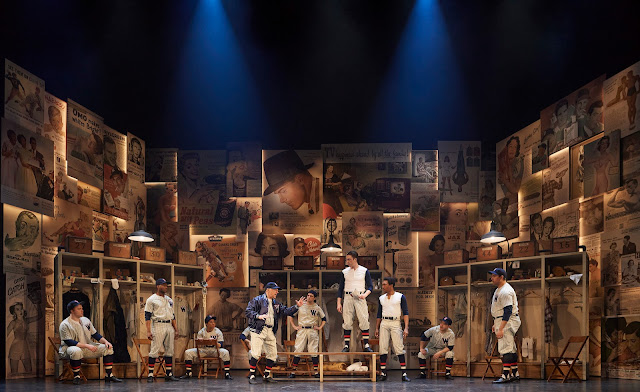
Jay Turvey with the Ballplayers in Damn Yankees, at the Shaw Festival. (Photo: Michael Cooper)

Richard Adler and Jerry Ross might have entered the pantheon of Broadway songwriters if fate hadn’t extinguished their star so fast. Adler was thirty-one and Ross twenty-eight when George Abbott commissioned them to write the score for The Pajama Game (1954), adapted by Abbott and Richard Bissell from Bissell’s novel 7-1/2 Cents, about the tensions between labor and management in a Midwestern pajama factory. It was a legendary show: Abbott and Jerome Robbins co-directed, a young Bob Fosse staged the dances, and it ran for three years. (A boisterous movie version in 1957, helmed by Abbott and Stanley Donen, captures the spirit of the original, with all but two members of the Broadway cast reprising their performances.) In 1955 lightning struck again for Adler and Ross with Damn Yankees. Adapted by Abbott and Douglass Wallop from Wallop’s book The Year the Yankees Lost the Pennant, Damn Yankees was as big a hit as The Pajama Game. But six months after its triumphant premiere, Ross died suddenly of lung disease. Adler never had another success, alone or with a collaborator, though his lovely score for the South Africa-set musical Kwamina, which he wrote for his wife, Sally Ann Howes, is ripe for rediscovery. (Its interracial love story was undoubtedly too controversial for 1961.)

Monday, June 20, 2022

Transitions: The Secrets of Dumbledore and Fiddler’s Journey to the Big Screen

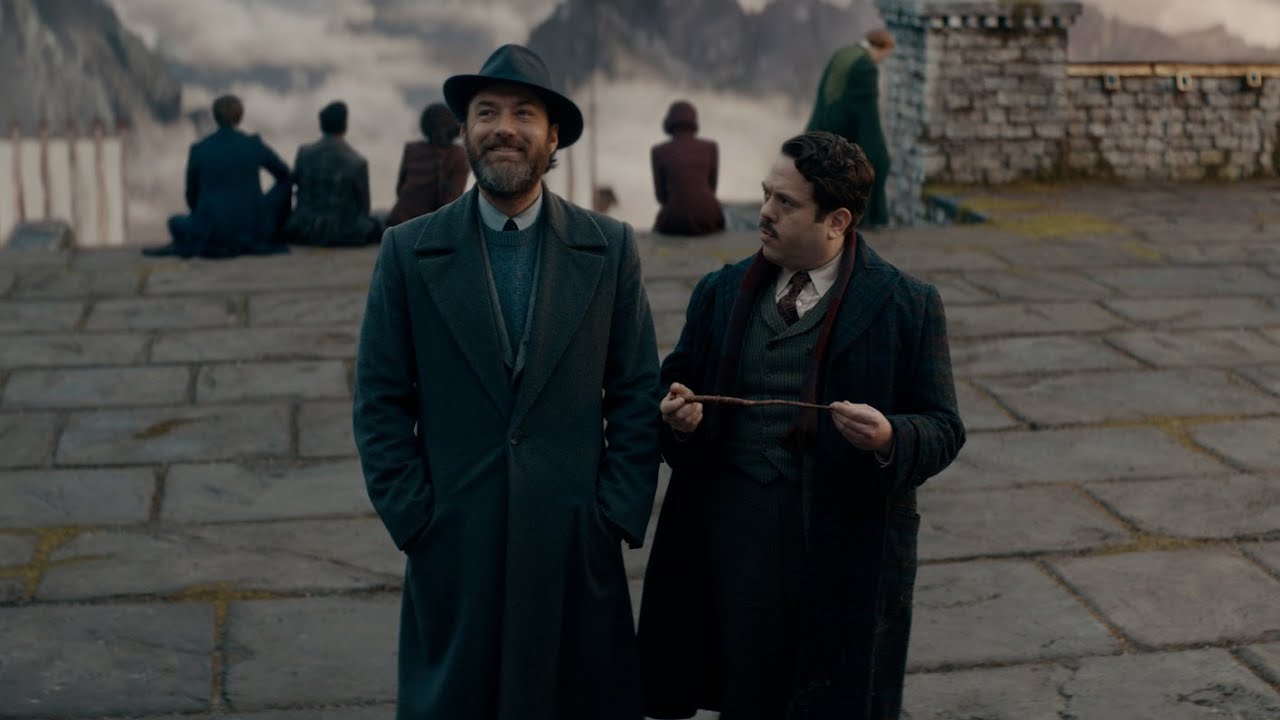
Jude Law and Dan Fogler in Fantastic Beasts: The Secrets of Dumbledore.

The third chapter of the Fantastic Beasts series, The Secrets of Dumbledore, begins with an exquisite piece of fairy-tale storytelling.  In the forests of China, Newt Scamander (Eddie Redmayne) – the English magizooogist (i.e., scholar of and caretaker for magical creatures) at the center of the narrative, set in the 1920s – oversees the birthing of a calf by a rare equine animal known as a Qilin, pronounced Chillin. The mother has a woven golden mane and a face like a mask; her tender calf is skeletal, a golden glow pulsating through his fragile skin. When the minions of the series’ villain, Gellert Grindelwald, attack, felling the mother, Newt struggles to save the baby Qilin, but he fails. He has to watch, helpless, as the calf is kidnaped and the mother expires, a single tear rolling down her cheek. It’s only then that Newt sees what everyone has missed in the chaos:  that she actually gave birth to twins.

Monday, July 6, 2020

Time and Place: Tonight with Belafonte, The Mikado, And So We Come Forth

Harry Belafonte in Tonight with Belafonte (1959).

A friend who was trolling through YouTube this week came across something truly extraordinary: Tonight with Belafonte, an hour-long “special” (as they used to be called) from 1959 directed by Norman Jewison – who went on to make Fiddler on the Roof, among many other movies – and starring Harry Belafonte and Odetta. The Jamaican-American Belafonte was at the peak of his popularity: when I was a Montreal kid in the fifties, every family I knew stocked his albums, his rendition of “The Banana Boat Song” was a big hit, and he even made a pass at a movie career, though it didn’t pan out for him as it did for his buddy Sidney Poitier. (Belafonte made only a handful of movies, including Otto Preminger’s adaptation of Carmen Jones, Oscar Hammerstein’s Americanized version of the Bizet opera.) Staggeringly handsome and sexy – he had caramel skin and a taut, high-waisted frame – with a warm, dynamic presence and a magnificent vocal instrument, he was most famous for popularizing calypso in North America. But as charming as those sides were, I think he was at his best with ballads (like my childhood favorite “Scarlet Ribbons”), which he rendered with a focused emotional intensity that lit them up. Odetta was a folksinger with a deep contralto whose fame was eclipsed by the movement of folk to rock ‘n’ roll, but she had one of the great soulful voices of the twentieth century, phrasing of diamond-like purity and precision and a powerhouse delivery. (Think Ethel Waters, Mahalia Jackson, Nina Simone.)

Monday, January 27, 2020

The Forgettable and the Forgotten: We All Fall Down and Ivan Passer

Eleanor Reissa and Stephen Schnetzer in We All Fall Down. (Photo: Nile Hawver)

The Huntington Theatre Company’s commitment to producing new work is admirable, but is We All Fall Down, the Lila Rose Kaplan piece receiving its premiere at the Calderwood Pavilion, really the best script they could find? It’s a cutesy sitcom about an assimilated Jewish family holding its first Passover Seder in their Westchester home, and when, around the last third of the play, the broad jokiness more or less gives way and Kaplan finally reveals why the hell the matriarch, Linda (Eleanor Reissa), has gathered them and a couple of friends to honor a tradition she has never believed in, the tone simply shifts to melodrama. Yes, that’s right: this play is firmly in the I-laughed-I-cried genre. There isn’t a moment of authenticity in the entire ninety-five minutes.

Monday, January 6, 2020

Little Women: Temporal Bigotry

Emma Watson, Saoirse Ronan, Florence Pugh, and Eliza Scanlen in Greta Gerwig's Little Women.

Greta Gerwig’s Little Women is the first movie version in which almost none of the charm and poignancy of the beloved Louisa May Alcott novel, published in 1868 and 1869, comes through. Not counting the lost silents – there were two, in 1917 and 1918, one in England and one in America – Gerwig’s is the fourth major adaptation for the big screen. George Cukor’s 1933 film, with its picture-postcard visuals, came out from RKO, though it's in the mold of MGM’s vellum-bound, studio-set approach to the Victorian classics. It’s beautifully adapted (by Sarah Y. Mason and Victor Heerman, though imdb.com lists nine other uncredited contributors, including Charles Brackett) and meticulously detailed, with an A-list cast that features Spring Byington as Marmee, Joan Bennett as Beth, the stunning beauty Frances Dee as Meg and Douglass Montgomery as Laurie. And in Katharine Hepburn’s portrayal of Jo it touches greatness. It was Hepburn’s second year in Hollywood and her fourth picture, and no one has ever been more ideally suited to the role of Alcott’s feisty, ambitious, iconoclastic – and autobiographical – heroine. In the early scenes she overplays Jo’s gawkiness and tomboyishness, but she seems to find her stride as her character does, her grandiose romantic flourishes taking on the shape of Jo’s discovery of the world and her place within it. Hepburn shows us how Jo grows up, and I can’t be the only viewer who has never forgotten the moment when her Jo, after rejecting Laurie’s marriage proposal, confesses to Marmee in an anguished moan, “I feel as if I’d stabbed my best friend in the heart!”

Monday, October 28, 2019

Found and Lost: Fiddler on the Roof, Fiddler: A Miracle of Miracles and The Late Show

A scene from Fiddler on the Roof at Manhattan's Stage 42. (Photo: Matthew Murphy)

Since Fiddler on the Roof swept New York five and a half decades ago, there’s never been a shortage of productions. And no wonder: with its Tchaikovsky-inflected score by Jerry Bock and Sheldon Harnick, Jerome Robbins’s exuberant dances and especially the big-boned, amazingly accomplished Joseph Stein book, Fiddler is a strong candidate for the best Broadway musical ever written. (Most likely contender: Gypsy. Extended lists furnished on request.) Of all the versions I’ve seen, Norman Jewison’s 1971 movie, which ends with images of some of the exiled Russian Jews making their slow, fateful way toward America, remains my favorite, but I loved Bartlett Sher’s 2016 Broadway revival, with Danny Burstein as Tevye and Jessica Hecht as Golde. Last spring’s West End revival, directed by Trevor Nunn, was less impressive – the performances were of highly variable quality and it contained an embarrassing quantity of schmaltz; by the time it ended every major character on stage had cried at least once, even the young revolutionary Perchik.

The idea of performing the show for New York audiences in Yiddish seems such an obvious one that it’s surprising no one thought of it before the current National Yiddish Theatre Folksbiene revival, a runaway hit at Stage 42 on Theatre Row directed by Joel Grey. Grey, who turned 87 in April, has staged the musical with graceful simplicity, in the style of a Yiddish vaudeville, with a farcical Rabbi (Adam B. Shapiro) leading the ensemble of Sholom Aleichem folk-fable shtetl types, and the choice is inspired; it even lifts the second-act village-rumor chorus number, “I Just Heard,” which has always been a dud, and makes it work. Stein’s and Harnick’s libretto is mostly comic for the long (nearly two-hour) first act, the striking exceptions being the verse of “If I Were a Rich Man” where Tevye fantasizes longingly about having the time to pray in synagogue every day, “Sabbath Prayer” and “Sunrise, Sunset.” (Shraga Friedman, who did the Yiddish translation, has turned “If I Were a Rich Man” wittily into “If I Were a Rothschild,” which also provides a reminder for musical-theatre aficionados that Bock and Harnick went on to write The Rothschilds.) The pogrom that interrupts the joyous wedding party at the end of act one marks the tonal shift that prepares us for all the sadness in the last hour – Hodel’s joining Perchik in Siberia, Chava’s marrying out of the faith, and finally the eviction of the Jews from Anatevka. The robustness and stylized humor of the first act of this Fiddler give the downbeat elements more poignancy and more potency.

Monday, June 11, 2018

Effigies of Wickedness!, The Rink, Brief Encounter: Words and Music

Lucy McCormick, Le Gateau Chocolat, Peter Brathwaite, and Katie Bray in Effigies of Wickedness! (Photo: Helen Murray)

When the Nazis staged an exhibition of “degenerate music” in Düsseldorf in 1938, the accompanying manifesto characterized the targeted music – some the work of Jewish and black artists, much of it political and cynical and satirical, some of it experimental – as “effigies of wickedness.” The current co-production of the Gate Theatre and the English National Opera, a cabaret of German songs from 1920 through 1939 but mostly representing the Weimar era (which officially ended with Hitler’s rise to power in 1933), has taken that phrase as its title. This is social and political theatre – Brechtian theatre – at its most potent. In the Gate’s compact Notting Hill space above a pub, four dazzling singer-actors – Peter Brathwaite, Katie Bray, Lucy McCormick and the drag performer Le Gateau Chocolat – and three wonderful musicians (Geri Allen, Cassie Kinoshi and Fra Rustumji), under the direction of the Gate’s artistic director Ellen McDougall and the musical direction of Phil Cornwell, present fourteen songs, most of them translated into English by Seiriol Davies and David Tushingham. Many who love Bob Fosse’s Cabaret may understand that the Kit Kat Klub numbers are imitating a style of commentary art songs that was popular in the late twenties and early thirties, but we know almost nothing from the repertoire of Berlin’s kabarett theatre: the score of Kurt Weill and Bertolt Brecht’s The Threepenny Opera (1928), perhaps a smattering of songs from their Happy End and The Rise and Fall of the City of Mahagonny (1929 and 1930 respectively). The only tune I recognized in Effigies of Wickedness! was “Petroleum Song” (lyric by Felix Gasbarra), which Teresa Stratas recorded in her magnificent two-album set of Weill songs nearly thirty years ago. All the others were revelations to me, and every one is a gem. The production illuminates the work of forgotten composers like Misha Spoliansky, Hanns Eisler and Frederick Hollander, whose name may be familiar to Marlene Dietrich aficionados. (He wrote the music for The Blue Angel and, emigrating to Hollywood in the crush of German-Jewish artists fleeing Hitler in the early thirties, worked on several of her American movies as well as many others.)

Thursday, June 7, 2018

Neglected Gem: The Ballad of Cable Hogue (1970)

Stella Stevens and Jason Robards in Peckinpah's The Ballad of Cable Hogue. (Photo: Getty)

In a brilliant essay for Critics at Large on women in Sam Peckinpah’s movies, Amanda Shubert wrote that The Ballad of Cable Hogue “distills the romantic spirit at the core of Peckinpah’s sensibility: love without possession.” In the romance between Cable (Jason Robards), who finds water in the middle of the Arizona desert and turns it into a watering hole called Cable Springs for stagecoach passengers, and Hildy (Stella Stevens), a prostitute whom the citizens of nearby Dead Dog run out of town, love without ownership is merely an extension of the transitoriness to which they are philosophically dedicated because they recognize it as the state of things. In the movie’s opening episode, Cable is robbed by his partners, Taggart (L.Q. Jones) and Bowen (Strother Martin) – playing a variation on the bounty hunter roles they created in Peckinpah’s The Wild Bunch the previous year – and left for dead without water in the desert. He survives four dry days through sheer orneriness while, like Tevye in Fiddler on the Roof, he keeps up a running monologue to God, assuming that his maker has no intention of letting him die of thirst. He finds water just as he’s about to give up, but the sign of God’s grace at the eleventh hour and the sudden twist in his fortune impart an indelible awareness of morality and the fact that we don’t own time, or our own lives. For Hildy, Dead Dog – a town that deserves its name – where she ekes out a ramshackle existence, seeing customers in a room above the saloon, is merely a way station for her; her destination is San Francisco, and being forced to leave brings it that much closer. She stops by Cable Springs and lives with Hogue for a few blissful weeks – what the characters played by George Clooney and Jennifer Lopez in Steven Soderbergh’s Out of Sight would call a “time out” from their lives. She wants him to come with her to San Francisco, but he’s stubborn about waiting for Taggart and Bowen to swing through the desert again so he can get his long-awaited revenge. So she goes on without him. She returns for him three years later, this time to invite him to New Orleans, after he’s had that revenge, or something like it; by now he’s ready to run away with her. But fate has other plans, and Hildy is its unwitting envoy: the chauffeur-driven automobile that brings her slides down a hill, Cable steps in, instinctively, to save Bowen, and he ends up getting run over. Hildy keeps him company during his last days, and leaves after his funeral.

Monday, May 7, 2018

Musical Comedy Revivals: My Fair Lady and The Will Rogers Follies

Harry Haddon-Paton, Lauren Ambrose, and Allan Corduner in Bartlett Sher's My Fair Lady. (Photo: WNYC)

In Bartlett Sher’s lush, rewarding revival of My Fair Lady at Lincoln Center, Lauren Ambrose gives the best portrayal I’ve ever seen of Eliza Doolittle, the Cockney flower seller transformed into an Edwardian lady. Ambrose, best known as one of the co-stars of TV’s Six Feet Under, has only a smattering of theatrical experience (which includes a fine performance in Sher’s production of Clifford Odets’s Awake and Sing! in 2006) and no background at all in musicals, but she turns out to have a pellucid lyric soprano voice and an unerring sense of musical-comedy style.

Monday, November 6, 2017

In Pieces: Rags

Sean MacLaughlin, Samantha Massell, and Christian Michael Camporin in Rags. (Photo:Diane Sobolewski)

Rags failed spectacularly on Broadway in 1986, closing after eighteen previews and four performances. Rumors of trouble during the Boston tryouts may have dogged the New York opening, though my recollection is that they focused on the unreliability of the star, opera diva Teresa Stratas in her musical-theatre debut, who kept missing performances. (That’s the reason I didn’t make an effort to see the show – I didn’t want to be disappointed if Stratas, a great actress as well as a great singer, didn’t appear that night.) So I was staggered when, on the advice of a friend, I bought a copy of the original cast album, recorded with Julia Migenes-Johnson substituting for Stratas. It’s not just that the score is lush and thrilling, Charles Strouse’s music inviting comparisons to Jerome Kern and Kurt Weill and Stephen Schwartz’s lyrics displaying a specificity and emotional authenticity that none of his previous work for the theatre could have led anyone to anticipate. It’s also that the story the songs develop and embellish, as the plot synopsis in the liner notes confirms, is a complex and multi-leveled examination of the experience of Jewish immigrants living in New York at the end of the first decade of the twentieth century. The book writer, Joseph Stein, was most famous for writing Fiddler on the Roof, and Rags seems intended as an unofficial sequel.The protagonist is Rebecca Hershkowitz, who comes to America with her little boy David to escape the Russian pogroms, though her husband Nathan, who preceded them to these shores, doesn’t know they’re seeking him and she doesn’t connect with him until the end of the first act. In the meantime she works in a sweatshop and is drawn somewhat reluctantly into the life of her new home. The musical is her coming of age, which is prompted not only by the hardship of her time in America but also by the people around her: David’s curiosity and openness to the new world, the anger of her friend Bella Cohen at the poverty they can’t rise above, and the labor organizer Saul, who at first unsettles her and then gets her thinking. (They’re also attracted to one another.) Nathan, it happens, has changed his name to Nat Harris and gone to work for the corrupt Tammany Hall political machine. When they find each other again, he promises to take her out of the slums to a sheltered, luxurious uptown existence, but Bella’s death in the Triangle Factory fire radicalizes her and she leaves Nathan’s world for Saul’s. The finale is bittersweet: Rebecca’s moral triumph and her self-discovery are filtered through the tragedy of Bella’s death and the deaths of her co-workers and mediated by the reprise of the first chorus number, “Greenhorns,” which views the wave of immigrants as mere grist for the economic mill rather than as human beings striving to find happiness. That’s the view that Saul and Rebecca have pledged to fight, and the fight has just started.