Showing posts sorted by relevance for query fiddler on the roof. Sort by date Show all posts

Monday, July 21, 2014

A Classic Musical and a Comedy About Musicians: Fiddler on the Roof and Living on Love

Fiddler on the Roof (Photo by Diane Sobolewski).

Working on one of those Goodspeed Opera House sets (designed by Michael Schweikardt) that are small miracles of permutation and economy, Rob Ruggiero’s production of Fiddler on the Roof refurbishes the great Broadway show for a more intimate space without sacrificing its dramatic power, the musicality of its Jerry Bock-Sheldon Harnick score, or the breadth of Joseph Stein’s book. (Parker Esse has reproduced the Jerome Robbins choreography – which, given its distinctness and celebrity, is probably the best idea. I assume it’s also a copyright requirement.) With Adam Heller giving a superb performance as Tevye the dairyman, who carries on informal conversations with God as he hauls his cart through the streets of the Russian town of Anatevka, the Goodspeed Fiddler is all that one might hope.

Monday, February 15, 2016

A Classic and a Rarity: Fiddler on the Roof and Cabin in the Sky

Lori Wilner (left), Jessica Hecht and Danny Burstein in Fiddler on the Roof. (Photo: Joan Marcus)

I fell in love with Fiddler on the Roof when, at thirteen, I heard the original cast album; by the time I saw it on Broadway I knew the wonderful Jerry Bock-Sheldon Harnick score by heart and I’d read Joseph Stein’s libretto through several times. (Those were the days when Random House regularly published new playscripts in deluxe hardback copies furnished with production photos.) Zero Mostel had already been replaced in the role of Tevye by the distinguished Group Theatre alumnus Luther Adler; I caught it again on the road a few years later with Herschel Bernardi. In my senior year at college Norman Jewison’s movie version came out, with the robust, warm-toned Israeli actor Topol in the starring role. It managed not only to reproduce the glories of the stage version (including, of course, the Jerome Robbins choreography) but to make a link, in the final moments, to the next chapter of the story of the Jewish diaspora: the exiles from the Russian shtetls, borne away on a raft in the film’s most exquisite image, would be the first generation of Jewish-Americans.

In his magnificent new Broadway revival, Bartlett Sher tries to make the leap to the twenty-first century by bookending the show with his leading man, Danny Burstein, in a parka reading from a book about the Jews of Anatevka before – and after – he dons the hat and prayer shawl of Tevye the dairyman. This frame is meant to situate the story in the larger one about refugees that is still, of course, with us. But it’s too vague to work and frankly, why would you want it to? If you felt the need to imply that the narrative of Fiddler on the Roof is only one chapter in a broader story, then the direction you’d have to head in would lead to the Holocaust – and that would be a truly terrible idea. The subject matter of the musical is rich enough; it doesn’t need generalization. Its great virtue is its specificity.

Monday, April 25, 2016

Constructing Musicals: Jack Viertel’s The Secret Life of the American Musical

Cast of Fiddler on the Roof on Broadway, 1977. (Photo: Bobby Bank)

Jack Viertel’s new book The Secret Life of the American Musical (Sarah Crichton Books) is a gift for those of us who love musical theatre; I read it over just a couple of days and would have devoured it in a single sitting if time had allowed. Viertel, a one-time dramaturg, drama critic and arts editor who is now, among many other accomplishments, the artistic director of City Center’s Encores! series, has taught musical theatre at NYU’s Tisch School for the last ten years, and this volume emerged from his classes as well as from his extensive experience with musicals over the past three decades. I suspect it would be impossible to find anyone who knows more about the subject, and in The Secret Life of the American Musical he offers a comprehensive master class in how good musicals are constructed. Even for those of us who have seen and listened to hundreds of musicals, the book is a series of revelations – mostly because of his method of juxtaposing shows that are vastly different in style, tone and subject matter to show how the same principles operate across the spectrum.

Monday, October 28, 2019

Found and Lost: Fiddler on the Roof, Fiddler: A Miracle of Miracles and The Late Show

A scene from Fiddler on the Roof at Manhattan's Stage 42. (Photo: Matthew Murphy)

Since Fiddler on the Roof swept New York five and a half decades ago, there’s never been a shortage of productions. And no wonder: with its Tchaikovsky-inflected score by Jerry Bock and Sheldon Harnick, Jerome Robbins’s exuberant dances and especially the big-boned, amazingly accomplished Joseph Stein book, Fiddler is a strong candidate for the best Broadway musical ever written. (Most likely contender: Gypsy. Extended lists furnished on request.) Of all the versions I’ve seen, Norman Jewison’s 1971 movie, which ends with images of some of the exiled Russian Jews making their slow, fateful way toward America, remains my favorite, but I loved Bartlett Sher’s 2016 Broadway revival, with Danny Burstein as Tevye and Jessica Hecht as Golde. Last spring’s West End revival, directed by Trevor Nunn, was less impressive – the performances were of highly variable quality and it contained an embarrassing quantity of schmaltz; by the time it ended every major character on stage had cried at least once, even the young revolutionary Perchik.

The idea of performing the show for New York audiences in Yiddish seems such an obvious one that it’s surprising no one thought of it before the current National Yiddish Theatre Folksbiene revival, a runaway hit at Stage 42 on Theatre Row directed by Joel Grey. Grey, who turned 87 in April, has staged the musical with graceful simplicity, in the style of a Yiddish vaudeville, with a farcical Rabbi (Adam B. Shapiro) leading the ensemble of Sholom Aleichem folk-fable shtetl types, and the choice is inspired; it even lifts the second-act village-rumor chorus number, “I Just Heard,” which has always been a dud, and makes it work. Stein’s and Harnick’s libretto is mostly comic for the long (nearly two-hour) first act, the striking exceptions being the verse of “If I Were a Rich Man” where Tevye fantasizes longingly about having the time to pray in synagogue every day, “Sabbath Prayer” and “Sunrise, Sunset.” (Shraga Friedman, who did the Yiddish translation, has turned “If I Were a Rich Man” wittily into “If I Were a Rothschild,” which also provides a reminder for musical-theatre aficionados that Bock and Harnick went on to write The Rothschilds.) The pogrom that interrupts the joyous wedding party at the end of act one marks the tonal shift that prepares us for all the sadness in the last hour – Hodel’s joining Perchik in Siberia, Chava’s marrying out of the faith, and finally the eviction of the Jews from Anatevka. The robustness and stylized humor of the first act of this Fiddler give the downbeat elements more poignancy and more potency.

Monday, June 20, 2022

Transitions: The Secrets of Dumbledore and Fiddler’s Journey to the Big Screen

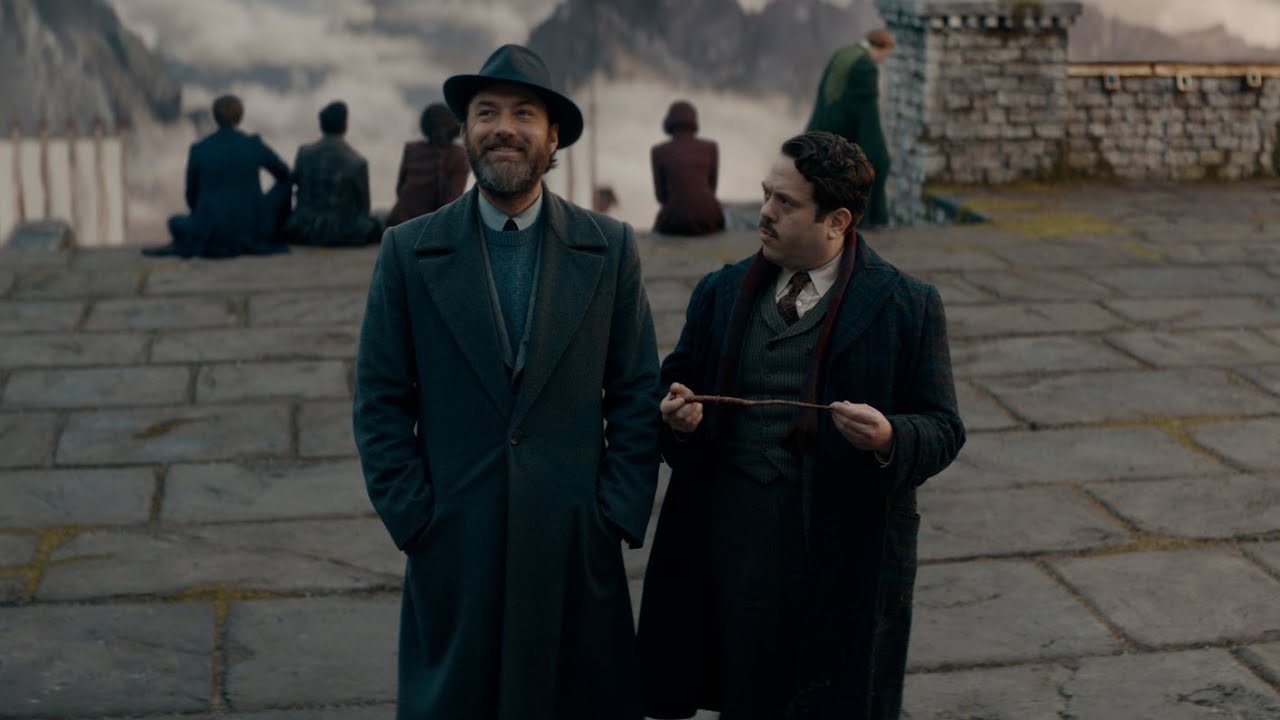
Jude Law and Dan Fogler in Fantastic Beasts: The Secrets of Dumbledore.

The third chapter of the Fantastic Beasts series, The Secrets of Dumbledore, begins with an exquisite piece of fairy-tale storytelling.  In the forests of China, Newt Scamander (Eddie Redmayne) – the English magizooogist (i.e., scholar of and caretaker for magical creatures) at the center of the narrative, set in the 1920s – oversees the birthing of a calf by a rare equine animal known as a Qilin, pronounced Chillin. The mother has a woven golden mane and a face like a mask; her tender calf is skeletal, a golden glow pulsating through his fragile skin. When the minions of the series’ villain, Gellert Grindelwald, attack, felling the mother, Newt struggles to save the baby Qilin, but he fails. He has to watch, helpless, as the calf is kidnaped and the mother expires, a single tear rolling down her cheek. It’s only then that Newt sees what everyone has missed in the chaos:  that she actually gave birth to twins.

Friday, March 30, 2012

Of Culture, High and Low – Footnote and Sholem Aleichem: Laughing in the Darkness

Lior Ashkenazi and Shlomo Bar Aba in Footnote

It may seem like an unusual subject for a movie, but it’s apt that Joseph Cedar’s Israeli film Footnote – a provocative story of a father and son who are both scholars – deals with the specifics of academia and the vagaries of scholarship, since Israel is one country that values higher education, so much so that it punches above its weight when it comes to winning Nobel Prizes and the like. Footnote is also one of the more welcome Israeli features since it offers up a nuanced view of a country that is the sum of more than the divisive politics and tensions that seem to solely define it in most mainstream media coverage of the region.

Footnote, which swept Israel's top film awards (The Ophirs), garnered an Oscar nomination for best Foreign-language film, and won Best Screenplay at Cannes, also marks a maturation of Cedar’s talents. It is his most compelling, original and best-made movie yet, albeit one that falls short of the finest recent Israeli cinema. An Orthodox Jew, a rarity among the mostly secular filmmakers in Israel, Cedar began his career delving into the religious underpinnings of Israeli society. His debut movie Time of Favor (2000) was a slick but interesting thriller about a religious Jewish plot to blow up The Temple Mount, one of Islam’s holiest shrines, and the charismatic rabbi (Assi Dayan) whose sermons inadvertently inspired some of his more diligent students to interpret his words as a literal call to arms. Campfire (2004), based on Cedar’s time living in a religious settlement, was a choppy but fascinating look at the unique Jews who populate such places, seen through the eyes of a widow and her two young daughters who join a West Bank settlement. Beaufort (2007) was a powerful though admittedly familiar tale of an Israel Defense Forces unit about to vacate the high ground of a hard-won battle to capture a Crusader castle, a symbol of Israel’s ultimately futile invasion of Lebanon. Footnote (2011) goes further afield; it’s a drama that, though it deals with Talmudic discourse, is neither concerned with religion nor conflict, except through the passive aggressive one playing out between father and son.

Sunday, November 9, 2014

Four Decades of the American Musical

Oklahoma! on Broadway in the 1940s.

Half a century ago The Modern Library published Six Plays by Rodgers & Hammerstein and the complete libretti of Gilbert & Sullivan operettas; when I was in grade school, those two books were the earliest purchases I made for my own library of musical-theatre scripts. I recalled my excitement at having these musicals at my fingertips when I received my copy of The Library of America’s new two-volume collection American Musicals.  It’s expertly edited by Laurence Maslon (who was responsible for Kaufman and Co.: Broadway Comedies, their aggregate of George S. Kaufman collaborations) and handsomely packaged, with gorgeous production photos – most of which I’ve never seen before – and copies of show posters and sheet music. Each of the volumes contains the books and lyrics of eight musicals, arranged chronologically and divided roughly into decades, 1927-1949 and 1950-1969.

Wednesday, June 28, 2023

Plays with Music: Brokeback Mountain and The Curious Case of Benjamin Button – and a Brief Farewell

Mike Faist and Lucas Hedges in Brokeback Mountain. (Photo: Manuel Harlan)

Receiving its world premiere at London’s compact, comfortable new Sohoplace in London, Brokeback Mountain, Ashley Robinson’s ninety-minute dramatization of the Annie Proulx story most people know through the 2005 film, is a trim, skillful production. Jonathan Butterell has staged it effectively in the round on Tom Pye’s pared-down set and Mike Faist and Lucas Hedges, the two actors succeeding Jake Gyllenhaal and the late Heath Ledger in the roles of the young Wyoming cowboys embarking on a forbidden, tragic gay romance, are both excellent, especially Hedges as Ennis Del Mar, the more inexperienced of the two lovers. The problem is that damn material, which is meager and phony and keeps striking the same mournful note over and over. The show includes a small band playing country-western ballads (mostly) that merely replicate the mood. You walk out of the theatre starved for a little variety – and, God knows, an ounce of humor.

Monday, October 26, 2015

Goodspeed's Musical Capracorn & Verdi’s Shakespeare at the Met

Duke Lafoon (right), with Ella Briggs, in A Wonderful Life at the Goodspeed Opera House. (Photo: Diane Sobolewski)

Considering the unusual kinds of musicals Sheldon Harnick collaborated on with the late Jerry Bock – Fiorello!, Tenderloin, She Loves Me, The Rothschilds and of course Fiddler on the Roof, all complex period shows with evocative settings – his determination to turn It’s a Wonderful Life into a musical is a little puzzling. Frank Capra’s 1946 movie is so well known that most Americans can probably recite whole sections of the screenplay off by heart, which makes you wonder why anyone would bother adapting it in the first place. And for those of us who aren’t seduced by its all-too-familiar charms, the project just seems untenable. The picture, with its Albert Hackett-Frances Goodrich script (the last of several versions that were floated to RKO, including efforts by Clifford Odets and Marc Connelly), may be the most beloved of all Christmas movies – though, famously, it wasn’t a hit on its original release and didn’t attain its legendary status until the Vietnam era – but it’s also certainly the weirdest. The story may have an angel named Clarence striving to earn his wings and Capra’s usual Christian-flavored populist hokum (the whole town of Bedford Falls turns out at the eleventh hour to save their friend George Bailey from bankruptcy and prison), but there’s a bitterness at its core that’s so jarringly at odds with its depiction of the self-sacrificing hero as to be pathological. Capra crafts sequences of horror and despair that linger in the mind longer after you’ve digested the treacly happy ending, like the one where the alcoholic druggist George works for in his boyhood mixes a lethal medicine by accident for one of his patients (George prevents him from sending it out) or the climactic episode in which Clarence shows George, who’s about to commit suicide, what a cold, heartless town Bedford Falls would have been had he never been born. And in his best scenes Jimmy Stewart gets so deep into George’s anger and disappointment and misery at the way life has cheated him that the upbeat finale simply isn’t convincing.

Sunday, July 26, 2015

Remembering Theodore Bikel

Theodore Bikel on stage as Tevye in Fiddler on the Roof.

I once met Theodore Bikel, the esteemed singer/actor who, earlier this week, passed away at age 91. It was back in 1998, at a conference encompassing the directors of programming and others involved with the world’s various Jewish film festivals – I was Director of Programming of the Toronto Jewish Film Festival from 1996-2004 – and, for some reason, Bikel was in attendance. Better still, he sat at my table during the conference’s opening ceremony. I remember being quite thrilled to meet him and I introduced myself and we chatted a bit – he seemed nice – and I especially recall this funny joke he told, in his deep baritone voice. The joke goes: The Pope has been invited to ask the first question of the world’s greatest and smartest computer. His question: Is there a God? The answer, from the computer: THERE IS NOW! (Besides being amusing, I think the joke is pretty prescient, as it’s easier to imagine the current Pope Francis being asked to interact with the computer than his two less hip predecessors.) I mention this because Bikel, over his long distinguished career, made quite an impression in big – his theatrical, film and television work – and small – the joke – ways on those who encountered him. Whether it was his involvement with Montreal rap singer Socalled (aka Josh Dolgin) in a smart, catchy re-working of the classic Yiddish song "Belz, Mayn Shtetele Belz" (Belz, my town Belz) in 2007 as "(Rock The) Belz", available as part of the Rough Guide to Klezmer Revolution CD, his role as Rance Mohammitz in Frank Zappa's surreal 1971 film 200 Motels or his powerful turn as the esteemed Yiddish writer Sholom Aleichem in his recent one man show Sholom Aleichem: Laughter Through Tears, Bikel left an indelible mark on those who heard his music or saw his work.

Monday, February 20, 2017

Electric Blues: Bette Midler in The Criterion Collection Blu-ray Release of The Rose

Bette Midler in The Rose (1979).

When Bette Midler takes the stage as The Rose in Mark Rydell’s 1979 movie of the same name, singing the rocker “Whose Side Are You On?,” her face, mashed up as she spits out the lyrics, is ferocious. She’s not trying to look beautiful; on the contrary, she’s owning her odd-duck looks, facing off the stadium audience, daring them not to love her for who she is. There’s no grandeur to her self-presentation, just fuck-you bravado and sexual aggressiveness, but then she makes a connection with a handsome young man at the edge of the stage and she breaks into an unexpected toothy smile, as if she’s found a date for the high school prom. At other times her smile can look voracious, even predatory. Her whole face seems to be pushed toward her nose, and both her dramatic eye make-up and her frizzy hair accentuate the bones in that face, though when Vilmos Zsigmond’s lighting attaints its softest neon glow, her hair is like an aureole that turns her into a pop Madonna. You can’t pin down her look, and God knows you can’t pin down her performance to one thing. When we first see her, stepping off the tour’s private plane, she’s dressed like Janis Joplin in a broad-brimmed hat with gauze dripping from the back and a thin, wavy pink dress and shades, and she’s so drunk that she can’t stay upright: she has to hold onto the railing, and she misses a step or two, as if the stairway were melting under her. This is the wayward, unmoored side of Rose. We see it again on the plane when she sings a cozy, growling, sloshed version of “Let Me Call You Sweetheart” – a song she learned off a Furry Lewis side – with a muted guitar accompaniment, then peers out the window, disoriented, bursting into tears.  And again late in the picture, when her manager and promoter Rudge Campbell (Alan Bates) tells her he’s setting her adrift (it’s his way of scaring her into submission) and she looks away from him, her face wavering on the edge of another realm.

Monday, August 28, 2017

Prince of Broadway: Overstuffed and Undernourished

 Karen Ziemba, Emily Skinner, Chuck Cooper and Tony Yazbeck in Prince of Broadway. (Photo: Matthew Murphy)

The new revue Prince of Broadway, built around the career of Harold Prince, is like an all-you-can-eat buffet at a mediocre restaurant. It runs just over two and a half hours and contains thirty-five songs from sixteen musicals (plus a finale, “Do the Work,” written especially for the show by Jason Robert Brown, who also contributed arrangements and orchestrations), presented in mostly tepid reproductions intended to conjure up the feel of their sources, one after another. (Susan Stroman, who co-directed with Prince and choreographed, has barely left her mark on them.) The entire project is misconceived. It makes sense to plan an evening around the work of a theatrical artist whose work is distinctive and unified; that’s what the joyous 1999 Fosse! did, and Ain’t Misbehavin’ and several Stephen Sondheim revues. But you can’t get a sense of the shows Prince has directed by restaging numbers from them: a pair of singers in working-class Victorian costumes standing in front of a flat don’t suggest the spectacle of Sweeney Todd (1979) and eight actors in shtetl garb dancing briefly across the stage of the Samuel J. Friedman Theatre are more like a parody of Fiddler on the Roof (1964) than an evocation of it. You’d need the original set designs and, more importantly, the original performers to provide any indication of what these musicals meant. Prince of Broadway doesn’t even distinguish between the shows Prince directed and the ones he only produced, like Damn Yankees (1955), West Side Story (1957) and Fiddler – as if there were no difference between what directors and producers do. In a lengthy program note, Prince credits dozens of collaborators, yet the revue implicitly tells us that he was the creative force behind every one of these shows, even when other people devised their staging and helmed their rehearsals. This is a vanity production that verges on the delusional.

Monday, July 7, 2025

Idealism and Identity: Camelot and Out of Character

Dakin Matthews as Pellinore and Ken Wulf Clark as King Arthur in Camelot. (Photo: Daniel Rader.)

Over the years I’ve grown wary of revivals of Lerner and Loewe’s musical Camelot, but that’s not because, over the six and a half decades since it opened on Broadway, it’s acquired a reputation for having unsolvable book problems. For last season’s production at Lincoln Center, Aaron Sorkin overhauled Lerner’s book – whether in an effort to rescue it or to make it more appealing to a twenty-first-century audience wasn’t clear, but Sorkin’s rewrite was disastrous. It was also unnecessary. I’ve known Camelot all my life and I think it has a script of remarkable depth and substance. As a little boy in love with theatre, I saw it on Broadway with the original cast and I’ve never forgotten the experience. Based on T.H. White’s The Once and Future King and set in a magical version of medieval England, the musical is about the birth of idealism and the struggle to keep it alive in a world that defaults so easily to the embrace of human vices. It’s a hunk of a show, all right, but that’s because, like Fiddler on the Roof and Hamilton, it presents a layered, complex narrative with resonant themes embedded in it. And so it makes demands on directors, designers and actors that are perilously difficult to fulfill.

Monday, July 24, 2017

George Bernard Shaw, Lillian Hellman and Paula Vogel: Issues

Andrew Lawrie, Sara Topham and Jim Mezon in the Shaw Festival's production of Saint Joan. (Photo: David Cooper)

This article contains reviews of Saint Joan, The Little Foxes, and Indecent.

George Bernard Shaw lays out the argument of Saint Joan with unerring precision. Joan is a French peasant, a teenager, unwavering in her Catholic devotion yet possessed of a country girl’s common sense; when she hears the voices of saints in the church bells, urging her to lead an army to throw the English out of France, she accepts them without doubt or hesitation and her no-nonsense certainty that she is doing the right thing convinces one man after another, right up to the Dauphin, whom she dreams of helping to crown King Charles VII. But as soon as she wins the war for him she finds herself mired in political turmoil that she doesn’t understand and that will end inevitably with her being burned at the stake. She has run afoul not only of the English (obviously) but of the church, represented by the Archbishop of Rheims and the Inquisition, who find in her intimate relationship with God a threat to the Catholic hierarchy. Even the Dauphin, now the monarch, is put off by her arrogance, which earlier he, like the officers she kicked into battle, found inspiring and sensible. The more she insists on being true to the simple faith that got her there in the first place, the more she damns herself in the eyes of the church, which forms an unholy alliance with its secular arm (and the English) to execute her.

Thursday, July 3, 2025

Mixed Media Report

This round-up includes reviews of Adolescence, Good Night, and Good Luck and Mission: Impossible: The Final Reckoning, as well as a tribute to Charles Strouse.

Stephen Graham and Owen Cooper in Adolescence. (Photo: Netflix.)

It’s a confirmed truth that British actors can do just about anything, but the consistency and range of performances in the recent four-part English series Adolescence (streaming on Netflix) is so impressive that it may have set a new standard. The style of the limited series, created and written by Stephen Graham, who plays one of the principal roles, and the prolific playwright and screenwriter Jack Thorne and directed by Philip Barantini, is documentary realism, and the characters are etched in such precise psychological detail that they register more as figures in an Impressionist group painting come to life than as actors at work. You carry them away with you; I watched the first half at the end of the evening and woke up early the next morning with them still crowded into my brain. (I couldn’t get back to sleep until I’d finished the series.) My praise is meant to extend to the young performers, who give performances of unwavering authenticity on a par with the adults. Those of us who love watching English TV drama – and that includes almost everyone I know – have our favorite actors, but the only member of the cast of Adolescence I recognized was Graham, whom I’d admired as the captain of the whaling ship in The North Water and as Jamie Bell’s brother in the movie Film Stars Don’t Die in Liverpool. I assume that my lack of familiarity with the others enhanced the freshness of the experience, but then British actors are chameleons anyway.

Friday, June 27, 2025

New from Criterion: In the Heat of the Night and Killer of Sheep

Sidney Poitier and Rod Steiger in In the Heat of the Night. (Criterion Collection.)

Mark Harris’s wonderful book Pictures at a Revolution ingeniously uses the five 1967 films nominated for the Best Picture Oscar to chronicle the shift from the old to the new Hollywood. They covered the spectrum at the moment when a new sensibility – countercultural, free-spirited, ironic about the filmmaking shibboleths – had begun to slip in and captivate young audiences for whom the new retreads of old-fashioned movies held no appeal. Within a couple of years the studios, exasperated and baffled by filmgoers’ lack of interest in the latest expansively budgeted musicals and adventure spectacles and their preference for off-the-beaten-path items like Easy Rider and M*A*S*H, had turned the asylum over to the inmates: hipster writers and directors who shared a view of the world with their audiences. But in 1967 both Hollywoods were represented in the nominations. At one end were the leaden Doctor Dolittle, occupying the spot unofficially reserved for a lavish musical that was assumed to reflect big-studio production values (some years there were two) and the social problem drama Guess Who’s Coming to Dinner, both of which offered embarrassing evidence that the old ways had stopped working. At the other end were Bonnie and Clyde and The Graduate, which the youth of America had turned into enormous hits. Bonnie and Clyde was the movie of the year, but in 1967 there wasn’t a snowball’s chance in hell that it would walk away with the statuette. However, it was already too late for Guess Who’s Coming to Dinner, with its simple-minded civics-class approach to the topic of race. The film that won the award was Norman Jewison’s In the Heat of the Night, adapted by Stirling Silliphant from a John Ball novel about a northern Black homicide detective (Sidney Poitier) who finds himself between trains in a small Mississippi town during a murder investigation and is hauled in reflexively for questioning by the local white cops. Released after producing his badge and calling his chief in Philadelphia, he winds up helping the sheriff (Rod Steiger) solve the crime.

Monday, April 24, 2017

Iconic Shows of the 1960s: Hello, Dolly! and Rosencrantz and Guildenstern Are Dead

Bette Midler in Hello, Dolly! at Broadway's Shubert Theatre. (Photo: Julieta Cervantes)

Hello, Dolly! opened in January 1964 and stayed open for just under seven years. It wasn’t the best musical on Broadway in those years – it was no Fiddler on the Roof – but it represented, and continues to represent, the end of the golden age of Broadway musicals. It was a big, brassy star vehicle, built around the rather specialized talents of Carol Channing but flexible enough to be refitted for the long line of older women who made comebacks in the role of the widowed matchmaker Dolly Gallagher Levi. (The source material for Michael Stewart’s book was the Thornton Wilder comedy The Matchmaker.) There was some controversy when Barbra Streisand, at only twenty-seven, inherited the role in the 1969 movie, but her stupendous performance was its lifeblood; the movie, directed in a stifling, museum-piece style by Gene Kelly, would have sunk under its own weight without her. And it contained one of the great moments in movie-musical history: in the middle of the title song – certainly the best-known item in the Jerry Herman score – Streisand, decked out in a golden Gay Nineties gown with feathers on her head, harmonized with Louis Armstrong, whose cover had been as big a hit as the show itself.

The new revival, starring Bette Midler as Dolly and David Hyde Pierce as Horace Vandergelder, the wealthy but parsimonious Yonkers shop owner who is supposedly her client but really the object of her own romantic machinations, arrives with more anticipation than any Broadway show in years. Advance hype aside (and God knows there’s been plenty), how could it not? Midler hasn’t appeared in a book musical since she played one of Tevye’s younger daughters in the original run of Fiddler, before she became famous; aside from the (non-musical) solo performance I’ll Eat You Last: A Chat with Sue Mengers in 2013, her only New York appearances have been in a couple of revues – one of which, Clams on the Half Shell, I was lucky enough to see back in 1975. Her Broadway comeback, at seventy-one, is not going to disappoint her legion of fans. She plays Dolly with one foot firmly planted in the Jewish vaudeville tradition, grinning that famous cat-that-ate-the-canary grin, and the highlight of her performance is indeed culinary: in the middle of act two she dispatches a stuffed chicken with dumplings at a table stage right with hilarious gusto while most of the rest of the ensemble, gathered in a courtroom upstage after the evening’s hijinks at Manhattan’s Harmonia Gardens Restaurant, waits for her to finish so the plot can take its final turn. And she could hardly have landed a funnier scene partner than Pierce, who revivifies a role that has generally brought out little in the men who’ve played it besides a side of undernourished, overbaked ham. Pierce’s first-act number, “It Takes a Woman,” performed with a male chorus, is one of the evening’s surprising highlights – the choreographer, Warren Carlyle, has staged it wittily – and “Penny in My Pocket,” written for the original Horace, David Burns, but cut out of town, has been restored to give Pierce a second-act number.

Thursday, November 17, 2011

Reflections on Pauline Kael

The simultaneous publication of Brian Kellow’s biography Pauline Kael: A Life in the Dark (Viking) and The Age of Movies: Selected Writings of Pauline Kael, a Library of America anthology of her movie criticism edited by Sanford Schwartz, restores Pauline Kael's status as the most important film reviewer in the history of the medium. All thirteen of her books, including the last cross-section, For Keeps, which she assembled herself in 1994, are out of print; movies no longer generate the excitement, the intellectual debate and generational ownership, that they did while Kael held her post at The New Yorker – especially in the first decade (1967-1976) of her tenure, when the “Current Cinema” column passed back and forth at six-month intervals between her and Penelope Gilliatt. (Kael got it to herself when she returned to the magazine in 1980 after a brief stint in Hollywood; in the last few years before she retired in 1991, she shared it with Terrence Rafferty.) Reading Kellow’s book and dipping into the Library of America volume brings back some of the feeling of movie-going during the Vietnam era, when Hollywood was undergoing a renaissance no one could have anticipated and the latest imports from Europe enhanced the sense Kael had – and communicated eloquently to her readers – that we were living in a charmed period for the medium. Kael always acknowledged her luck at beginning to write regularly about movies (her appointment at The New Yorker, at the age of 48, was her first extended paying gig) just at the moment when old Hollywood was collapsing and younger, hip directors and screenwriters who sparked a connection with the new, counter-cultural audience were slipping into the crevasses. We were lucky because she understood the cultural significance of what she saw up on the screen and had the critical astuteness that allowed her to evaluate its quality.

Saturday, January 4, 2025

New on Broadway: Eureka Day, Death Becomes Her and Swept Away

From left: Thomas Middleditch, Amber Gray, Bill Irwin, Chelsea Yakura-Kurtz, and Jessica Hecht in Eureka Day. (Photo: Jeremy Daniel)

Eureka Day premiered in a production by Berkeley’s Aurora Theatre Company half a dozen years ago, and it’s finally arrived on Broadway via off-Broadway (in 2019) and London (in 2022). Written by Jonathan Spector and directed by Anna D. Shapiro, it’s a sensationally funny satire of contemporary woke communities – about the impossibility of reaching consensus among progressive people who are trying painfully hard to maintain, or at least convey, sensitivity to each other’s viewpoints when reality seems to have deliquesced into a bog of ferociously held competing opinions. The characters we meet are five members of the board of a private Berkeley elementary school called Eureka Day School who find they have to meet a crisis: a mumps epidemic that divides the parents, some of whom believe in traditional medical practices and some of whom resolutely do not. The school’s middle-aged director is Don, who has a gentle manner and almost bottomless patience but whose demeanor, as Bill Irwin plays him, suggests that his desperation to keep an even keel and indicate respect toward all the other voices in the room has been eating away at him. (He’s like one of Christopher Durang’s befuddled heroes, but without the repressed anger that flares up suddenly every now and then.) Eli (Thomas Middleditch) is a tech billionaire and young father whose generosity has funded the struggling school’s various initiatives, like an all-gender washroom. Eli’s son and the daughter of another board member, Meiko (Chelsea Yakura-Kurtz), are good friends, and their play dates enable the adults to engage in extramarital games of their own; though Eli claims that he and his wife have an open relationship, it turns out that either he’s misrepresented the situation to Meiko or else he and his wife don’t necessarily agree on the rules. The latest addition to the group is Carina (Amber Gray), a Black woman whose perspective, according to the longest-running member, Suzanne (Jessica Hecht), is particularly welcome. Suzanne articulates that view euphemistically, but it comes across as presumptuous and condescending – especially since Carina, like the others, comes from a comfortable middle-class background. But Suzanne is a genius at spurious apologies that sound perfectly sincere, so the colleagues who find her putting words in their mouths tend to trip over themselves when they call her out on it, or come across as more brusque than they’d intended.

Monday, December 30, 2024

Three Musicals: Once Upon a Mattress, She Loves Me and A Wonderful World

Sutton Foster as Princess Winnifred in Once Upon a Mattress. (Photo: Joan Marcus)

Once Upon a Mattress
, the Looney Tunes alteration of Hans Christian Andersen’s fairy tale “The Princess and the Pea” with book by Jay Thompson, Marshall Barer and Dean Fuller, music by Mary Rodgers and lyrics by Barer, opened on Broadway in 1959 and has been playing high schools and children’s theatres ever since. This musical is so familiar to stage kids and their loyal parents that it’s easy to forget how jovial and funny it is, and how tuneful and witty the score is. So it was a boon to New York theatregoers that Encores! opted to stage it early in the year with Sutton Foster as Princess Winnifred – a production, adapted by Amy Sherman-Palladino and staged by Lear de Bessonet, that wound up in the current Broadway season, with most of the Encores! cast, for a limited but enthusiastically received run. (There was a revival in the late nineties starring Sarah Jessica Parker.)