Monday, March 13, 2023

Neglected Gem: The Suspect (1944)

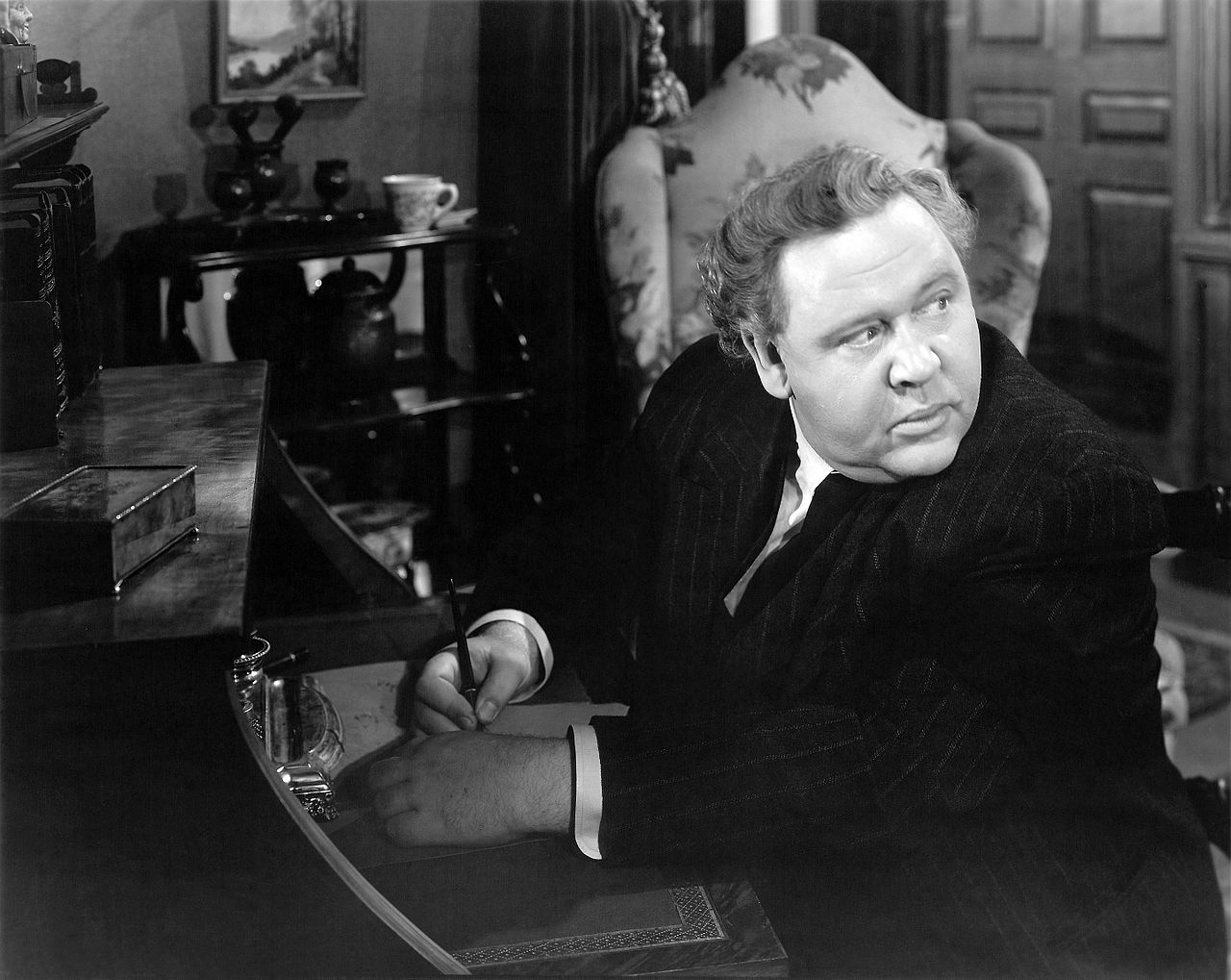
Charles Laughton in The Suspect (1944).

Robert Siodmak began his filmmaking career in Germany, hot-footed it to France when Hitler came to power and wound up among the many German émigrés in Hollywood, including his friend Billy Wilder, who had co-written his first two films, People on Sunday and The Man in Search of His Murderer. (Siodmak was on the last ship to America before the Nazis marched on Paris.) His American career never made him as famous as Wilder or Fritz Lang, but he made some very good pictures, including The Spiral Staircase, The Killers and The Crimson Pirate. Perhaps the best of them is The Suspect, adapted by Bertram Millhauser and Arthur T. Horman from a novel by James Ronald, which Criterion Channel is showcasing this month.

Tuesday, March 7, 2023

Ahab and Quixote: The Endless Search

(Courtesy Ecco Press/Harper Collins);(Wordsworth Editions)

“Tell me your company, and I will tell you what you are.” – Sancho Panza, Don Quixote.

“Call me Ishmael.” – Nameless narrator of Moby Dick.

Certain pieces of great writing seem to haunt us throughout our lives. It’s almost as if their authors are stalking us and offering up new reasons for rereading and rediscovering whatever it was about them that mesmerized us during our initial encounter. Of course, which pieces and which authors vary from person to person: for some it’s King Lear or Jane Eyre or For Whom the Bell Tolls (all of which leave me utterly cold, despite the fact that I appreciate their greatness). Such recursively magnetic books might be touchstones from our youth, such as On the Road or Howl, for me, or they might be lighthouses that show us the way out of some dark storm or other, such as all of the poetry ever written by Wallace Stevens.

It often appears as if some people will literally find any excuse at all to read once again and then write again about two groundbreaking novels in particular, Don Quixote by the Spaniard Miguel de Cervantes and Moby Dick by the American Herman Melville, and I readily admit to being one of those people. But I also claim that my excuse is a valid one (don’t we all?) and situate them in a parallel track which becomes obvious once the reader temporarily accepts my obsession with both. I’ll go so far as to claim (almost) that they are the same novel in some salient ways, and that the twisted times we currently are living through contain psychological and even spiritual echoes of each in the same way that Melville himself evokes Cervantes for me.

Monday, March 6, 2023

Martin McDonagh, Almost Reformed: The Banshees of Inisherin

Colin Farrell and Brendan Gleeson in The Banshees of Inisherin.

Set on an island off the coast of Ireland in the early 1920s, the era of the original “troubles,” where the locals can hear the gunshots marking the violence of the virtual civil war from the mainland, Martin McDonagh’s The Banshees of Inisherin is a portrait of Irish life in a goldfish-bowl community. The two main characters, Colm Doherty (Brendan Glesson) and Pádraic Súilleabháin (Colin Farrell), are buddies who have been drinking together regularly in the local pub. But one day, when Pádraic comes by to pick up his friend at home for their daily pint, Colm refuses to answer the door. He’s decided that he doesn’t like Pádraic anymore – that he’s a dullard with nothing to say for himself and that Colm, who leans toward melancholy, no longer wants to waste his time hanging out with him when he could be focusing on writing music and playing it with enthusiastic graduate music students.

Monday, February 27, 2023

Empire of Light: Something Remains

 Olivia Colman in Sam Mendes's Empire of Light.

In Sam Mendes’s Empire of Light, Olivia Colman plays Hilary, the assistant manager of an old-fashioned moviehouse called the Empire in Margate, England in 1980 and 1981 who is sleeping with her married boss, Donald Ellis (Colin Firth). When Stephen (Micheal Ward), a young Black man, joins the staff they become first friends, then lovers – and then Hilary, who is prone to schizophrenic episodes, breaks down. Mendes, who also wrote the script, overloads the picture – with Hilary’s psychological struggles and Stephen’s encounters with the National Front and a layer of trite sentiment about the ability of movies to keep up our faith and hope when life seems most dire. Following The Fabelmans, this is the second recent picture by a well-known director to throw a load of symbolic weight on the idea of movies. (It doesn’t help that the movies Mendes chooses to embody the salvific quality of movies are hardly inspiring; perhaps that was his intention, but if so it doesn’t accomplish what he wants it to.)

Tuesday, February 21, 2023

Literary Remakes: Pinocchio, All Quiet on the Western Front and Lady Chatterley’s Lover

Federico Ielapi as Pinocchio and Marine Vacth as The Blue Fairy in Matteo Garrone's Pinocchio (2019).

Those with fond memories of the 1940 Walt Disney Pinocchio are likely to respond to last year’s two screen incarnations of Carlo Collodi’s story – published in serial form in 1881 and 1882, and as a novel in 1883 – with some combination of bafflement and irritation. The Disney crew softened the original and bled out the folk-fable elements, but it’s gorgeous to behold, and the writers (seven credited, two uncredited) and supervising and sequence directors (seven, including one who signs himself “T. Hee”) and animators (too many to count) modeled the humor on a combination of vaudeville and silent-film comedy. (I chuckle whenever I think about the scene in the ocean where a school of fish swarm Jiminy Cricket and try to eat his umbrella.) And the Pleasure Island sequence, where Pinocchio, led astray by a cadre of schoolboys lured by the promise of an endless holiday, turn into donkeys fated to be put on the market is one of those genuinely terrifying set piece sequences that dot the early full-length animated Disney features. I tend to be wary of Disney cartoons, but this is one of the few I genuinely like.

Sunday, February 19, 2023

Opening Wednesday at a Theater or Drive-In Near You: An Interview with Charles Taylor

Author and film critic Charles Taylor. (Photo: Lelia McCabe)

I've long been a fan of 1970s American movies, a time when American cinema mattered and when it was a far cry from the mostly bland, pallid fare on tap in America today. Films from that era – The Godfather, Taxi Driver, Nashville, Alice Doesn't Live Here Anymore, McCabe & Mrs. Miller, The Conversation, Carrie, The Sugarland Express, Five Easy Pieces, Chinatown, The Last Picture Show, Blue Collar, The Landlord and many more – were nuanced, complex, often morally ambiguous, and reflected the breadth and depth of American society and the issues of the day that mattered. And the many talented filmmakers making those movies, including Martin Scorsese, Steven Spielberg, Robert Altman, Francis Ford Coppola, Brian De Palma, Hal Ashby, Arthur Penn, Peter Bogdanovich and Paul Mazursky, strived both for relevance and for impact but also displayed a sheer excitement in making movies that translated to the screen and the audience's enjoyment of what they were seeing.  For that reason, that thrilling era of moviemaking has also been the subject of a favourite course, American Cinema of the '70s: The Last Golden Age, that I have taught over the years and that I'm constantly tweaking – and, hopefully, improving – with each iteration. When Charles Taylor's superb book Opening Wednesday at a Theater Or Drive-In Near You: The Shadow Cinema of the American '70s (Bloomsbury USA) came out in 2017, I was so impressed that I switched things up and made it the subject of one of my classes. 

Monday, February 13, 2023

Some Like It Hot Refurbished, and a Brief Word of Farewell

Christian Borle & J. Harrison Ghee in Some Like It Hot. (Photo: Marc J. Franklin)

The best romantic comedy released in the early fifties, William Wyler’s Roman Holiday with Audrey Hepburn and Gregory Peck, was about the impossible romance of a princess and a reporter; it was a cross between a genteel version It Happened One Night and a reverse Cinderella story. But then Hollywood romantic comedy degenerated into sex cartoons with Jayne Mansfield at one end of the spectrum and mechanical farces at the other. One might have feared that the form was dead, until Billy Wilder’s divine Some Like It Hot came to the rescue at the end of the decade. It wasn’t remotely like any previous movie in this genre. (But then, Wilder’s The Lost Weekend hadn’t been like any other social problem picture or Sunset Boulevard like any other film noir.) Wilder and his co-writer I.A.L. Diamond took a page from Shakespeare’s cross-dressing comedies and then doubled it. When two jazz musicians witness the St. Valentine’s Day Massacre they run like hell, straight into drag. They figure their only retreat from the gangsters on their tail is to vanish into dresses and wigs and join an all-girls’ band. Tony Curtis’s Joe, a.k.a. Josephine, falls for the lead singer, Sugar (Marilyn Monroe at her most sublime), and chooses a second disguise – a millionaire named Shell Oil Jr. who entertains her on a borrowed yacht, where Curtis draws her in with a dead-on Cary Grant imitation. Jack Lemmon’s frantic Jerry/Daphne finds himself the object of the yacht’s actual owner, Osgood Fielding III (Joe E. Brown) – a courtship that Wilder and Diamond leave up in the air when the rest of the plot is resolved. The final line – spoken by Brown – when Jerry reveals his true gender to Osgood is one of the two best curtain lines in American romantic comedy. (The other concludes Charade, with Hepburn and Cary Grant, which followed Some Like It Hot four years later.)

Wednesday, February 8, 2023

Outside Looking In: The Seriously Funny Life and Work of George Carlin

“Comedy equals tragedy plus time.” – Dorothy Parker (among others).

“Dying is easy. Comedy is hard.” – George Burns (on his deathbed).

Having previously penned an excellent reappraisal of the consummately eccentric Frank Zappa, unique American composer and creator of the Mothers of Invention rock band, John Corcelli was perhaps ideally situated to undertake this new tome released by Applause Books in which he skillfully explores the similarly exotic outsider status of renegade comedian George Carlin. In his absolutely perfectly titled Outside Looking In: The Seriously Funny Life and Work of George Carlin, he lifts the curtain on the complexities of our mirth, and most importantly for such a delicate mission behind the front lines of laughter, he is sharp enough to appreciate the complex art of stand-up comedy but clever enough to know that it’s much easier to write about it than it is perform it. He leaves that to the experts, while still conducting a master class in how they do what they do. He did, however, study improv at Second City, thus certifying some of his credentials as a keen-minded participant in truly arcane craft.

Tuesday, January 31, 2023

The Art of Burning: The Dilemma of Ideas

Adrianne Krstansky (far left), Michael Kaye, and Rom Barkhordar (far right) in The Art of Burning. (Photo: T Charles Erickson)

Kate Snodgrass’s play The Art of Burning, in production by the Huntington Theatre Company at the Calderwood Pavilion, opens with an exchange between Patricia (Adrianne Krstansky), an artist who is in the midst of a divorce, and Mark (Michael Kaye), who seems to be acting unofficially on behalf of both her and her husband Jason (Rom Barkhordar). I never figured out that part, but the dialogue is tart and witty. Snodgrass has a gift for high-comic repartee and she excels at two-character scenes. The best one is between Mark and his wife Charlene (Laura Latreille), Patricia’s best friend, who has been cheating on him. He’s found out about the affair, she’s put an end to it, and he’s struggling to believe her claim that it won’t happen again. It’s as good a piece of dramatic writing as I’ve heard in the last several years.

Monday, January 30, 2023

Glorifying Intolerance: The Sad History of Banning Books

:reaktion books u of chicago.jpg

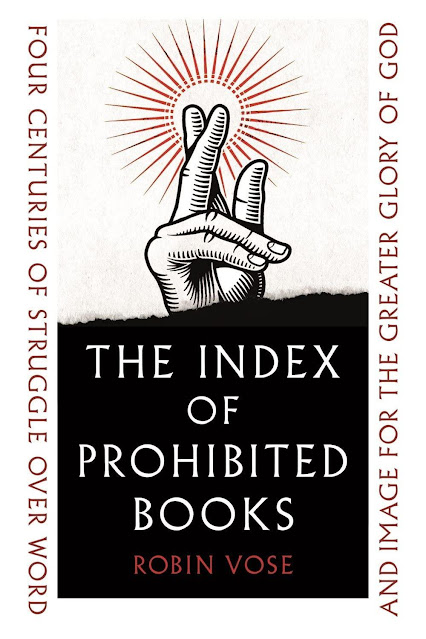
Art censorship, especially in cases that did not involve printed books, also once again reveals the limitations and often fortuitous nature of the whole Index project. Condemnations were often delayed for years or even centuries, or omitted altogether, as censors struggled to keep up with the constant flow of publication and creative works. They instead targeted individuals on a selective and often somewhat random basis, according to what came to their attention. Montaigne was quite dismayed by the close expert scrutiny his Essais received on his arrival in Rome, and it must also have been a hawk-eyed reader indeed who managed to pick out a single offending passage in the hundreds of pages of Cervantes’s Don Quixote.
– Robin Vose, The Index of Forbidden Books: Four Centuries of Struggle Over Word and Image For the Glory of God.

Alas, the history outlined in Robin Vose’s harrowing new study of institutionalized intolerance, The Index of Forbidden Books (Reaktion Books, distributed by University of Chicago Press), often veered all the way to the extreme right and even included, on special occasion, bonfires built to incinerate ideas which were deemed too dangerous, or sometimes just too alternative to orthodoxy, to be permitted on the open market of human consciousness. You can imagine how afraid the powers that be must have been around the turn of the first millennium, when the paranoid forces of paralyzing superstition were simply not enough and they needed to resort to more stringent methods of control, such as the complete non-existence of alternate perceptions of reality that ran counter to their own strategic plan for managing moral behaviours and belief systems. The one key ingredient they never quite clarified or explained, of course, was just why the supreme Deity they worshipped, and whose psychic persona armor they were obsessed with forcing down the throats of the entire population of the world, would ever need to be “glorified” in so crass a manner. 

Sunday, January 29, 2023

Lost in Translation: Wayne Mcgregor’s MADDADDAM

Siphesihle November and Jason Ferro in Wayne McGregor’s MADDADDAM. (Photo:Bruce Zinger; Courtesy of The National Ballet of Canada)

"But the people couldn’t be happy because of the chaos.” It’s a line uttered during the course of MADDADDAM, and it comes close to summing up reaction to a ballet where the dance got in a swirl of virtuosic theatrical effects. Based on a trilogy of dystopian novels by Canada’s Margaret Atwood, British choreographer Wayne McGregor‘s lavish three-act adaptation for the stage, a co-production of the National Ballet of Canada and England’s Royal Ballet, commission of The National Ballet, confuses and disappoints. It doesn’t tell a story that’s easy to follow, and it doesn’t use the art of dancing that measures up to the soaring imaginative peaks of Atwood’s speculative prose. Where her novels feel futuristic, McGregor’s ballet, whose world premiere took place at Toronto’s Four Seasons Centre at the end of November, appears curiously anachronistic, being more concerned with scenography – a hallmark of the early-20th-century Les Ballets Russes – than with pushing classical dance into brave new territory.

Monday, January 23, 2023

In Passing

Colin Farrell, Joel Edgerton and Viggo Mortensen in Thirteen Lives.

This piece includes reviews of Thirteen Lives,The Good Nurse,Glass Onion: A Knives Out Mystery and The Pale Blue Eye.

At the outset of Thirteen Lives, Ron Howard’s dramatization of the 2018 Tham Luang Cave rescue in northern Thailand, we see the twelve pre-teen and teenage football players and their coach enter the cave and then the monsoon begin to batter it. But then Howard and the screenwriter, William Nicholson, make an unconventional choice: they don’t show us the trapped souls again until, about halfway through the picture, the British divers, Rick Stanton (Viggo Mortensen) and John Volanthen (Colin Farrell), come upon them near the mouth of the cave twelve days into the ordeal, when many participating in the story or following it on the news fear they must be dead. Naturally the filmmakers understand that presenting the facts of the narrative from the point of view of those outside the cave is dramatically effective, but I think there’s an ethical dimension to their showing us what Stanton and Volanthen discover as they discover it. Howard and Nicholson strive to avoid melodrama; they don’t want to rev up the audience by cutting back and forth between the deprivations the footballers are suffering and the efforts of the crew – a wide, disparate combination of divers, Thai Navy SEALS and other military, police officers, volunteers of every stripe and the representatives of about a hundred government agencies – to track them down. They are resolute about draining Thirteen Lives of sentimentality; I wouldn’t say there’s none at all, but given the nature of the material there’s remarkably little. It’s a film of great integrity as well as tremendous skill. And the subject matter is so gripping that you’re grateful for the foreknowledge that the coach and all the kids got out alive. (One of the SEALS, Saman Kunan, played by a charismatic young actor named Sukollowat Kanarat, did not survive the operation, and another died a year and a half later of a blood infection he contracted during it.) 

Tuesday, January 17, 2023

The Far Country and Intimate Apparel: Identity and Remembrance

Eric Yang, Jinn S. Kim, and Amy Kim Waschke in The Far Country. (Photo: Ahron R. Foster)

The Far Country, recently produced by the Atlantic Theatre, begins in 1909 on Angel Island, outside San Francisco, where Chinese who seek citizenship undergo relentless, repetitive, often confusing interrogations designed to locate the tiny contradictions in their stories. In this case the candidate, Gee (Jinn S. Kim), was born in San Francisco to an immigrant who came over to America to work in the mines and an unknown mother – likely a prostitute. In his interview he explains that he went back to China to start a family, then left them behind to return to the States and begin a laundry business. Now he is seeking to visit his wife and children, already grown, in China. This story, we learn in the next scene, is a scam, at least the part about his family in the old country. In a small Chinese village Gee finds a widow (Amy Kim Waschke) in desperate straits – she owes money to a gangster she can never repay – whose son, Moon Gyet (Eric Yang), Gee wants to pass off as his own. If the boy, who is about sixteen, can memorize the narrative Gee has prepared for him and withstand the Angel Island interrogators, then Gee will pay the widow’s debts and Moon Gyet can work off the cost of his passage in his employ. Moon Gyet is bright, strong-willed and full of conviction, and though he has to stay on Angel Island for nearly two years, through two appeals of his case, ultimately he attains citizenship. Gee bankrolls the extended process (the cost includes bribes), adding years to the young man’s indentured servitude, but Moon Gyet considers himself lucky: not only has he won entrance to America, “the gold mountain,” but he’s kept his mother and siblings alive. In the second act he returns to his village, dressed as an American gentleman, in search of a young woman from a similarly destitute family he wants to pass off as his wife. He is, in the vernacular of the time, selling his name.

Monday, January 9, 2023

New from Criterion: Hôtel du Nord, Le Corbeau and Summertime

Jean-Pierre Aumont and Annabella in Hôtel du Nord (1938).

I look eagerly forward to the monthly announcements of the new Blu-Ray releases from Criterion and to viewing (or more often re-viewing) a handful of them in gleaming new prints. Here are three that came my way over the past few months. 

Wednesday, January 4, 2023

Portrait of the Artist, Part III: Aftersun and Armageddon Time

Frankie Corio and Paul Mescal in Aftersun.

Aftersun was inspired by the Scottish writer-director Charlotte Wells’s memories of her father. It’s a first feature by someone who has made only shorts before, and it has a distinctive voice and a hazy, meandering, experimental style; the angles are unusual and the images often seem off-kilter. The main character, Sophie (played by Frankie Corio), is an eleven-year-old girl who lives in Glasgow with her mother; her parents have split, and her father, Calum (Paul Mescal), has been trying to restart his life in England, so they seldom get to see each other. Just before Sophie goes back to school for fall term, her dad takes her on a trip to Turkey.  They stay, with other English-speaking tourists, at a vacation hotel called Ocean Park, where she hangs about the pool or the game room or the arcade when she and Calum aren’t on touring the shops or out on day trips. The movie isn’t linear, and as Calum lets Sophie use his video camera, especially when they loll around their hotel room, it’s meant to evoke the feel of home movies, like Jim Sheridan’s magnificent, magic-realist In America, which has an Irish video-camera buff heroine not much older than Sophie. But whereas Sheridan’s picture has a strong narrative, Aftersun is casual, anecdotal. Not much happens. Sophie plays pool with some British teenagers and observes them drinking and making moves on each other; a boy her own age spends time with her and they indulge in a little mild petting. And she and her dad work hard to make their time together count because it’s so short.  He wants her to have a good time; she wants to find out things about him that she doesn’t know, such as what he was like when he was eleven and what sort of future he envisioned for himself.

Thursday, December 22, 2022

Dylan in Winter, Part II: Greil Marcus’s Folk Music

Bob Dylan, November 1961. (Photo: Michael Ochs)

I.

Many things matter about Folk Music: A Bob Dylan Biography in Seven Songs (Yale University Press; 273 pp.), Greil Marcus’s fourth—and, he has said, last—book about its subject. But your personal allegiance to Dylan in recent times isn’t one of those things. Whether you particularly value or even like the songs Marcus studies—in order of presentation, “Blowin’ in the Wind” (1962), “The Lonesome Death of Hattie Carroll” (1964), “Ain’t Talkin’” (2006), “The Times They Are A-Changin’” (1964), “Desolation Row” (1965), “Jim Jones” (1992), and “Murder Most Foul” (2020)—also doesn’t matter. The Dylan we surveil in these pages is not the sum of his successes or failures, or of any reader’s likes or dislikes. He is a creative force, a dark, hunched, music-producing presence prowling through decades of celebrity and centuries of history. If you retain a nerve of commitment to anything Dylan has ever done or been, that will be your point of entry, and meanings will flow even from songs you never cared about—songs you may not care about now, except as vehicles for Marcus to do what he does best. 

Monday, December 19, 2022

Portrait of the Artist, Part II: Funny Pages

Matthew Maher and Daniel Zolghadri in Funny Pages.

In the first scene of Funny Pages, a middle-aged man strips naked and hoists himself on top of the desk to pose for a teenage kid. The boy is Robert (Daniel Zolghadri), a gifted underground comic artist; the man, Mr. Katano (played by the playwright Stephen Adly Guirgis), is his art teacher and the only adult he knows – besides the owner of the comics store where he works – who sees a spark of genius in his work and encourages him to quit school and pursue his art. Mr. Katano is a great model, but his eagerness to expose himself freaks Robert out, so after he’s finished the drawing he slips out of his mentor’s apartment as fast as he can. Katano chases after him in his car to make sure the incident hasn’t made it weird between them – as if there was the slimmest chance it wouldn’t have – and he’s so anxious to smooth things out with Robert that he swerves into the wrong lane and crashes fatally into another car. All of this takes roughly ten minutes of screen time. By the time you get to the end of this initial section you’re either gasping or howling with laughter, or maybe both. It may be the wildest opening of a movie I’ve ever sat through.

Tuesday, December 13, 2022

Christmas in Connecticut: Trimming a Moldy Tree

Matt Bogart, Audrey Cardwell and Josh Breckenridge in Christmas in Connecticut. (Photo: Diane Sobolewski)

Christmas in Connecticut shows up on TV every holiday season, but that doesn’t make it a classic. This Jell-o-bland 1945 comedy sits on a wobbly premise. An emphatically undomesticated magazine writer (played by Barbara Stanwyck) writes a fictitious column that presents her as a family woman cooking gourmet meals for her husband on a picturesque Connecticut farm. Her publisher (Sydney Greenstreet, looking like he knows how badly miscast he is), somehow ignorant of the truth, that she’s a single New Yorker who dines in restaurants, compels her to invite a war hero (the hopelessly bland Dennis Morgan) home for Christmas. Since her steady suitor (Reginald Gardiner) just happens to own a farm in Connecticut and she and her editor (Robert Shayne) are friendly with a gifted local chef (S.Z. Sakall), they decide to try to pull off an elaborate charade. Except for Stanwyck, who gives the tepid material the old college try, no one associated with the picture – not the director, Peter Godfrey, or the writers, Lionel Houser and Adele Comandini – could be called remotely distinguished.

The notion of turning Christmas in Connecticut into a stage musical feels desperate, but it’s December and after all, there is a limited number of holiday-themed properties. The result, at the Goodspeed Opera House, is a bargain-basement confection that, like the movie, is set just after World War II but has been tricked up to look like it passes the woke test with the addition of a socialistic naysayer and a gay couple. The book by Patrick Pacheco and Erik Forrest Jackson is even worse than the original screenplay, and the score by Jason Howland (music) and Amanda Yesnowitz (lyrics) is forced and worn from the opening number, which recycles ideas from Leonard Bernstein and Comden and Green’s Wonderful Town. Seven of the eight songs in the first act are belters, culminating in a stupefying novelty number called “Catch the Ornament,” in which the protagonist, Liz (Audrey Cardwell), and her Hungarian chef buddy, Felix (James Judy), invent a game to occupy the ill-fitting dinner guests. Let’s just say that “Catch the Ornament” makes “Turkey Lurkey Time” from Promises, Promises sound like a winner in the holiday-show-songs sweepstakes. Toward the end of act one, they slip in one ballad, “American Dream,” sung by the war vet, Jefferson Jones (Josh Breckenridge), that shifts the tone from fake-cynical to fake-inspirational. We get more of that in the second-act finale, a Christmas hymn titled “May You Inherit.”
Saturday, December 10, 2022

Dead and Alive: Double Murder by the UK’S Hofesh Shechter Company

The Hofesh Shechter Company performing Clowns. (Photo: Todd MacDonald)

Terrific. It’s a word denoting terror and intensity of experience. Both meanings apply to the Hofesh Shechter Company’s Double Murder program that slayed all who saw it at Toronto’s Harbourfront Centre at the end of October. Divided into two parts and presented as part of the ongoing Torque series of international dance, Double Murder plumbs the anxiety and dread of the pandemic with an imagination as fearless as it is foreboding. 

Israeli choreographer Hofesh Shechter, a resident of London who is an assistant artist at the city’s Sadler’s Wells dance organization, created the concept of the double bill during the lockdowns, later saying he wanted to present a brace of contrasting dances “for our times.” 

Clowns, with its relentless depictions of slit throats, brute rapes and shots to the head, came first, debuting in 2016 when the world was still healthy enough to digest an onslaught of deadly ironic imagery. It’s absurdist theatre constructed as a punch of a dance. Shechter in his program notes describes it as anarchic. The Fix, a recent work now following Clowns as part of an expanded 90-minute program, softens the blows. Concluding with a group hug, it is about togetherness, not turbulence, redemption, not moral rot. 

Thursday, December 1, 2022

Give And Take: The National Ballet of Canada’s Mixed Program

Svetlana Lunkina, Peng-Fei Jiang and Artists of the Ballet in Concerto. (Photo:Karolina Kuras, Courtesy of The National Ballet of Canada)

A mixed program is usually a study in contrasts with something new, something old and something breezily entertaining often sharing the same bill. The diversity of styles, frequently representing disparate ballet eras, creates its own sense of drama, making it a winning formula for companies wanting an alternative to the full-length classics that more draw in audiences. Take that variety away and a mixed program can fall flat, despite all good intentions. That’s the conclusion drawn from the National Ballet of Canada’s recent presentation of three works at Toronto’s Four Seasons Centre, representing Hope Muir’s first curated program since becoming artistic director a year ago, while Karen Kain was still in charge. Comprising two contemporary ballet premieres and a modernist revival, the program unveiled on November 9 felt disconcertingly monotonous as a season opener. Thematically as well as stylistically, the ballets were more similar than they were different, particularly the contemporary pieces, whose shared fondness for over-busy choreography made them seem like two sides of the same ballet coin. The exception was the still centre of Sir Kenneth MacMillan’s Concerto, a dazzler of abstract academic dance whose vivacious opening and closing sections bookended a pas de deux so serene it was blissful.