Showing posts sorted by relevance for query Sunset Boulevard. Sort by date Show all posts

Wednesday, February 28, 2018

Iconosphere: Cinema in the History of Art

William Holden, Sunset Boulevard, 1950.

“Movies are magic” Van Dyke Parks
When I was a kid in the 50s and 60s, growing up in the wasteland suburbs outside Toronto (Don Mills was, by the way, among the first such planned outliers in North America; it looked rather pleasant and was a splendid locale for experimenting with Aldous Huxley’s spiritual vitamins) and where I spent much of my time watching television like most of my fellow baby boomers, I was also treated to a rather unique experience that my fellow truants were not.

While whiling away the dreamy hours in front of that magic flickering box I would occasionally be taken aback by the sight of my own surname on the screen as the writer and producer of many a classic black-and-white film being screen on the new medium of TV.

There was, in those days, an almost total absence of the specifically programmed content we take for granted today, and instead the new-born networks would recycle movies from the early age of cinema for unsuspecting viewers such as myself. And when I asked them who this “Charles Brackett” was, their perhaps too-casual, somewhat innocent suburban response was something along the lines of “Oh ,yeah, I think he was part of the American branch of the family who had something to do with Hollywood.”

Something to do with Hollywood? He was, in fact, a member of Hollywood royalty, having also been a member of the Lost Generation in Europe along with Hemingway and Fitzgerald (both of whom he knew and nursed through their hangovers) before coming to New York and being a member of the Algonquin Room circle along with Dorothy Parker and Robert Benchley (more help with hangovers, Charlie being teetotal) while also serving as the drama critic for The New Yorker.

Like other talented writers (including of course, Fitzgerald and Faulkner) he was eventually financially lured to Hollywood, where he was teamed up by Paramount Studios with a recent émigré from Austria who barely spoke English, to write screenplays for the great Ernst Lubitsch.

Wednesday, June 21, 2017

Double Solitaire: Creative Partnerships Made in Hell

William Holden and Gloria Swanson in Sunset Boulevard (1950), written by Charles Brackett & Billy Wilder, directed by Wilder.

“When two great saints meet it is a humbling experience." – Paul McCartney, 1968.

1. brackettandwilder

It was called the Golden Age of Hollywood for good reason. The early evolutionary phase of the film industry, which I personally designate as roughly being from 1929 to 1959, immediately established the stylistic devices, narrative techniques, creative content and future direction that cinema would take as both a visual art form and a commercial business enterprise. Most importantly, perhaps, the paradoxical fact that cinema could be both entertaining and profitable, as well as both philosophically challenging and emotionally comforting, was etched in celluloid almost from its beginnings at the turn of the century. Fine cinema is quite simply the best of both worlds.

Among the many screenwriters, producers and directors who blazed that ever-expanding trail, few would have quite the lasting impact on both comedy and tragedy as impressive and influential as the iconic achievements of the volatile collaborative partnership between writer-producer Charles Brackett and writer-director Billy Wilder.

Sunday, December 29, 2024

The Big Carnival: Billy Wilder’s Ace in the Hole (1951)

Kirk Douglas in Billy Wilder's Ace in the Hole. (All movie stills courtesy of Paramount Studios.)

“The biology of the shadow has yet to be fully explored.”
Andrei Biely, 1913

“We are a nation of hecklers. The most hard boiled, undisciplined people in the world.”
Billy Wilder, 1950

I think it’s fair to say, at least from my perspective, that someone has finally come along and fully studied the biology of the shadow. After their divorce as filmmaking partners, both Charles Brackett and Billy Wilder went on to make solo efforts that pushed film noir even further towards an unexpected edge. Brackett produced Niagara with Marilyn Monroe in 1953, and Wilder created Ace in the Hole (a.k.a. The Big Carnival) with Kirk Douglas in 1951. By a strange coincidence, unless it was synchronicity, just after writing the section of the tumultuous story having to do with their final noir masterpiece as collaborators, Sunset Boulevard, I happened upon a TCM broadcast of Wilder’s first independent effort after their break-up. I had seen Ace in the Hole several times previously; however, it had seldom resonated in quite the same way as it did while I was watching it from a retrospective point of view. So I sat back with a glass of wine and my notebook, prepared to venture once again into Billy’s post-Brackett domain. My instinctive initial response was even more severe than my first viewings had been.

Wednesday, May 16, 2012

Kitchen-Sink Gangsters: Down Terrace and London Boulevard

Robin and Robert Hil star in Down Terrace

As I said in my post last year about the death of the DVD rental shop, one thing I would miss was the habit of walking the aisles looking at all the titles and stumbling across a gem I'd never heard of. Then after reading the plot on the back of the box, I decided whether to take a flier and rent it. The Eclipse was one such gem I discovered this way, which I've already discussed here. Now, with the announcement three weeks ago that Rogers would no longer rent DVDs, that window of discovery, for me at least (there are no independent DVD rental shops in the city north of Toronto where I live), has now closed.

However, I had one final chance this past weekend that resulted in, if not huge dividends, at least some very pleasant surprises. Three weeks ago, after Rogers announced their decision, I ventured to our one-remaining store to see what deals I could get. All DVDs were listed as buy one get one free. So, I was able to pick up about 8 or 9 recent films, such as Hugo, The Girl with the Dragon Tattoo (2012), A Dangerous Method, Cave of Forgotten Dreams, plus others, for about $7 each. Over the next two weeks, I went a couple of more times to see if the discount got greater. It had not. But this past Friday I decided to go one more time. The discount was now buying one get two free. They had been pretty picked over, but there were still a few things of interest, such as the three discs of Season Two of The Republic of Doyle. Then just as I was about to wrap it up, the manager came out and announced they had just been informed all DVDs were now $1 each. That changed things. I bought 27 movies. Timing is everything.

Wednesday, July 17, 2024

Tales from the Making of Niagara, 1953 by Richard Shmelter

Publicity still from Niagara (Photo by Gene Korman).
“Marilyn Monroe and Niagara Falls, a raging torrent of emotion that even nature can’t control.” – Boisterous but accurate publicity poster for the film’s release.

“I only stop when I’m done.” – Equally accurate self-analysis from Marilyn herself. 

I’ve always had a special place in my heart for Niagara, though some friends prefer to refer to my ardor for it in other ways: obsession, fixation compulsion, fetish. They’re quite right, of course. Maybe it evokes the frequent family road trips I took as a youngster from Toronto to Niagara Falls, or perhaps it was the obvious increase in temperature provoked in a ten-year-old boy caught in the torrential environment of Marilyn Monroe. Guilty as charged. I also enjoy reminding such friends that all those states of mind they teasingly attribute to my passion for this film are essentially the core features of the film noir genre itself.

I can’t count the number of times an argument, or let’s call it a heated disagreement, ensued between myself and other viewers or reviewers who took the noir genre more literally in its black and white, dark urban streets, femme fatale and psycho-thriller overtones. Some friends were underwhelmed by the splashy aura of the falls motif in Niagara, the nearly rural touristy setting, and of course the palette, even if they were mutually taken with Marilyn’s Rose and her sinister appeal. I’m a huge fan of all of those nourish aspects too, but I’m also a huge defender of Niagara as a late-blooming and innovative exponent of the genre that becomes all the more obvious if you simply watch it in black and white as a viewing experiment.

So I’m delighted to report that Richard Shmelter, author of the thoroughly readable and charmingly obsessive Tales from the Making of Niagara, 1953, published by Malibu Sunset Media, not only shares my sense of its brilliantly noirish sunlit darkness, but also acclaims it as the film that first put Monroe on the stellar star map and also made her what she clearly was, has been and I suppose always will be: what he calls an iconic influencer. The fact is that, in the absence of a historical context back then in the 50’s for the very postmodern social media concept of what an influencer is and does, Shmelter demonstrates that the impact of her persona and gravitas makes it not only acceptable to call her that, but almost imperative. I guess that kind of makes her a posthumous influencer.

Monday, June 15, 2026

Resurgence: The Christophers

Michaela Cole and Ian McKellan in The Christophers. (Photo: Department M.)

There isn’t a sentimental moment in Ian McKellen’s portrayal of the artist Julian Sklar in Steven Soderbergh’s The Christophers. Julian is a painter in the sunset of his life who hasn’t made any new work in twenty years; he’s long since faded from celebrity, but a mystique remains around an unfinished series known as “the Christophers,” which he abandoned when he broke up with the lover to whom they were dedicated. His dreadful children (amusingly sketched by James Corden and Jessica Gunning), with whom he has apparently had no relationship for years, terrified that at his death they will be left without any inheritance, hire a young artist named Lori Butler (Michaela Coel) to forge finished versions of the paintings if indeed they exist at all, or to create them if they don’t. They persuade her to apply for the job of their dad’s new assistant in order to gain entrée to his studio. But though Lori has a history with Sklar that he is unaware of and that should definitely encourage her to take his children’s side – as a nineteen-year-old aspiring painter, she endured a withering critique by him on a TV show – her response to the young Sklars’ mission turns out to be very complicated. So is Ed Solomon’s intriguing screenplay, which weighs the questions of legacy and ownership in the arts and the bearing of the personal on the artistic as no movie has since Olivier Assayas’s Summer Hours in 2008.

Saturday, April 23, 2016

Able Archer: How Comedies Mature (or, at least, Age Gracefully)

The seventh season of FX's Archer premiered on March 31st.

I’ve spent approximately 30 hours of my life watching a goofy cartoon about a super-spy’s ridiculous adventures. That might seem like a waste, were it not for the fact that, as it progresses through its seventh season, the FX comedy Archer remains one of the funniest things on TV. In its most recent seasons, that’s been a function of its willingness to significantly tweak – I won’t say reinvent, because it remains fundamentally the same show – its basic formula to stay fresh. It’s a reminder of how even shows that are light, trifling entertainment (and it’s no disparagement to Archer to call it that) can find ways to develop and even, in their way, grow.

As Mark Clamen’s 2012 review of the show for this site indicates, Archer isn’t exactly highbrow. It’s frequently violent and crude (albeit loaded with surprisingly intelligent references, a trademark of creator Adam Reed’s work). While it functions as a satire of the James Bond franchise and all of the hyper-masculine trappings that go with it, it’s still often gleefully immature and politically incorrect. It’s also a great showcase for the voice-acting talents of a number of underappreciated actors, including H. Jon Benjamin in the title role of secret agent Sterling Archer, Aisha Tyler as his long-suffering girlfriend Lana, and Jessica Walter as his mother (she’s essentially reprising her role from Arrested Development here, but she does it so well that it doesn’t matter). Perhaps the best example of how Reed understands how to utilize his talent is his use of Judy Greer, who’s so well-known for playing second bananas that she’s gamely made fun of herself for it. In Archer, she gets a chance to shed that bland persona, playing the deeply demented Cheryl (or Carol, or any of a variety of other names), a role that provides some of the strangest, and occasionally most disturbing, jokes on the show.

Monday, May 25, 2020

Neglected Gem Double Bill: Slither (1973) and Rafferty and the Gold Dust Twins (1975)

James Caan and Peter Boyle in Slither (1973)

When those of us who lived through the great renaissance of American movies – that magical era that was roughly bounded by Bonnie and Clyde (1967) at one end and Taxi Driver (1976) at the other – look back fondly on it, it’s not just the masterpieces that come to mind. After all, The Godfather I and II and The Conversation, The Wild Bunch, Cabaret, McCabe & Mrs. Miller and Nashville are as much in the DNA of American pictures as Citizen Kane or Sunset Boulevard or The Manchurian Candidate. What made the era unique, particularly the first half of the seventies, was the off-kilter, off-the-cuff sensibility that made going to movies, including many small ones that never really caught on and have been buried by the passing decades, a continually surprising and inspiriting experience. Many of these films seemed in the process of unspooling while you watched. You didn’t know where they were going to take you, because tones shifted and both the scripts and the direction seemed to have been set up like tiny fireworks displays showcasing the quirky, unpredictable talents of character actors, some of whom, flying in the face of Hollywood tradition, had become or were becoming stars.

Two movies that embody these qualities are the road comedies Slither, from 1973, written by W.D. Richter and directed by Howard Zieff, and Rafferty and the Gold Dust Twins, from 1975, written by John Kaye and directed by Dick Richards. (Both are available on Prime and they would make an ideal double bill.) Road comedies, of course, by definition embrace the unexpected (whatever happens to lie ahead) and the open-ended. In a good road comedy, the spirit of improvisation and adaptability and the democratic impulse have prepared the characters to look at the rest of their lives as an unmapped journey and the people they’ll meet as unknown quantities, too complicated for easy judgments.

Monday, March 16, 2020

Parodies: The Confession of Lily Dare and Little Shop of Horrors

Nancy Anderson and Charles Busch in The Confession of Lily Dare. (Photo: Carol Rosegg)

The last two shows I caught in New York before the theatre went dark were both lighthearted parodies, Charles Busch’s The Confession of Lily Dare (produced by Primary Stages at the Cherry Lane Theatre in the West Village) and the latest revival of Little Shop of Horrors (at the midtown off-Broadway house the Westside). Busch has chosen an obscure subject for a 2020 audience – the mother-love melodramas that were popular in the late 1920s and early ‘30s, the days just before the Hays (Production) Code went into effect in Hollywood, imposing decades of infantilizing self-censorship on filmmakers. But the matinee audience sitting around me, howling with delight, seemed to get the references. (They must have been devoted TCM viewers.) In Lily Dare, the closest pals and associates of a notorious San Francisco madam, a whore named Emmy Lou (Nancy Anderson) and a gay honky-tonk pianist named Mickey (Kendal Sparks), meet at her grave and recall her meteoric rise and tragic downfall. Busch himself, a drag performer imbued with firecracker wit, hair-trigger timing and devastating charisma, played Lily in flashbacks.

Thursday, January 3, 2013

That What Doesn't Kill You: The Buster Keaton DVD Box Set

In Billy Wilder’s Hollywood Gothic, Sunset Boulevard (1950), Buster Keaton puts in a brief appearance, alongside silent-film stars H. B. Warner and Anna Q. Nilsson, as one of Norma Desmond’s bridge partners. Keaton was only in his mid-fifties at the time, but he and the others are presented as has-beens who’ve survived their cultural moment, the silent era, and now dare not venture out into the sunlit world of teenagers and transistor radios, for fear of crumbling to ash; they’re unwrapped mummies, with bitter frozen faces and sawdust in their veins. A year earlier, James Agee’s famous Life magazine article about silent film comedy had begun to kick some life back into Keaton’s dozing reputation, a development that led to him appearing on such TV shows as Candid Camera and This Is Your Life, as well as an embarrassing Hollywood biopic, starring Donald O’Connor, purporting to tell what the ads called his “sad, happy, loving story.” (Short version: even the most caring and supporting studio boss in the world can only do so much to save you from yourself when you’re that big a drunk.)

Keaton’s professional comeback – which, by the early ‘60s, included the lead in a short film written by Samuel Beckett and guest appearances on The Twilight Zone and Route 66, not to mention How to Stuff a Wild Bikini  might have ended there if he hadn’t formed a partnership with the film collector Raymond Rohauer, who had several of Keaton’s early films transferred from deteriorating nitrate stock and began re-releasing them to theaters, thus making it possible for audiences to see, for the first time in decades, the work of the lovable, glowering old coot they’d been nostalgically embracing. If some of the attention lavished on Keaton in his twilight years had been based on the sentimental feeling that he was a sad clown who’d fallen on hard times, exposure to any five minutes of The General or Steamboat Bill, Jr. or The Navigator or Our Hospitality tended to blow away any idea that the people paying attention to this man were doing him some kind of favor.

Thursday, March 12, 2015

Sins of the Children: David Cronenberg and Bruce Wagner's Maps to the Stars

Julianne Moore in Maps to the Stars.

“Everything is research, in a sense,” says Robert Pattinson in David Cronenberg’s new inside-Hollywood movie, Maps to the Stars. Pattinson’s character, a struggling actor and aspiring screenwriter who supports himself by working as a limo driver, is the resident Tod Hackett figure in this Day of the Locust set-up: he doesn’t represent a central consciousness for the film, but he’s the only character in it who could pass for sane. He’s also the only character on view who seems to be essentially decent, up to the point when, in the name of “research,” he agrees to screw his client, a movie actress and sex symbol (Julianne Moore), in the back seat of the car while it’s parked outside a house where they can be seen by the young woman (Mia Wasikowska) he has been dating.

Maps to the Stars has been in the planning stages for so long that Bruce Wagner, who wrote the script, turned the material into a novel when it looked as if he and Cronenberg would never be able to make the movie. But whenever the scene was first written, with Pattinson in the role, it gets what dirty charge it has from the audience’s knowledge that Pattinson endured his own public humiliation a few years ago when his Twilight co-star and real-life girlfriend, Kristen Stewart, was reported to have had an affair with her director on Snow White and the Huntsman. When Billy Wilder made Sunset Boulevard sixty-five years ago, a Gothic horror satire about Hollywood, with a bitchy, acidic tone and in-jokes, he had the advantage of giving audiences a close-up look at an unfamiliar world. Today, with a twenty-four news cycle that devotes a disproportionate amount of its attention to show-business “news,” most of it shaped to make everyone feel like an insider, it’s like everyone is spending part of their day doing the research to appreciate a movie like this.

Tuesday, September 17, 2024

The Lost Weekend: A Brilliant Darkness

Ray Milland in The Lost Weekend (1945).

“It’s like the doctor was just telling me—delirium is a disease of the night, so good night.” – Bellevue Nurse Bim, in The Lost Weekend.
The Lost Weekend, released November 29, 1945. Paramount Pictures. Directed by Billy Wilder, Produced by Charles Brackett, Screenplay by Charles Brackett and Billy Wilder, based on a novel by Charles Jackson. Cinematography by John Seitz. Edited by Doane Harrison. Music by Miklos Rozsa.  Duration: 101 minutes. Featuring Ray Milland and Jane Wyman, Phillip Terry, Howard Da Silva, Doris Dowling, Frank Faylen. Wilder has explained that part of what originally drew him to this material was having worked with Raymond Chandler on the screenplay for Double Indemnity, subsequent to Brackett’s brief vacation. Chandler had been a recovering alcoholic during that stint and claimed that the stress and tumult of his working relationship with Wilder (actually not that much different from Wilder’s relationship with Brackett) caused him to start drinking again to survive the collaboration. Wilder has claimed that he made the film, about a drunk with chronic writer’s black, at least partly in order to explain Chandler to himself.

One’s Company, Two’s a Crowd: that could be the business card logo of struggling novelist Don Birnam in The Lost Weekend, but also of his real life alter ego Charles Jackson, author of the novel on which Billy Wilder and Charles Brackett based their Academy Award-winning 1945 cinematic study of the struggle to outrun your own shadow. This unsettling masterpiece of internalized noir is an example of a certain brand of dark cinema at its finest, and when it was shown recently on the TCM network we got to see exactly why that is: it’s a kind of exotic corporate merger between personal and professional angst, exploring two competing compulsions, writing and drinking, and it takes no prisoners in exposing the raw nerve inhabiting and inhibiting the urge to tell stories. Ironically, it also demonstrated to Brackett and Wilder that, at least for the time being, they were stronger working in tandem than apart, despite the fact that they could barely stand being in the same room together.

Sunday, October 27, 2024

Cries in the Night: Children of Film Noir – Nocturnarama, A Noir Childhood

.
‎BearManor Media (June 2023).
“Nailing down a coffin lid is far easier than nailing down a universally agreed upon definition of the term film noir.”  – Robert Strom

Every so often a book comes along that somehow manages to evoke our childhood and our love of films at the same time. Robert Strom’s Cries in the Night: Children in Film Noir is just such a book.

I grew up in a place I used to call Shadowland, a quiet suburb of Toronto known officially as Don Mills (the first formally designed suburb in North America) where there wasn’t much to do but listen to music and watch movies. Luckily I was also a kid in the 1960’s, a time when the best of both of those pursuits was available to us in abundance. When I was about ten years old my life was changed forever by a secret practice I used to engage in when the rest of my relatively normal suburban family was fast asleep at night. Back in those days, after midnight the public broadcasting system in Canada used to transmit overnight classic movies across the airwaves and into our homes, and I would quietly go out into our dark living room, turn on the television and start watching old films long into the wee wee hours. That was my initial and probably too young exposure to dark movies I would never have been allowed to watch in theatres or during the daylight.

Sunday, May 17, 2026

Object Lessons: Videotape


(Bloomsbury Books.)

“Objects have the longest memories of all. Beneath their stillness, they are alive with all the experiences they have ever witnessed.”
--Teju Cole

Object Lessons, published by Bloomsbury Books, is an illuminating series of short, beautifully designed books about the hidden lives of ordinary things. As Oana Godeanu-Kenworthy’s incisive biography of this impactful technology reveals, over the span of a single decade, the VHS format changed the privileged relationship between privacy and entertainment, pried open the closed societies behind the Iron Curtain, and then mysteriously sank back into oblivion. Although what we now call streaming has assumed prominence, the legacy of the humble videotape still continues to inform modern entertainment. And I’m delighted to say that both Godeanu-Kenworthy and I appear to share a similar, if not parallel, fondness for the technology that preceded our present stream-mad dimension. Here’s my outset admission: I’ve always been a huge fan of the analog world, its haptic tone and the various shapes it took, and I still am. The author of this charming little book, which has a giant subject and theme that belies its scale, also shares in her book’s beginnings what might account for her fondness. Our first exposure to any given medium of expression is often the most effective for our successive modes of experience.

Wednesday, January 23, 2019

It’s Been a Hard Day’s Life: Growing Up Berman

Tosh Berman (left) gesturing tantrically with family friend Allen Ginsberg. (Photo: Wallace Berman)

Review of the new memoir, Tosh: Growing Up in Wallace Berman’s World by Tosh Berman, published by City Lights Books.


"If the first movie your father takes you to as a child is . . .  And God Created Woman, you can be sure of two things. First, that your father is an extraordinary person. Second, that you are destined to lead an extraordinarily interesting life." – Ron Mael, Sparks
Both of Mael’s observations ring totally true in this engaging, endearing, and surprisingly modest chronicle of a life lived under the white hot lights of a radical couple of proto-hippie parents: Wallace and Shirley Berman, an avant-garde artist famed as one of the originators of “assemblage art” and his gorgeous and exceedingly generous (for letting him be who he was) wife and muse. The Bermans were obviously not your average family, and their son Tosh (from the Russian Antosha) is partly the living evidence of a life lived for reasons far beyond the quotidian behavioral realm of domestic security or conventional social structures. His father , and the legendary works of art he made, as well as the stratospheric friendships he cultivated, were a vital transitional link between the beat culture of the '50s and the hippie counterculture of the '60s. Thus young Tosh grew up on the circus high-wire in the big-top tent of accelerated Change.

Monday, February 13, 2023

Some Like It Hot Refurbished, and a Brief Word of Farewell

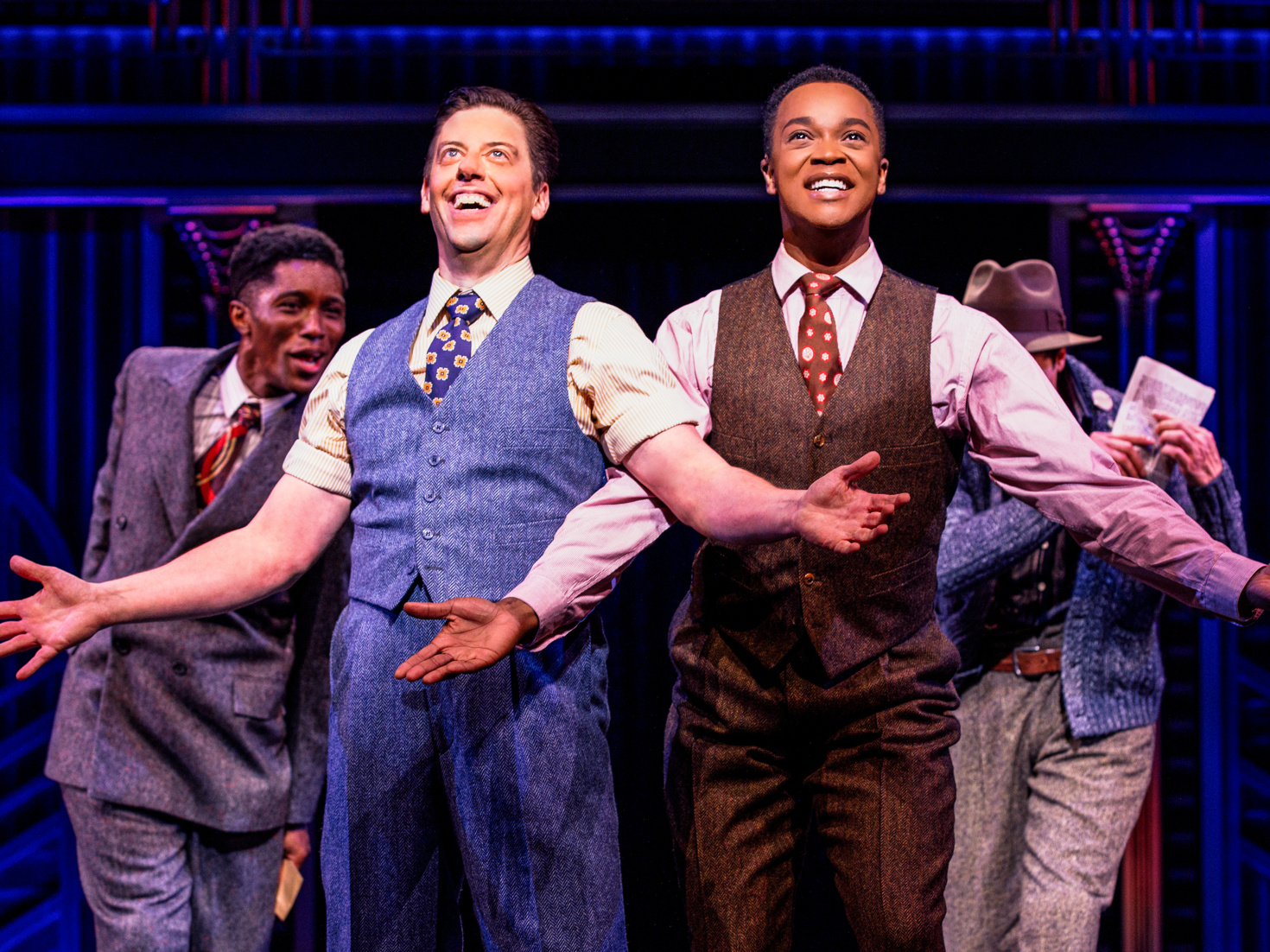
Christian Borle & J. Harrison Ghee in Some Like It Hot. (Photo: Marc J. Franklin)

The best romantic comedy released in the early fifties, William Wyler’s Roman Holiday with Audrey Hepburn and Gregory Peck, was about the impossible romance of a princess and a reporter; it was a cross between a genteel version It Happened One Night and a reverse Cinderella story. But then Hollywood romantic comedy degenerated into sex cartoons with Jayne Mansfield at one end of the spectrum and mechanical farces at the other. One might have feared that the form was dead, until Billy Wilder’s divine Some Like It Hot came to the rescue at the end of the decade. It wasn’t remotely like any previous movie in this genre. (But then, Wilder’s The Lost Weekend hadn’t been like any other social problem picture or Sunset Boulevard like any other film noir.) Wilder and his co-writer I.A.L. Diamond took a page from Shakespeare’s cross-dressing comedies and then doubled it. When two jazz musicians witness the St. Valentine’s Day Massacre they run like hell, straight into drag. They figure their only retreat from the gangsters on their tail is to vanish into dresses and wigs and join an all-girls’ band. Tony Curtis’s Joe, a.k.a. Josephine, falls for the lead singer, Sugar (Marilyn Monroe at her most sublime), and chooses a second disguise – a millionaire named Shell Oil Jr. who entertains her on a borrowed yacht, where Curtis draws her in with a dead-on Cary Grant imitation. Jack Lemmon’s frantic Jerry/Daphne finds himself the object of the yacht’s actual owner, Osgood Fielding III (Joe E. Brown) – a courtship that Wilder and Diamond leave up in the air when the rest of the plot is resolved. The final line – spoken by Brown – when Jerry reveals his true gender to Osgood is one of the two best curtain lines in American romantic comedy. (The other concludes Charade, with Hepburn and Cary Grant, which followed Some Like It Hot four years later.)

Tuesday, March 27, 2012

Fighting Ageing Every Step of the Way: Ben Babchishin's Short Videos on Music and Ageing

Bill Bourne, in a scene from For the Record Featuring… Bill Bourne.

I first came across the filmmaker Ben Babchishin on the Internet. It’s complicated. Master folk muscian Bill Bourne was playing in town at The Pearl Company and I had agreed to go to see him. That day my wife was out of town, so when I got home from work I took her car to run a couple errands. I drove up to the used CD shop in town to pick up something I had ordered, and as I turned left I was t-boned by a teenaged girl who was late for work. “Don’t call the police,” she begged. It was her second accident in a month. As I looked at my wife’s car, the rear passenger door bent neatly in half, I was glad not to be hurt, but wondered how I would ever explain this. The car and I limped home; I spent 2 hours on the phone with insurance companies, and thought … I’m not going out tonight. Then I decided that music might be healing, and took my car to The Pearl Company. My ride there was tentative, every intersection a challenge … but by the end to the night, Bourne and his band had cheered me up. My wife’s car was still a mess when I got home.

I was taken by Bourne, bought his Bluesland CD, and found it enjoyable. I was searching for the name of his guitar player on the Internet when I discovered a DVD called For the Record Featuring … Bill Bourne. I contacted the site, and quickly had a reply from Ben Babchishin, the filmmaker. He offered to send me a copy. He asked me about other music I liked. He told me about another film he’d made for Bravo TV, Mae Moore & Lester Quitzau: In Their Own Backyard. When I told him that I knew about Quitzau and Moore he said he would send that film too. He told me about some of the roadblocks he encountered too. When he suggested to the producers at Bravo he wanted to do a documentary on Valdy, they had replied, “Unhunh … who’s Valdy?”

Friday, April 12, 2024

Cry Me a River: The Sweet Sorrow of Film Noir


“Life is a tragedy when seen in a close-up, but a comedy when seen in the long shot.” – Charlie Chaplin

Melodrama: the essential link between classical tragedy and ‘dark film’. “Suffering, with style” is the succinct and totally apt way that Turner Classic Movies curator Eddie Muller characterizes this unique mode of film noir storytelling: “The men and women of this sinister cinematic world are driven by greed, lust, jealousy and revenge, which leads inexorably to existential torment, soul crushing despair and a few last gasping breaths in a rain soaked gutter. But damned if these lost souls don’t look sensational riding the Hades Express. If you’re going straight to hell, you might as well travel with some style to burn.”

From the moment the term film noir or dark film was first employed by advanced French critics in the post-World War Two global culture, there was also an instant debate about what it encapsulated so vividly. Muller, who is also an author of crime fiction himself, further defines the concept as being about a protagonist who, driven to act out of some desperate desire, does something that he or she knows to be wrong, even understanding what dire consequences will follow. Karma always looms large in noir.

Friday, August 16, 2013

Neglected Gem #45: What Just Happened? (2008)

Robert De Niro and John Turturro in Barry Levinson's What Just Happened?

Barry Levinson’s 2008 What Just Happened? approaches Hollywood venality, greed and ego with a razor edge, an elegant style and a distanced wit – a killer combination. It’s adapted from What Just Happened?: Bitter Hollywood Tales from the Front Line, a juicy, deftly written and economical (150-page) memoir by producer Art Linson, who lays out the process of getting movies made in the film industry and tells amazing and often scathing stories about some of the ones he worked on, like Great Expectations, Fight Club, The Edge and Pushing Tin. (He has an earlier book, A Pound of Flesh: Perilous Tales of How to Produce Movies in Hollywood.) Here’s Linson holding forth on the subject of the pitch:

For those of you who have never been in a pitch meeting, it’s nothing much different from door-to-door sales except the financial stakes are higher. You must convince the guy with the checkbook that he needs whatever soap you are selling. I’m not sure anyone actually needs to buy an idea for a movie. If you buy an idea, you have to pay to have the script written. Writers are expensive. In most instances the scripts are badly done and only a small percentage ever get filmed. Because of the high turnover factor, the executive who winds up buying the script probably won’t even have his job by the time the wretched thing gets made and is ready for release. Either someone else will be the beneficiary of its success, or the poor sucker who was fired will inevitably be blamed for supporting it. Under these rules, I’m always amazed at the optimism that’s displayed so early on for something that might not pay off for years. 

Saturday, June 15, 2013

Back to High School: The Great Gatsby

Leonardo DiCaprio in The Great Gatsby

Baz Luhrmann’s The Great Gatsby bears little resemblance to the slender masterpiece on which it is based – F. Scott Fitzgerald’s now iconic 1925 novel – but that probably won’t come as much of a surprise to anyone who has followed this director’s career. While his critics see him as a sort of Andrew Lloyd Webber of movies whose histrionic period pieces (Moulin Rouge!Romeo + Juliet) put one in mind, to borrow a phrase from Pauline Kael, of “a dog with the broken bones of a cat sticking out,” few of Luhrmann’s fans would likely contest that characterization. To them, Luhrmann’s movies are carnival sensations, romances to excess that celebrate the hysterical pace of the modern age in brazen, trashy style (and anyone who doesn’t like their cats grafted messily onto dogs is just a purist, patrician snob). There’s a faint odor of schoolyard allegiance that clings to the debate around Baz Luhrmann, and it never fails to make me feel like the teenager who chooses to stay home with a book while all her friends go out to a rave.