Showing posts sorted by relevance for query the Shaw Festival. Sort by date Show all posts

Saturday, August 23, 2025

Stratford and the Shaw Festival II: Shaw

Gabriella Sundar Singh as Barbara Undershaft in the Shaw Festival's current production of Major Barbara. (Photo: David Cooper.)

Is Major Barbara Shaw’s masterpiece? The main contenders would be Heartbreak House and Man and Superman, but when I saw Joseph Ziegler’s centennial revival of Major Barbara twenty years ago – with Diana Donnelly as Barbara, the young Salvation Army major, and Benedict Campbell as her estranged father, Andrew Undershaft, co-head of an armaments empire given the complexly ironic name of Lazarus and Undershaft – I was staggered. Ziegler’s gorgeous, immense production – it unfolded in three hours and twenty minutes and was riveting throughout – was a luminous rendering of Shaw’s brilliant, endlessly surprising dramatic argument that you can’t save the soul without feeding the stomach. (That sly thief Brecht rephrased it for the second-act finale of his Threepenny Opera: “First feed the face / And then talk right and wrong.”) In Major Barbara, Undershaft first proves to his daughter that her beloved Sally Ann is as dependent on the generosity of the warmongers and liquor salesmen as any other institution; then he seduces away her fiancé, the Greek scholar Adolphus Cusins, to become the heir to his business; and finally he sells Barbara herself on his factory, a model socialist community whose workers are beaming with health and pride. In Shaw’s witty and perverse social comedy, Lazarus and Undershaft, purveyors of death and destruction, are the heroes. No wonder Cusins calls his father-in-law-to-be Machiavelli and the Prince of Darkness.

Monday, September 15, 2014

The Shaw’s Early Shaw: Arms and the Man & The Philanderer

Kate Besworth and Martin Happer star in the Shaw Festival’s production of Arms and the Man (Photo: Emily Cooper)

In George Bernard Shaw’s early comedy Arms and the Man, Bulgaria is at war with Serbia, and the heroine, Raina, the daughter of one major and the fiancée of another, glories in the excitement of the conflict and the swashbuckling self-presentation of the latter, a handsome warrior named Sergius who marches into the fray like a character out of a Walter Scott novel. But on the last night of battle, a Swiss mercenary fighting for the Serbs, Captain Bluntschli, slips into her boudoir to escape from the Bulgarians, and she doesn’t have the heart to give him away. She even feeds him – chocolate creams, his favorite. (She nicknames him her “chocolate cream soldier”; hence the title of the Oscar Strauss operetta version of the material, The Chocolate Soldier.) Bluntschli’s conduct offends her notions of how soldiers should comport themselves, but he and not Sergius is a professional soldier; he finds Sergius’s heroics ridiculous (not to say dangerous). But while Bluntschli undercuts Raina’s schoolgirl notions, he also wins her heart; Shaw’s play may burlesque the romantic temperament, but it’s a romantic comedy and one of his most lighthearted works. It’s also, not surprisingly, one of his most frequently produced plays.

Monday, August 31, 2015

Ibsen and Barrie Rarities at the Shaw Festival

Moya O'Connell and Ric Reid in The Lady from the Sea, at Niagara-on-the-Lake's Shaw Festival. (Photo: David Cooper)

The Lady from the Sea is an infrequently performed late Ibsen, one of those realist plays of his that teeters on the edge of symbolism, like The Wild Duck. (He wrote it in 1888, between Rosmersholm and Hedda Gabler.) The character who has earned the title moniker among locals in a Norwegian seacoast town is Ellida Wangel. She is married to a devoted doctor but has grown increasingly distant from him and hasn’t quite taken on the burden of stepmother to his two daughters, Bolette and Hilde. He assumes that the problem is her inability to get over the death of their own child (she hasn’t slept with him since), but it’s more complicated. Ellida is haunted by a lost love, an American sailor to whom she was engaged but who ran away to escape imprisonment for the murder of a ship’s captain. The connection she feels to the unnamed American is powerful, primal and also terrifying, because she senses that he is drawing her into the sea itself, where they threw their wedding rings when they plighted their troth. In the course of the play the stranger returns and calls on Ellida to fulfill her promise to him, refusing to recognize her as a woman married to another man.

Monday, July 31, 2017

Didacticism and Virtue at the Shaw Festival

Shawn Wright and Jeff Irving with the cast of Androcles and the Lion at the Shaw Festival. (Photo: David Cooper)

At every performance of the Shaw Festival’s production of Androcles and the Lion, George Bernard Shaw’s 1913 dramatization of the Aesop fable, a member of the audience is picked to play the lion. Other theatregoers who have been handed colored balls before the play begins are invited to throw them onto the stage at will, interrupting the dramatic action and prompting a variety of responses from the actors, who have to tell an anecdote or recite a section of Shaw’s preface to the play or share any thought that pops into their heads. This process is in the service of what Tim Carroll, the Shaw’s new artistic director, calls “two-way theatre,” which is intended to break down the barrier between the actors and the audience. Carroll directed Androcles, but his mission is visible in the productions he didn’t stage, too. In Wilde Tales, the lunchtime show, adapted by Kate Hennig from four Oscar Wilde fairy tales and directed by Christine Brubaker, children from the audience sit along the sides of the Court House stage with signs and other props; their participation is encouraged at certain points in the action. In Alan Bennett’s The Madness of King George, directed by Kevin Bennett (who trained with Carroll during his tenure as associate director at Shakespeare’s Globe in London), the house lights remain on during the performance and the cast interacts with members of the audience – especially those who are sitting right on the stage of the Royal George – just as actors at the Globe play up to those groundlings who have found standing room right below the thrust, within easy reach of the performers. Five of the six plays I saw at the Shaw began with a member of the staff – an assistant stage manager or head dresser or what have you – addressing the audience and providing some tidbits of information about his or her job.

Tuesday, September 3, 2019

Shaw Entertainments: The Ladykillers and Getting Married

Chick Reid and Damien Atkins in The Ladykillers at the Shaw Festival in Niagara-on-the-Lake. (Photo: David Cooper)

Performed by overlapping ensembles, The Ladykillers and Getting Married, comedies of very different stripes, are the most sheerly enjoyable shows I saw at the Shaw Festival this season. The Ladykillers is Graham Linehan’s 2011 stage version of the screenplay William Rose wrote for the beloved Ealing comedy from 1955, starring Alec Guinness – fitted out with hilarious fake incisors that made him look like a cadaverous shark – as the brains of a gang of robbers who work out of his rented room in an innocent silver-haired widow’s house fronting a railroad track. (The Coen Brothers remade it in 2004, with Tom Hanks in the Guinness part.) Getting Married is a George Bernard Shaw comedy of manners that’s little known, at least outside Niagara-on-the-Lake, where the festival has performed it on four previous occasions.

Monday, August 25, 2014

Discovery: The Charity That Began at Home

Fiona Reid, Jim Mezon and Laurie Paton in The Charity That Began at Home (Photo: David Cooper / Shaw Festival)

For theatre aficionados, one of the ongoing pleasures of the Shaw Festival in Niagara-on-the-Lake, Ontario is its commitment to unearthing forgotten plays by Shaw’s contemporaries. This year the festival offered two: J.B. Priestley’s When We Are Married (1937) and The Charity That Began at Home (1906) by St. John Hankin, who was associated (like Shaw) with the Royal Court Theatre and wrote five plays before committing suicide at the age of thirty-nine. (The Shaw has mounted two of the others, The Return of the Prodigal and The Cassilis Engagement.) Though Joseph Ziegler’s production of When We Are Married is skillfully mounted and performed, Priestley’s farcical satire of middle-class English morality – about three couples who learn, at the celebration of their mutual twenty-fifth wedding anniversary, that they were never legally married – is awfully thin stuff. But The Charity That Began at Home turns out to be the revelation of the season.

Monday, August 22, 2022

Crowd Pleasers: Damn Yankees and Gaslight at the Shaw Festival

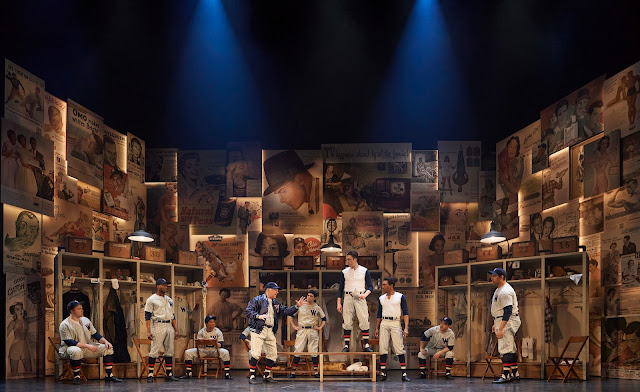
Jay Turvey with the Ballplayers in Damn Yankees, at the Shaw Festival. (Photo: Michael Cooper)

Richard Adler and Jerry Ross might have entered the pantheon of Broadway songwriters if fate hadn’t extinguished their star so fast. Adler was thirty-one and Ross twenty-eight when George Abbott commissioned them to write the score for The Pajama Game (1954), adapted by Abbott and Richard Bissell from Bissell’s novel 7-1/2 Cents, about the tensions between labor and management in a Midwestern pajama factory. It was a legendary show: Abbott and Jerome Robbins co-directed, a young Bob Fosse staged the dances, and it ran for three years. (A boisterous movie version in 1957, helmed by Abbott and Stanley Donen, captures the spirit of the original, with all but two members of the Broadway cast reprising their performances.) In 1955 lightning struck again for Adler and Ross with Damn Yankees. Adapted by Abbott and Douglass Wallop from Wallop’s book The Year the Yankees Lost the Pennant, Damn Yankees was as big a hit as The Pajama Game. But six months after its triumphant premiere, Ross died suddenly of lung disease. Adler never had another success, alone or with a collaborator, though his lovely score for the South Africa-set musical Kwamina, which he wrote for his wife, Sally Ann Howes, is ripe for rediscovery. (Its interracial love story was undoubtedly too controversial for 1961.)

Monday, September 14, 2015

Shaw’s Shaw: Pygmalion and You Never Can Tell

Jeff Meadows (left),  Harveen Sandu, and Patrick McManus in Pygmalion at the Shaw Festival. (Photo: Emily Cooper)

Peter Hinton’s production of Shaw’s Pygmalion at the Shaw Festival is set in contemporary London, and for nearly two acts (the play is in five brisk acts) the conceit is great fun. Henry Higgins (played energetically and with considerable wit by Patrick McManus) hovers around Covent Garden in jeans and a t-shirt with a tape recorder or leans on his bike. Clara Eynsford Hill (Kristi Frank), disaffected and entitled, texts blankly while she and her mother (Julain Molnar) wait for their hapless, puppy-eyed brother Freddy (Wade Bogert-O’Brien) to find them a cab in a rainstorm; around them is a collection of raucous street folk including a busker with a guitar, a hooker in cut-offs and a young, wheelchair-bound homeless man. Higgins’ study (act two) is full of TV monitors; Eliza (Harveen Sandhu) catches her reflection in one of them and shrieks in surprise. The study is set up to allow Higgins – and Colonel Pickering (Jeff Meadows), the fellow linguist who moves in with him – opportunities for both research and leisure: a dart board upstage right offers a touch of local-pub atmosphere. When Eliza’s father Alfred Doolittle (Peter Krantz) appears in the middle of the second act, he wears a neon orange sanitation uniform and an earring, and he has to struggle to pull himself up out of Higgins’ beanbag chair.

Monday, September 7, 2015

Heigh-Ho, the Glamourous Life: Light Up the Sky at the Shaw

Charlie Gallant, Claire Jullien and Thom Marriott in Light Up the Sky at the Shaw Festival. (Photo: David Cooper)

Light Up the Sky is one of Moss Hart’s solo comic efforts; he wrote it in 1948, long after his collaboration with George S. Kaufman had petered out. It’s about the Boston tryout of a debut play by a young greenhorn named Peter Sloan, the only person involved in the project who isn’t a seasoned veteran. The narcissistic star, Irene Livingston, the lachrymose director, Carleton Fitzgerald, and the cutthroat producer, Sidney Black, have all worked together before, but they’ve been at their best for some reason during rehearsals for Sloan’s show, a post-apocalyptic allegory that opens in the ruins of Radio City Music Hall. Consequently Peter has been deluded into thinking that they’re pure-hearted professionals who think with their hearts and sacrifice themselves for their art. However, when the opening-night audience laughs at the seriousness of their combined efforts, they revert to form, and Sloan, the most vulnerable of them, becomes their pet punching bag.

Tuesday, May 30, 2017

Delightful Diversion: Shaw Festival's Me and My Girl

Michael Therriault and Elodie Gillett in the Shaw Festival production of Me and My Girl.  (Photo: David Cooper) 

Me and My Girl, the 1930s musical with a revised book by British writer and comedian Stephen Fry, knocked them dead, as they used to say in the theatre, when it opened Saturday night at the Shaw Festival. The audience jumped to its feet for a roaring standing ovation which rightly praised Ashlie Corcoran's rollicking direction along with the crackerjack cast featuring Michael Therriault and Kristi Frank in lead roles.

The show, which continues at the Festival Theatre until Oct. 14, has launched new artistic director Tim Carroll's first season at the helm of Shaw, the Niagara-the-Lake theatre festival committed to staging the dramatic works of Irish playwright George Bernard Shaw along with the other works from the Shavian era, with a bang. There's no shortage of enthusiasm here.

Monday, August 19, 2019

Rarities at Stratford and the Shaw Festival: Nathan the Wise, Sex, and Rope

Diane Flacks (centre) with members of the company in Nathan the Wise. (Photo: David Hou)

Nathan the Wise by the German Enlightenment playwright Gotthold Ephraim Lessing (it was written in 1779) is so seldom performed that I’d never heard of it until Canada’s Stratford Festival elected to produce it this summer. It’s a fable, set in ancient Jerusalem, with more narrative complications than a Shakespearean romance. The title character (played by Diane Flacks) is a wealthy Jew who has used his fortune to maintain friendly relations with the powerful Muslim and Catholic forces in the city, represented respectively by the young Sultan, Saladin (Danny Ghantous), and the old Patriarch (Harry Nelken). When Nathan returns from a business trip, Daya (Sarah Orenstein), the Christian woman who manages his household and takes care of his daughter Rachel (Oksana Sirju), tells him that Rachel was rescued from a fire by an itinerant Knight Templar (Jakob Ehman) with whom she has fallen in love. The Knight Templar, a soldier in the service of the Catholic Church, has also won the affection of the Sultan, who slaughtered his fellows – prisoners captured in the holy war between the Christians and the Muslims – but spared his life because he looks so much like Saladin’s long-lost brother. The story is a series of revelations of the true identities of the characters, not just the Knight Templar but also Rachel, and of Nathan’s own past. And of course, it’s a plea for tolerance in which two of the three voices of racial hatred – Saladin and the Knight Templar – prove to be capable of crossing the boundaries that separate Christians, Muslims and Jews. The Patriarch, who at one point advocates burning Nathan at the stake, is the third, and he doesn’t alter his point of view.

Monday, August 20, 2012

Ragtime at the Shaw Festival: History Lessons for the Already Enlightened

In his novel Ragtime, E.L. Doctorow uses the ragtime era – roughly the period between the turn of the twentieth century and the beginning of the First World War – to investigate the confluence of contradictory impulses as America begins to hog the world spotlight. Henry Ford and J.P. Morgan embody the American dream in its quintessential (Horatio Alger) form, but their domination implies the oppression of wage slaves and the muting of voices that aren’t white and Christian. In Doctorow’s narrative scheme, the white-bread, well-off New Rochelle family, which has no reason to expect to meet anyone who isn’t exactly like them, crosses paths with African Americans (Mother finds a black baby buried but still breathing in her garden and takes in both mother and child), Jewish immigrants (in Atlantic City, Mother makes the acquaintance of Tateh, the Latvian Jewish immigrant who brings his little girl to America and winds up becoming a filmmaker) and the forces of radicalism (Younger Brother, Mother’s sibling, hears Emma Goldman orate in Union Square and later volunteers himself as a bomb maker for the mightily abused black man Coalhouse Walker, a one-time ragtime pianist and the baby’s father).

Ragtime is a relatively compact book with an epic feel. Doctorow is fascinated by all of the strands of this chapter in American history; his modernist contribution is a rich sense of irony.  He juxtaposes opposites: Ford and Morgan with Goldman and Booker T. Washington (Coalhouse's hero); the industrial dream that Ford represents with Tateh's immigrant dream to pull his daughter out of poverty; Ford's automobile with Tateh's moving pictures -- both produced by a mixture of art and technology. He also juxtaposes Coalhouse's rags with the vaudeville show in which Evelyn Nesbit, a celebrity but not an artist, draws curious crowds. Nesbit's husband, Harry Thaw, has killed her lover, the architect Stanford White; this so-called "crime of the century" makes her a star -- at least, for a few moments. In the first phase of his coming of age, Younger Brother falls in love with her. When she rejects him, he turns to other obsessions. Goldman's oratory and Walker's ordeal politicize him, turning him from a callow would-be lover into a warrior for the cause of the downtrodden and disenfranchised. And Harry Houdini’s escape trick becomes a metaphor for the escape trick every successful immigrant masters – yet, like Houdini, never masters completely.

Monday, September 5, 2011

Comedies of Manners: The Admirable Crichton & Heartbreak House at the Shaw Festival

Steven Sutcliffe and  Nicole Underbay

James Barrie’s comedy of manners The Admirable Crichton has spawned so many movies that it’s in the collective imagination even if people no longer recognize its title. Gloria Swanson starred in a Cecil B. DeMille silent version called Male and Female in 1919; there was a breezy, vaudeville-style musical adaptation called We’re Not Dressing in 1934 with Bing Crosby, Carole Lombard, Ethel Merman and Burns & Allen; and a faithful English film, released in North America as Paradise Lagoon, came out in 1957. Lina Wertmüller’s Marxist variation, Swept Away by an Unusual Destiny in the Blue Sea of August, received undeserved acclaim in 1975. Yet, serviceable as it is, the play itself is rarely revived. The Shaw Festival is mounting it this season, for the first time in thirty-five years.

The premise is ingenious. An English lord with liberal ideas – he has a habit, wearying to his family and embarrassing to his domestic staff, of inviting the servants to tea – winds up shipwrecked on a desert island with his daughters, an indolent young member of the leisure class who is paying court to one of them, and a pair of servants, including his indispensable valet Crichton. Because only Crichton possesses the practical skills to keep them alive and thriving, he becomes the ruler of the island community and his employer, the Earl of Loam, is demoted to the position of servant – until they’re rescued and returned to England. Loam learns through experience what Crichton has been protesting all along: that class boundaries can’t be traversed, even though the make-up of the upper class may shift according to Darwinian dictates. (Except for Paradise Lagoon, the film versions don’t stick to Barrie’s high-comedy ending. We’re Not Dressing adopts romantic-comedy mode – Lombard is the snobby heiress who has to be brought down to earth by Crosby’s unpretentious sailor – and Swept Away, which is rather nasty, takes great pleasure in putting down the rich bitch, Mariangela Melato, by showing that she can’t resist the sad-eyed macho prole played by Giancarlo Giannini. Male and Female veers away from comedy of manners early on straight into melodrama.)

Monday, August 8, 2011

Higgins and Eliza: Pygmalion & My Fair Lady

The West End revival (at the Garrick Theatre) of Shaw’s Pygmalion appears to be a vanity project for a miscast Rupert Everett. Everett is famous for velvet-gloved high-style comedy; his way of tossing off a line can turn the romantic comedy My Best Friend’s Wedding (1997) or the Michael Hoffman film of A Midsummer Night’s Dream (1999) into high comedy. Shaw, of course, wrote high comedies, and it’s easy to imagine Everett in some of them. (A decade ago he would have made a superb Jack Tanner in Man and Superman, perhaps opposite Helena Bonham Carter as Ann.) But the role of the misanthropic phonetician and voice teacher Henry Higgins doesn’t suit him. He doesn’t know what to do with Higgins’s unmannerly explosions – his big scenes flatline. And the role provides no outlet for his understated sexiness; it wastes him and it’s wasted on him.

His Eliza Doolittle, Kara Tointon, isn’t right either. Eliza is generally played by an actress of natural elegance – Wendy Hiller in the 1938 movie (playing opposite Leslie Howard), Audrey Hepburn in the screen version of My Fair Lady – who slums merrily for the first three acts and then comes into her own after the Embassy Ball. At this point Higgins has succeeded so brilliantly into turning the Cockney flower girl into a princess that at the end she’s truly in limbo, having been irrevocably educated past her origins. Tointon doesn’t have the aristocratic grace to be convincing as a transformed Eliza in the second half, but she’s too actressy to be plausible as the Covent Garden guttersnipe. She’s competent but you can feel her straining for her effects. She’s at her best in the third act (just before intermission) when Higgins brings her along to his mother’s for tea to try her out on the guests who wander into her salon, including the callow Freddy Eynsford-Hill (played by another triple-decker name, Peter Sandys-Clarke), who falls for her. (Diana Rigg strolls through the part of Mrs. Higgins like a gracious guest star on a wobbly TV variety hour.) The joke in this scene is that at this juncture in her education, Eliza has learned both the dialect and the manners of an upper-crust young woman phonetically, so the Eliza we saw in the first and second acts keeps rattling around inside the varnished shell like broken pieces of pottery. Tointon’s handling of the scene is a comic routine but a clever and entertaining one.

Monday, August 17, 2015

The Divine: Too Much Going On

Fiona Reid in The Divine: A Play for Sarah Bernhardt, the Shaw Festival in Niagara-on-the-Lake. (Photo: David Cooper)

In 1905, the legendary French actress Sarah Bernhardt brought a troupe of actors to Québec City to perform three plays in repertory. She was already in her early sixties, but according to the nineteenth-century traditions that still adhered into the early twentieth, great stars were thought of as ageless and inhabited their vehicles for decades. So the idea of “The Divine Sarah,” as she was popularly called, continuing to play ingénue roles like Marguerite in Camille by Dumas or the title role in Scribe and Legouvé’s Adrienne Lecouvreur wouldn’t have seemed bizarre to audiences or critics – though realists like Strindberg and Chekhov were breaking ground by challenging this and other implausibilities in a theatre that still clung to the vision of the Romantic age. (Arkadina, the actress in The Sea Gull, is a second-tier diva of the Bernhardt school, and Chekhov has some fun at her expense.) Bernhardt’s visit incited a furor when the archbishop, representing a still feudal and repressive Catholic church, objected strenuously to her appearing on a Québec stage. He would have had many reasons for trying to shut her down: she played male as well as female characters, she didn’t shy away from lurid and controversial subject matter, her offstage lifestyle was unconventional and scandalous, and – not least among the qualities that would have made her an unsavory figure in the eyes of the church – she had been born Jewish, though she’d converted to Catholicism.

This historical incident was the starting point for The Divine: A Play for Sarah Bernhardt, a new work by the Québecois playwright Michel Marc Bouchard that the Shaw Festival in Niagara-on-the-Lake is premiering this season (in a translation by Linda Gaboriau). Bouchard has added several narrative layers. The protagonist isn’t Bernhardt (played by Fiona Reid) but a young seminarian named Michaud (Ben Sanders), the son of a cabinet minister and a devotee of the actress, who is sent to deliver the archbishop’s letter denouncing her but winds up writing a play for her. The hero of his drama – the role she is eager to play – is actually based on his dormitory mate Talbot (Wade Bogert-O’Brien). Talbot is a working-class boy whose mother (Mary Haney) has, through considerable personal sacrifice, placed in the seminary (where his classmates are all aristocrats like Michaud) because the priesthood is the only route of escape from poverty for a boy from his background. Mrs. Talbot and her twelve-year-old son Leo (Kyle Orzech) slave in a shoe factory in wretched conditions; children like Leo, whose employment is officially illegal, are especially vulnerable. (Two little girls recently died horrible deaths here when their hair caught in the machine.) And there’s even more plot: Talbot’s entry into the seminary follows his severe beating of a priest who was initially his intellectual mentor and then began abusing him when Talbot was twelve. Brother Casgrain (Martin Happer), the director of the seminary, offers Talbot a scholarship as well as an education for Leo if he agrees not to make an official complaint about the abuse. Casgrain is also Michaud’s protector: the rules here are strict, but Michaud keeps flouting them, and Casgrain lets him get away with it. (Casgrain sees his younger self in Michaud, though his affection clearly has an un-acted-upon erotic component.) The play also covers Talbot’s coming of age, which includes his sowing his wild oats with an actress in Bernhardt’s company (Darcy Gerhart), with whom he visits an opium den and a gambling house before making love to her.

Monday, July 10, 2017

Musicals Round-up Part I: Niagara-on-the-Lake and London

Kristi Frank and Michael Therriault in the Shaw Festival production of Me and My Girl. (Photo: David Cooper)

This article contains reviews of Me and My Girl (Shaw Festival), Dreamgirls (West End), and On the Town (Regent’s Park).

Michael Therriault is so thoroughly winning and energetic in Me and My Girl at the Shaw Festival that you feel he could carry the production on his back if he had to. The musical is built as a vehicle for the performer who plays Bill Snibson, the Lambeth Cockney who discovers he has inherited an earl’s title and is expected to relocate to Mayfair, and the diminutive Therriault, with his pop-eyed charm and apparently elastic body, claims squatter’s rights to every scene he’s in. Therriault is a well-known Canadian musical-theatre actor (he played Gollum in the musical of Lord of the Rings both in Toronto and in the West End), but the only time I’d seen him before this summer was in Studio 180’s production (in Toronto) of Parade, as the Jewish factory owner Leo Frank, framed for the rape and murder of one of his employees in pre-World War One Atlanta. He was superb, but the role was so downbeat that I didn’t immediately make the connection to the song-and-dance man who plays the lovable, insouciant Bill. Therriault’s peculiar gift is for balancing charisma with modesty – like Dick Van Dyke, though his musical-comedy gifts are more extensive than Van Dyke’s and he’s more believable as a Cockney than Van Dyke was in Mary Poppins.

Monday, August 27, 2012

French Without Tears: The Popular Music of Another Time

The cast of French Without Tears at the Shaw Festival (Photo: David Cooper)

French Without Tears at the Shaw Festival in Niagara-on-the-Lake comes half a year too late for the Terence Rattigan centennial, but productions of this skillfully assembled entertainment are too rare for caviling – especially considering what a fine job director Kate Lynch and her (mostly) young cast have done with this one. It was the play that made Rattigan famous: the 1935 West End production ran for years and the play was filmed in 1940. To my knowledge he never wrote anything else like it. It’s a distinctly thirties mix of drawing-room comedy, junior division, and romantic comedy; the closest American equivalent would probably be something like Having Wonderful Time, the Arthur Kober play set at a Catskills adult summer camp that was filmed, quite enjoyably, in 1938 with Douglas Fairbanks Jr. and Ginger Rogers. French Without Tears is about a group of privileged young Englishmen living together in a villa in France over the summer and studying French in preparation for the Diplomatic Corps or international business. Except for the most juvenile among them, Kenneth (known as Babe and played by Billy Lake), whose haplessness at acquiring the language preoccupies him – the opening image, which gets repeated, is of him slamming his head against the dining-room table – the boys’ focus isn’t, of course, their studies, but women. One of them, Brian (Craig Pike), has been paying his attentions to a local (offstage) flirt named Chi-Chi. The others orbit around Babe’s sister Diana (Robin Evan Willis), who is officially dating Kit (Wade Bogert-O’Brien) but enjoys unsettling Alan (Ben Sanders), the most intellectually gifted of the crew, and the handsome newcomer Bill Rogers (Martin Happer), a naval lieutenant-commander a little older than the others. (The title of the play derives from a now démodé promise once offered by language instruction programs.)

Monday, September 9, 2019

Song and Dance, Part III: Brigadoon

Matt Nethersole (centre) and the cast of Brigadoon at the Shaw Festival. (Photo: David Cooper)

If you love classic American musicals, then you may feel, as I do, a creeping dread when you attend a revival of one and find a credit in the program for “revised book.” I wasn’t aware that Alan Jay Lerner and Frederick Loewe’s lovely 1947 musical fantasy Brigadoon required revising, but the Shaw Festival’s production uses a 2014 rewrite, first seen at the Goodman Theatre in Chicago, by a playwright named Brian Hill. Hill has apparently sought to make the show more relevant to today’s audiences by turning the protagonist, the American Tommy Albright (George Krissa), into a World War II veteran and altering the motivation for the spell cast on the town of Brigadoon, which Tommy and his friend Jeff Douglas (Mike Nadajewski) come upon when they get lost in the Scottish Highlands during a hunting vacation. As Lerner wrote it, Brigadoon’s late minister asked God to put the town to sleep every night for a hundred years in order to keep it from falling under worldly influences. In Hill’s version, it’s war – and specifically (though it’s unnamed) the tragic Battle of Culloden – that devastated the Highlands and from which the minister wanted to protect his beloved Brigadoon. The director of the Shaw production, Glynis Leyshon, underscores this idea by beginning the show, clumsily, with Second World War newsreel footage. Who first came up with the harebrained notion that if an old dramatic property can’t be linked to contemporary concerns it’s not worth taking down off the shelf? City Center staged Brigadoon two years ago using the original book and the audience gave it a (well-deserved) standing ovation.

Tuesday, August 15, 2023

The Playboy of the Western World and The Apple Cart: Flying High at the Shaw

Marla McLean and Qasim Khan in The Playboy of the Western World. (Photo: Emily Cooper)

In the preface to his 1907 masterpiece The Playboy of the Western World, the Irish playwright John Millington Synge writes, “On the stage one must have reality and one must have joy . . . In a good play every speech should be as fully flavoured as a nut or apple . . .” This dictum explains the play’s unusual style and texture, realism folded in with folk-fable imagination and humor and language so musical that it sings in your ears even when you’re just reading the text. Synge claims that he owes both the wildness of the narrative and the richness of the vernacular to his close attention to the way rural working-class Irish people speak (or did around the turn of the twentieth century).

Sunday, July 31, 2016

New Productions: Chekhov, Shakespeare, Wilde

Moya O’Connell and Neil Barclay in Uncle Vanya at the Shaw Festival. (Photo: Emily Cooper)

Uncle Vanya, staged by Jackie Maxwell (in her final season as artistic director), is the crown jewel among the offerings at the Shaw Festival this summer. (At least, among the shows I was able to see; unfortunately, I arrived too early to catch either Sweeney Todd or Strindberg’s The Dance of Death.) The production draws you in from the opening moment, where the old nanny, Marina (Sharry Flett, infusing the character’s grandmotherly warmth with ironic humor), calls Dr. Astrov (Patrick McManus) on his drinking, and you don’t break free of its spell until long after you’ve wandered out of the Court House, the ideal Shaw venue for Chekhov’s delicate, impressionistic “scenes of country life” because of its intimacy. (It’s where the company also performed a memorable Cherry Orchard in 2010.)