Showing posts sorted by relevance for query Arthur Laurents. Sort by date Show all posts

Thursday, December 23, 2021

West Side Story: Rumble in the Rubble

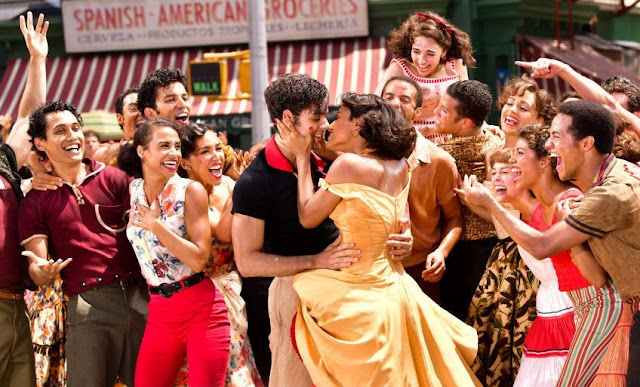
David Alvarez Ariana DeBose in West Side Story (2021).

The enthusiasm over Steven Spielberg’s remake of West Side Story, the street-gang retelling of Romeo and Juliet that opened on Broadway in 1957 and was first filmed by Robert Wise in 1961, reminds me of the outpouring of praise that greets Rodgers and Hammerstein’s 1945 Carousel every time it generates another Broadway revival. Just imagine, runs the usual buzz, someone wrote this serious, important musical back in the dark ages when musicals were frivolous! How modern, how prescient! How daring to kill off the protagonist, to incorporate domestic abuse, to put disaffected youth on the stage! How fresh it still seems, how up-to-the-minute! Well, I see no reason to condescend to lighthearted musicals, especially when they come equipped with scores by Kern, the Gershwins, Porter, Berlin and Rodgers and Hart. But the truth is that the American musical took its first resounding step past frivolity when Kern and Oscar Hammerstein II wrote Show Boat, with its tragic racial subplot, exactly three decades before West Side Story. And that’s a good musical. 

Sunday, October 19, 2025

Killers: Rope and Punch

Ephraim Birney and Daniel Neale in Rope. (Photo: Hartford Stage.)

The English playwright Patrick Hamilton – best known for Angel Street, the thriller that became the classic 1945 film Gaslight – wrote Rope in 1929, five years after the celebrated Chicago murder case that inspired it. Two well-heeled University of Chicago students, Nathan Leopold and Richard Loeb, who were lovers, kidnapped and murdered Loeb’s fourteen-year-old cousin Bobby Franks to prove that they could commit the perfect crime – and that, as superior intellectual specimens, they had the right to operate outside the realm of accepted morality. (The irony was how badly these self-proclaimed Nietzschean Übermenschen bungled it.) The case, which their lawyer, Clarence Darrow, used as his most famous argument against capital punishment – he succeeded in getting his clients life sentences rather than the gallows they seemed fated for – has never entirely disappeared from popular culture: it has generated plays, films, a musical and one famous novelization, Meyer Levin’s Compulsion. In a 2018 review in this publication of the book The Leopold and Loeb Files: An Intimate Look at One of America’s Most Infamous Crimes, Devin McKinney conveys with poetic eloquence the enduring power of this murder, which has moved so many interpreters to theorize on the motivation of the killers but has remained an unsolvable mystery.

Wednesday, July 12, 2023

Shy: The Life of Mary Rodgers

Carol Burnett and Joe Bova in the original Broadway production of Once Upon a Mattress (1959).

Mary Rodgers, the daughter of the legendary Broadway (and occasionally Hollywood) composer Richard Rodgers, wrote the music for the 1959 musical Once Upon a Mattress. Aside from The Mad Show, a downtown revue she contributed to that ran for a year, Mattress was her only hit show, but she worked on many other stage musicals that flopped (often out of town) as well as a handful of TV musicals. She also wrote the Freaky Friday children’s books, assisted Leonard Bernstein on the Young People’s Concerts on TV, chaired or served on the boards of many schools and other organizations, and raised five kids; a sixth died tragically in childhood. (One of them, Adam Guettel, is the composer-lyricist of The Light in the Piazza, which I join my Critics at Large colleague Joe Mader in calling the best musical written in the twenty-first century.) This life, which Oscar Wilde’s Lady Bracknell would have pronounced “crowded with incident,” is memorialized in Shy: The Alarmingly Outspoken Memoirs of Mary Rodgers  (Farrar, Straus and Giroux, 2022), which Rodgers co-wrote with the current New York Times theatre critic Jesse Green and on which he provided the finishing touches after she died, at the age of eighty-three, in 2014. (Green was then reviewing plays for New York Magazine.)

Monday, June 1, 2015

Backstage Musicals in London: Gypsy and Sunny Afternoon

Imelda Staunton in Gypsy. (Photo: Johan Persson)

It’s easy to argue for Gypsy, first produced on Broadway in 1959 and currently enjoying a sold-out revival in London’s West End, as the greatest of all American musicals. (Closest contender: Fiddler on the Roof.) Arthur Laurents’s book, suggested by the memoirs of the stripper queen Gypsy Rose Lee, is in the vein of John O’Hara’s for Pal Joey. Like that 1940 landmark musical, Gypsy has a seedy backstage milieu – second-rate vaudeville houses across the country at the twilight of vaudeville, when talkies were stealing away their audiences, and finally burlesque theatres – and an anti-heroic protagonist. But though Pal Joey’s script is colorful and sexy, the second act is a bit of a shambles (the distinctive characters and the marvelous Rodgers & Hart score bring it home), and the show lacks depth. An exposé of naked show-biz ambition, Gypsy, which has a superb score by Jule Styne (music) and a young Stephen Sondheim (lyrics), is almost O’Neill-like in its intensity and darkness.

Monday, May 16, 2016

Do I Hear a Waltz?: An Encores! Misstep

Melissa Errico and Richard Troxell in Do I Hear a Waltz? (Photo: Sara Krulwich)

Stephen Sondheim’s only collaboration with Richard Rodgers was the 1965 musical Do I Hear a Waltz?, adapted by Arthur Laurents from his 1952 Broadway success The Time of the Cuckoo. Shirley Booth had starred in the play, as a lonely Midwesterner who comes to Venice on vacation in the hopes of enjoying a romantic fling, and Katharine Hepburn took over the role in David Lean’s 1955 film version, Summertime. Though Sondheim’s early musicals were partnerships with other composers – West Side Story with Leonard Bernstein and Gypsy with Jule Styne – he had established himself as a composer-lyricist with A Funny Thing Happened on the Way to the Forum and Anyone Can Whistle at the beginning of the sixties. But Rodgers was, of course, the fabled writing partner of Sondheim’s adolescent mentor Oscar Hammerstein II, and Laurents was the man who wrote the book for Gypsy, so he agreed to the collaboration. But these two men of strikingly different sensibilities didn’t get along, and though the musical had a modest run it didn’t make much of an impression. (Neither did the leading lady, Elizabeth Allen.) And Sondheim has never thought much of it; in interviews and in his book Finishing the Hat he’s referred to it, quoting his friend, Rodgers’ daughter Mary a “why?” musical – as in “Why bother turning this material into a musical?”

Last weekend’s revival by Encores! marks the first time Do I Hear a Waltz? has been produced in New York since the original production. I saw the show as a teenager and know the cast album well, and I’ve always thought that the material was interesting and the score had considerable charm. Except for a couple of songs in No Strings, it’s the only late Rodgers score worth listening to; the ballads are especially lovely. Leona, the protagonist, thinks of herself as independent and resilient, but she’s febrile, with an all-or-nothing romantic fervor and fragile sensibilities; “Why is it I get so easily hurt?” she asks herself in one lyric, and the answer seems to be that she alternates between asking too much and not having the flexibility or the courage to accept what she’s offered if it’s not perfect. “Throw the dream away,” the Venetian shopkeeper Renato Di Rossi, who courts her, pleads in another song; he’s married, but in a union that has long since passed from passion into a state of mutual respect, and he doesn’t have money. The musical pits Leona’s Yankee puritanism with a more relaxed European attitude toward sex, embodied not only in Renato but also in Signora Fioria, the middle-aged proprietor of the pensione where Leona stays with two American couples. Signora Fioria seduces the younger of the two men, a painter named Eddie Yeager, whose marriage to the naïve, trusting Jennifer has begun to fray at the edges. When Leona spots Eddie going off in a gondola with the hotelkeeper, her moral shock is piled on top of her difficulties in taking Renato as he is, for good and for ill. The second act is overloaded: Laurents introduces one too many plot strands and the climactic scene teeters on the edge of melodrama, or perhaps goes over that edge, depending on your point of view and, I would think, the quality of the production.
Wednesday, December 1, 2021

Remembering Sondheim

;
Stephen Sondheim, New York, July 10, 1961. (Photo: Richard Avedon)

Stephen Sondheim was ninety-one when he died on the day after Thanksgiving, yet it was a shock. Unreasonably, I thought he would live forever. For nearly three decades he’d been the sole surviving legendary songwriter from the golden age of musical theatre (Alan Jay Lerner and Frederick Loewe left us in 1986 and 1988 respectively; Irving Berlin in 1989; Jule Styne in 1994) – for he was still in his twenties when he collaborated with Leonard Bernstein on West Side Story and with Styne on Gypsy. He was all of thirty-five when he worked with Richard Rodgers on Do I Hear a Waltz? (Arthur Laurents, who departed ten years ago, wrote the books for all three shows.) Sondheim hadn’t written a new musical since Road Show in 2003, though he was toiling for years on an adaptation of Luis Buñuel’s two final movies. But there were countless major revivals of his work – Company, with a female Bobby, is on Broadway at present – and he generally showed up for them. Revue after revue was constructed around his songs, and every milestone birthday prompted a star-studded event, all of them except his Covid-shrouded ninetieth televised on PBS. Movies were still being made of his musicals; still more are promised, even though none of them has been any good. (I haven’t seen Steven Spielberg’s remake of West Side Story, which is about to be released.) Sondheim was continually, tirelessly present, so who could ever imagine him gone?

Monday, July 31, 2023

Summer Musicals: Summer Stock and Gypsy

Corbin Bleu and the dancers in Summer Stock. (Photo: Diane Sobolewski)

Summer Stock, released in 1950, followed a particularly unhappy time in Judy Garland’s life and career – after the deterioration of her marriage to the director Vincente Minnelli, after she made her first suicide attempt and was committed to a rehab center, and after M-G-M replaced her on Annie Get Your Gun with Betty Hutton. Yet it feels like a breather for her: though her weight fluctuated during the filming (in her last big number, “Get Happy,” she’s strikingly trim), her performance is ebullient and unstrained. It was her third and final pairing with Gene Kelly – the others were For Me and My Gal in 1942 (his film debut, after he’d conquered Broadway in Rodgers and Hart’s Pal Joey) and The Pirate, for Minnelli, in 1948 – and his warmth and virility, his earthiness and easy jocularity, always brought out an appealing vaudevillian quality in her. None of her other co-stars was so ideal a vocal match for her, and though it’s great to see her with Fred Astaire in Easter Parade (1948), especially in the “Couple of Swells” number, when she and Kelly dance together they seem to belong to the same club. Summer Stock (which Charles Walters directed) is lightweight, and there’s nothing much in the George Wells-Sy Gomberg script that hadn’t been done in previous backstage movie musicals like the ones Garland and Mickey Rooney co-starred in, or Irving Berlin’s Holiday Inn. Garland plays Jane Falbury, who’s struggling to keep her farm from going under, and Kelly is Joe Ross, who persuades her to let him produce a show in her barn. But it never pushes the sweetness or the rural Americana, it has a fine supporting cast (except for Gloria De Haven as Jane’s self-centered sister: her acting is really awful), and Garland and Kelly’s scenes together are endearing.

Monday, August 24, 2015

Sweet Charity: Manhattan Waif

Julie Martell (centre) with the cast of Sweet Charity, at Niagara-on-the-Lake's Shaw Festival. (Photo by David Cooper)

The 1966 musical Sweet Charity is built around a debased modern version of a fairy-tale heroine, an eternally optimistic New York taxi dancer who falls for men who invariably let her down. The book, which Neil Simon based on the great Fellini movie Nights of Cabiria, employs the Manhattan setting to localize Charity’s story, just as Fellini made use of Rome; one episode, where Charity, in the right place at the right time, finds herself on an improbable date with a dishy Italian superstar who’s just quarreled with his paramour, is straight out of the film. But Simon and the songwriters, Cy Coleman and Dorothy Fields, and the director-choreographer, Bob Fosse – who conceived the project as a vehicle for his frequent muse and one-time wife Gwen Verdon, a magnificent show dancer with an endearing cracked voice full of burgundy bubbles – softened the narrative. Cabiria (played, unforgettably, by Fellini’s wife, Giulietta Masina), is a hooker who pictures herself living out the last act of a romance; the first man who treats her like a lady, Oscar (François Périer), turns out to be a thief who swindles her out of her life savings. (One of Fellini’s coups is the way he uses a pair of props, a cigarette and a pair of shades, to suggest a sinister side to Oscar moments before Cabiria intuits his true intentions.) In the musical, Oscar is a timid, earnest fellow Charity connects with when they’re trapped in an elevator together; their courtship takes them all over the city, including a hippie church and Coney Island).

Tuesday, May 16, 2023

Gypsy at the Goodspeed: The Vaudeville Spirit

Talia Suskauer and Laura Sky Herman in Gypsy. (Photo: Diane Sobolewski)

You know that Jenn Thompson, the director of the Goodspeed Opera House’s production of Gypsy, has a steady hand on the wheel right from the opening scene. It’s an audition for child acts in a dilapidated Seattle theatre in the grim last years of vaudeville, when the talkies dealt it a long, painful death that coincided with the Depression. The stage is crowded with kids in a variety of garish get-ups and their mothers until Uncle Jocko (Edward Juvier), the ulcerated, borderline creepy, far-from-unbiased comic hosting the variety show, banishes the latter. Then Rose (Judy McLane), who is promoting her little girl, Baby June (Emily Jewel Hoder), bulls her way down the aisle; the rules don’t apply to her. June has a head full of blonde curls and an affected squeal; she’s a nightmarish proto-Shirley Temple, flanked by her awkward older sister Louise (Cameron Blake Miller). Thompson’s staging picks up the show-biz chaos, its comedy and preposterousness and desperation, which finds its most feverish embodiment in Rose, the quintessential stage mother – perhaps the greatest and most original creation in the history of musical theatre.

Monday, January 14, 2013

Keeping It Real and Going for Broke: Notes on Recent Performances, Part II (The Women)

Viola Davis and Maggie Gyllenhaal in Won’t Back Down

Jessica Chastain’s Oscar nomination for Zero Dark Thirty was predictable, given her rather baffling promotion over the last few years to everyone’s go-to character actress, and given the showcase role of the CIA agent who leads the hunt for Osama Bin Laden. And she gives a perfectly competent performance. Chastain’s always efficient; offhand I can’t think of a moment in any of her pictures that stands out as unconvincing. The trouble is that nothing she does stands out at all; she isn’t remotely interesting. By contrast, the performances of Viola Davis and Maggie Gyllenhaal in Won’t Back Down have an explosive immediacy; the night I saw the movie, they seemed to alter the energy in the suburban cineplex. Won’t Back Down passed virtually unnoticed except for some nasty critical swipes, the kind that could have been written by reviewers after seeing the trailers. The actual movie, an unabashedly partisan drama – clearly inspired by the documentary Waiting for ‘Superman’ – about two mothers of learning-disabled kids, one of them a teacher herself, who struggle to take over a dismally stalled public elementary school, isn’t especially clever or complex; its approach to filmmaking is fairly basic. But it struck me as an honest piece of work; the fact that the scenes don’t feel rigged for easy emotional effects makes the film satisfying in a way that social problem pictures hardly ever are, and audiences evidently don’t expect them to be. The director (Daniel Barnz) and his co-writer (Brin Hill) get the temperature right in the exchanges between the teachers and parents, the teachers and the union officials, and the teachers on both sides of the issue. And the two actresses are, as always, marvelous to watch. (I wouldn’t have considered missing a movie with both of them in it.) Gyllenhaal is an unerringly fresh actress: she leaps off the screen even in tired, gray indie movies. Here she plays a young mother whose limited education and working-class, single-mother status haven’t spotlighted her natural leadership abilities before now, but who instinctually draws on her vivacity and humor and an apparently indefatigable optimism to rouse teachers and other parents to get worked up over what initially sound like impossibly far-fetched ambitions. Davis plays her first convert: Gyllenhaal’s character rescues her from cynicism and defeat.

Tuesday, September 23, 2025

Barbra Streisand, Robert Redford and The Way We Were


I opted to listen to Barbra Streisand’s 2023 memoir, My Name Is Barbra, rather than reading it in hard copy so that I could hear her inimitable phrasing – the quality that made me a diehard fan of her albums when I started collecting them in 1964, at the age of thirteen. (The first one I owned, a gift from my aunt and uncle, was the original cast album of Funny Girl, which had recently opened on Broadway; I played “Don’t Rain on My Parade” through so many times that it’s a miracle I didn’t wear down the vinyl.) I was lucky: Streisand’s movie career began the week I started university, when she opened in the film version of Funny Girl, and I saw each of those great early performances – in Hello, Dolly!, The Owl and the Pussycat, Up the Sandbox and The Way We Were – as they came out, on the big screen. What I mostly desired from the memoir was information about, and her personal response to, her early triumphs on stage (her scene-stealing supporting performance in I Can Get It for You Wholesale led to Funny Girl), television (where she, Joe Layton and Dwight Hemion reconceived the variety special with the explosively inventive My Name Is Barbra in 1965), LP and film. My usual experience with the memoirs of performers I love is that they’re fun as long as they chronicle the origins of a career but run out of steam once the writer has made the leap into stardom. And this one comes in at a shade under a thousand pages! Plus I haven’t cared much for Streisand’s pop albums and found only a few of her later pictures interesting – though, notably, I’ve never missed one. (Her film career had pretty much faded by the early nineties.)

Monday, February 10, 2025

Two Servos, With Love: Broadway's Maybe Happy Ending and Gypsy

Helen J Shen and Darren Criss in Maybe Happy Ending.

The musical Maybe Happy Ending is first surprising, then charming, and finally touching. It’s a romantic musical about robots written by Will Aronson (who composed the music) and Hue Park (who collaborated with Aronson on the book and lyrics), that comes to Broadway by way of Korea. The two protagonists, Oliver (Darren Criss) and Claire (Helen J Shen), live across the hall from each other in apartments in the Helperbot Yards in Seoul, where they were left after their owners “retired” them – though Oliver is under the impression that his, James (played by Marcus Choi in flashbacks), will be coming by any day to pick him up and ferry him to his home on Jeju Island. It’s been twelve years, but Oliver continues to live in happy expectation, watching the movies James taught him to love and listening to the classic jazz that is his special legacy from James. (James continued Oliver’s subscription to Jazz Monthly when he departed.) Oliver’s only companion is a plant he’s named HwaBoon – another gift from James – until one day Claire knocks on his door and asks him to let her use his recharger. At first, true to the conventional romantic-comedy set-up, they don’t like each other, but they warm up and eventually realize that, in defiance of the way their manufacturer created them, they have begun to have feelings for each other. And since Claire’s owner left her with her old car, the bots are able to embark on the archetypal romantic-comedy journey, to Jeju Island to find the long-gone James.

Monday, June 11, 2018

Effigies of Wickedness!, The Rink, Brief Encounter: Words and Music

Lucy McCormick, Le Gateau Chocolat, Peter Brathwaite, and Katie Bray in Effigies of Wickedness! (Photo: Helen Murray)

When the Nazis staged an exhibition of “degenerate music” in Düsseldorf in 1938, the accompanying manifesto characterized the targeted music – some the work of Jewish and black artists, much of it political and cynical and satirical, some of it experimental – as “effigies of wickedness.” The current co-production of the Gate Theatre and the English National Opera, a cabaret of German songs from 1920 through 1939 but mostly representing the Weimar era (which officially ended with Hitler’s rise to power in 1933), has taken that phrase as its title. This is social and political theatre – Brechtian theatre – at its most potent. In the Gate’s compact Notting Hill space above a pub, four dazzling singer-actors – Peter Brathwaite, Katie Bray, Lucy McCormick and the drag performer Le Gateau Chocolat – and three wonderful musicians (Geri Allen, Cassie Kinoshi and Fra Rustumji), under the direction of the Gate’s artistic director Ellen McDougall and the musical direction of Phil Cornwell, present fourteen songs, most of them translated into English by Seiriol Davies and David Tushingham. Many who love Bob Fosse’s Cabaret may understand that the Kit Kat Klub numbers are imitating a style of commentary art songs that was popular in the late twenties and early thirties, but we know almost nothing from the repertoire of Berlin’s kabarett theatre: the score of Kurt Weill and Bertolt Brecht’s The Threepenny Opera (1928), perhaps a smattering of songs from their Happy End and The Rise and Fall of the City of Mahagonny (1929 and 1930 respectively). The only tune I recognized in Effigies of Wickedness! was “Petroleum Song” (lyric by Felix Gasbarra), which Teresa Stratas recorded in her magnificent two-album set of Weill songs nearly thirty years ago. All the others were revelations to me, and every one is a gem. The production illuminates the work of forgotten composers like Misha Spoliansky, Hanns Eisler and Frederick Hollander, whose name may be familiar to Marlene Dietrich aficionados. (He wrote the music for The Blue Angel and, emigrating to Hollywood in the crush of German-Jewish artists fleeing Hitler in the early thirties, worked on several of her American movies as well as many others.)

Monday, January 9, 2023

New from Criterion: Hôtel du Nord, Le Corbeau and Summertime

Jean-Pierre Aumont and Annabella in Hôtel du Nord (1938).

I look eagerly forward to the monthly announcements of the new Blu-Ray releases from Criterion and to viewing (or more often re-viewing) a handful of them in gleaming new prints. Here are three that came my way over the past few months. 

Sunday, November 9, 2014

Four Decades of the American Musical

Oklahoma! on Broadway in the 1940s.

Half a century ago The Modern Library published Six Plays by Rodgers & Hammerstein and the complete libretti of Gilbert & Sullivan operettas; when I was in grade school, those two books were the earliest purchases I made for my own library of musical-theatre scripts. I recalled my excitement at having these musicals at my fingertips when I received my copy of The Library of America’s new two-volume collection American Musicals.  It’s expertly edited by Laurence Maslon (who was responsible for Kaufman and Co.: Broadway Comedies, their aggregate of George S. Kaufman collaborations) and handsomely packaged, with gorgeous production photos – most of which I’ve never seen before – and copies of show posters and sheet music. Each of the volumes contains the books and lyrics of eight musicals, arranged chronologically and divided roughly into decades, 1927-1949 and 1950-1969.

Monday, August 19, 2019

Rarities at Stratford and the Shaw Festival: Nathan the Wise, Sex, and Rope

Diane Flacks (centre) with members of the company in Nathan the Wise. (Photo: David Hou)

Nathan the Wise by the German Enlightenment playwright Gotthold Ephraim Lessing (it was written in 1779) is so seldom performed that I’d never heard of it until Canada’s Stratford Festival elected to produce it this summer. It’s a fable, set in ancient Jerusalem, with more narrative complications than a Shakespearean romance. The title character (played by Diane Flacks) is a wealthy Jew who has used his fortune to maintain friendly relations with the powerful Muslim and Catholic forces in the city, represented respectively by the young Sultan, Saladin (Danny Ghantous), and the old Patriarch (Harry Nelken). When Nathan returns from a business trip, Daya (Sarah Orenstein), the Christian woman who manages his household and takes care of his daughter Rachel (Oksana Sirju), tells him that Rachel was rescued from a fire by an itinerant Knight Templar (Jakob Ehman) with whom she has fallen in love. The Knight Templar, a soldier in the service of the Catholic Church, has also won the affection of the Sultan, who slaughtered his fellows – prisoners captured in the holy war between the Christians and the Muslims – but spared his life because he looks so much like Saladin’s long-lost brother. The story is a series of revelations of the true identities of the characters, not just the Knight Templar but also Rachel, and of Nathan’s own past. And of course, it’s a plea for tolerance in which two of the three voices of racial hatred – Saladin and the Knight Templar – prove to be capable of crossing the boundaries that separate Christians, Muslims and Jews. The Patriarch, who at one point advocates burning Nathan at the stake, is the third, and he doesn’t alter his point of view.