Showing posts sorted by relevance for query warren beatty. Sort by date Show all posts

Wednesday, November 9, 2016

A Game of Chance: The Criterion Blu-ray Release of Robert Altman's McCabe and Mrs. Miller (1971)

Warren Beatty and Julie Christie in McCabe and Mrs. Miller.

Some forty-five years after its initial release, Robert Altman's seductive and allusive 1971 western, McCabe and Mrs. Miller, still has the potency of a dream you don't wish to wake from. And as dreams distort the familiar, Altman's picture also alters our sense of reality and transforms the genre's myths we've come to recognize into a lingering reverie of the past. Despite a script, based on an Edmund Naughton 1959 novel (McCabe), Altman doesn't just tell a story here; he lets one unfold intuitively as our narratives often do in life and from directions we can't predict and with outcomes we can't anticipate. The howling wind that opens the film may push gambler John McCabe (Warren Beatty) towards his fate in the growing town of Presbyterian Church (just as it will later bury him in the snow), but Altman is also playing a game of chance, and destiny is as much a crap shoot as the changing weather. While the camera pans right, the credits move horizontally to the left, turning our field of vision into a peripheral map that's always in search of a focal point. It sets us up beautifully for an elliptical tale where the meanings are delineated from between the lines of the story. Robert Altman might draw from the sources of the western, but he does it as if he were trying to uncork an old undiscovered bottle that once stored its essence.

Sunday, September 15, 2024

Robert Towne: A Portrait of the Artist as a Hollywood Screenwriter

Robert Duvall, Robert Towne, and Tom Cruise on the set of Days of Thunder (1990). (Photo: Don Simpson)

Robert Towne, who died July 1, at age 89, at his Los Angeles home, established irrefutably that a screenwriter could operate as an artist. Unlike literati such as Ben Hecht and Dorothy Parker, who separated movies from their real work, and writers who catered to directors, the way Jules Furthman did to von Sternberg and Hawks, and Frank Nugent to John Ford, Towne initiated and nurtured projects that fascinated him, and he fought to get his visions on the screen.

Towne elevated his chosen form by developing a style of his own, as intricate, expressive and plainspoken as Thornton Wilder’s or Mark Twain’s. He used sly indirection, canny repetition, unexpected counterpoint, and even a unique poetic vulgarity to stretch a scene—or an entire script—to its utmost emotional capacity. He changed how Americans hear themselves, whether with the vocabulary of everyday obscenity (in 1973’s The Last Detail) or the feel-good mantras of domesticated hedonism (“You’re great”; “George is great”; “Jill is great”; “Everything is going to be great”), given satiric edge in 1975’s Shampoo.

Wednesday, November 3, 2010

Talking Out of Turn #1: Jerzy Kosinski (1982)

From 1981 to 1989, I was assistant producer and co-host of the radio show, On the Arts, at CJRT-FM in Toronto. With the late Tom Fulton, who was the show's prime host and producer, we did a half-hour interview program where we talked to artists from all fields. In 1994, after I had gone to CBC, I had an idea to collate an interview anthology from some of the more interesting discussions I'd had with guests from that period. Since they all took place during the eighties, I thought I could edit the collection into an oral history of the decade from some of its most outspoken participants. The book was assembled from interview transcripts and organized thematically. I titled it Talking Out of Turn: Revisiting the '80s. With financial help from the Canada Council, I shaped the individual pieces into a number of pertinent themes relevant to the decade. By the time I began to contact publishers, though, the industry was starting to change. At one time, editorial controlled marketing. Now the reverse was taking place. Acquisition editors, who once responded to an interesting idea for a book, were soon following marketing divisions concerned with whether the person doing it was hot enough to sell it.

For a few years, I flogged the proposal to various publishers but many were worried that there were too many people from different backgrounds (i.e. Margaret Atwood sitting alongside Oliver Stone). Another publisher curiously chose to reject it because, to them, it appeared to be a book about me promoting my interviews (as if I was trying to be a low-rent Larry King) rather than seeing it as a commentary on the decade through the eyes of the guests. All told, the book soon faded away and I turned to other projects. However, when recently uncovering the original proposal and sample interviews, I felt that maybe some of them could find a new life on Critics at Large.

Jerzy Kosinski
The interview with author Jerzy Kosinski (The Painted Bird, Being There) took place in 1982 while he was promoting his novel, Pinball. The book was written in response to the murder of John Lennon a couple of years earlier. It's the story of a female fan who hunts down a popular rock star by seducing a former classical pianist to help her in the search. The novel examines the motivations of the pop fan: Is she moved more by the artist, or his art? Our talk also came shortly after the release of Warren Beatty's Reds (1982), which examined the life of the American Communist journalist John Reed (Ten Days That Shook the World) who covered the Russian Revolution. In the film, Kosinski played the Soviet ideologue Zinoviev.

Jerzy Kosinski was a Polish Jew who survived the Holocaust by living under a false identity. He wrote about that experience in The Painted Bird (1965). Many of his books took up the theme of anonymity and invisibility which, ironically, came to a head in the late eighties when he was being accused of plagiarizing some of his work. He ultimately committed suicide in 1991. His final note read: "I am going to put myself to sleep now for a bit longer than usual. Call it Eternity." Before Eternity knocked, we discussed the subject of anonymity and visibility.

Saturday, May 5, 2018

Neglected Gem: Visions of Light (1992)

Greta Garbo, left, on the set of Romance (1930), as photographed by William Daniels, right. (Photo: Getty)

When Gordon Willis, dubbed by fellow cinematographer Conrad Hall “the prince of darkness,” shot The Godfather, he deliberately underlit Brando’s face to preserve Don Corleone’s mystery – so we couldn’t read his soul through his expressive eyes. Vilmos Zsigmond obtained the muted, textured look of McCabe & Mrs. Miller by flashing, i.e., overlaying fog on the film stock. Roman Polanski, working on his first American movie, Rosemary’s Baby, got William Fraker to shoot Ruth Gordon on a bedroom phone so a doorway cut off part of her profile, and Fraker reports that the audience tipped their heads collectively to try to see around that doorway.

These anecdotes are part of the fun of seeing Visions of Light: The Art of Cinematography, a documentary by Arnold Glassman, Todd McCarthy and Stuart Samuels that operates like an enthralling ninety-minute course in the history and techniques of photographing movies. McCarthy, who compiled the script, interviews some two dozen cinematographers, including many of the major American and émigré European ones who were still around in the early nineties (the movie’s focus is almost exclusively on Hollywood), whose impressions of the work of their precursors shape the film’s historical perspective and whose reminiscences bring it into the modern era. This personal-history approach, and the precision and articulateness of the commentary by, among others, Conrad Hall (In Cold Blood, The Day of the Locust), Allen Daviau (E.T.), Michael Chapman (Taxi Driver, Raging Bull) and Vittorio Storaro (Apocalypse Now, The Last Emperor) gives Visions of Light a dynamism and integrity that compilation documentaries – movies about movies – almost never have. The talk doesn’t feel like filler between the fabulous clips; the clips are actually in the service of the arguments the photographers want to make.

Saturday, December 4, 2010

Talking Out of Turn #5: Robert Towne (1988)

From 1981 to 1989, I was assistant producer and co-host of the radio show, On the Arts, at CJRT-FM in Toronto. With the late Tom Fulton, who was the show's prime host and producer, we did a half-hour interview program where we talked to artists from all fields. In 1994, after I had gone to CBC, I had an idea to collate an interview anthology from some of the more interesting discussions I'd had with guests from that period. Since they all took place during the eighties, I thought I could edit the collection into an oral history of the decade from some of its most outspoken participants. The book was assembled from interview transcripts and organized thematically. I titled it Talking Out of Turn: Revisiting the '80s. With financial help from the Canada Council, I shaped the individual pieces into a number of pertinent themes relevant to the decade. By the time I began to contact publishers, though, the industry was starting to change. At one time, editorial controlled marketing. Now the reverse was taking place. Acquisition editors, who once responded to an interesting idea for a book, were soon following marketing divisions concerned with whether the person doing it was hot enough to sell it.

For a few years, I flogged the proposal to various publishers but many were worried that there were too many people from different backgrounds (i.e. Margaret Atwood sitting alongside Oliver Stone). Another publisher curiously chose to reject it because, to them, it appeared to be a book about me promoting my interviews (as if I was trying to be a low-rent Larry King) rather than seeing it as a commentary on the decade through the eyes of the guests. All told, the book soon faded away and I turned to other projects. However, when recently uncovering the original proposal and sample interviews, I felt that maybe some of them could find a new life on Critics at Large.

One section of the book deals with film directors who began confronting the changing face of the industry in the Eighties. By 1988, screenwriter Robert Towne had become one of Hollywood's most gifted, intelligent and in-demand writers. He emerged out of the Sixties as a key "script consultant" on Bonnie and Clyde (1967) and in the Seventies on The Godfather (1972). Towne soon became an influential screenwriter himself as that decade went forward (The Last Detail, Chinatown, Shampoo) and turned to directing in the eighties (Personal Best, Tequila Sunrise). When we chatted in 1988, while he was promoting Tequila Sunrise, an entertaining romantic melodrama starring Mel Gibson, Michelle Pfeiffer and Kurt Russell, neither of us could guess that he would make only two more movies (Without Limits, Ask the Dust) in the next couple of decades.

Sunday, September 29, 2013

Obsessive-Compulsive: Don Jon

Joseph Gordon-Levitt and Scarlett Johansson in Don Jon

In Don Jon, writer, director and star Joseph Gordon-Levitt gives us a comedy about sex as tightly compartmentalized as the life of its main character. Jon is a New Jersey bartender who takes a different girl home from the club every Saturday night and shows up for Catholic mass with his parents the next morning – the center that holds it all together is the hard-core porn he watches addictively on his computer. There’s something disarming about a movie this willing to be lighthearted about sexual compulsion, but Don Jon is not exactly Portnoy’s Complaint. Gordon-Levitt only shows us the clean surfaces of Jon’s obsessions – we don’t get a peak at the tension or the fear underneath, or even a taste of the pleasure principle that drives them.

I always thought that pornography appealed to people for similar reasons; it indulges the mechanics of sex, its kinks and fetishes and its carnal veneer, but it doesn’t get curious about what gets people into bed together in the first place. There’s nothing particularly subversive about two people fucking. On screen, as in life, eroticism is in the drama of emotional risk. Don Jon opens with a promising romantic comedy mis-en-scène when Jon, disillusioned by one-night stands, tracks down Barbara (Scarlett Johansson), a woman whose refusal to go home with him after an evening of dance floor foreplay makes him think she can supply the depth he’s been missing. Their incompatible sexual fantasies – his based on pornography (which she abhors) and hers on weepy romantic pictures (which he disdains) – is the smartest and funniest idea in the film, but Gordon-Levitt doesn’t follow through on its romantic possibilities; instead he sells out Barbara by turning her into an exploitative prude. When Don Jon turns out to be a small-scale redemption story about a guy who learns to stop jerking off and fall in love – and to give up his porn junkie lifestyle – you realize the movie’s not taking any chances. It gives in to erotic phobias instead of dramatizing them.

Thursday, March 20, 2025

Haunted: Ibsen's Ghosts at Lincoln Center

Lily Rabe and Levon Hawke in Ghosts. (Photo: Jeremy Daniel.)

When she reviewed Shoot the Moon in 1982, the film critic Pauline Kael wrote, “I’m a little afraid to say how good I think [it] is – I don’t want to set up the kind of bad magic that might cause people to say they were led to expect so much that they were disappointed.” Every critic who has been at the job for a long time recognizes this dilemma, though God knows it doesn’t come around very often. Kael’s next sentence is “But I’m even more afraid that I can’t come near doing this picture justice.” That’s my mood as I sit down to compose my thoughts on Jack O’Brien’s revival of Ibsen’s Ghosts, from a new adaptation by Mark O’Rowe, which will be playing upstairs in Lincoln Center’s Mitzi E. Newhouse Theater through April 13. O’Brien, who served as artistic director at the Old Globe in San Diego for four and a half decades, has helmed dozens of plays, many of them high-profile, and I have loved some of them, like Hairspray and the 2016 Broadway revival of The Front Page and the two runs he took at All My Sons, on TV in 1987 and in New York in 2019. (The earlier version, which was released on DVD, is unforgettable.) But his work with a quintet of actors in Ghosts is one of the most staggering evenings I’ve ever spent in the theatre.

Monday, March 14, 2022

New from Criterion: Love Affair (1939)

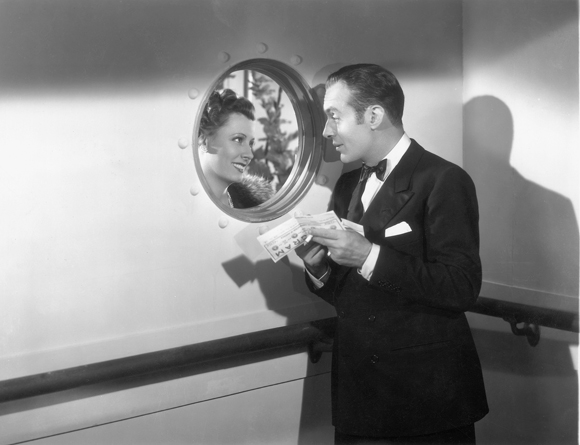
Irene Dunne and Charles Boyer's shipboard first meeting in Love Affair (1939).

The filmmaker Leo McCarey has been largely forgotten, but his Hollywood career spanned four decades and bridged the silent and talkie eras. Like Frank Capra, he received his training in silent comedy: he directed more than seventy-five shorts, and he was responsible for the collaboration of Stan Laurel and Oliver Hardy. When movies began to speak, he put his expertise at working fast and off the cuff to great effect – he directed the most brilliant of the Marx Brothers’ early Dadaist masterpieces, Duck Soup (1933), as well as helming pictures that starred W.C. Fields, Mae West and Eddie Cantor. His thirties output included two memorable comedies, Ruggles of Red Gap (with Charles Laughton as an English butler in the Wild West) and The Awful Truth, where Cary Grant strives to win back his ex-wife,  played by Irene Dunne. It also includes the romantic melodrama Love Affair, starring Dunne and Charles Boyer, which Criterion has just put out in a glistening print restored from sources in the Museum of Modern Art collection.

Wednesday, January 7, 2015

Knight of Light: Gordon Willis in Retrospective

A scene from Woody Allen's Manhattan (1979), shot by Gordon Willis.

Near the opening of his 1977 film Annie Hall, Woody Allen (playing Alvy, a version of himself) anticipates a rendezvous with the title character in front of a movie house. She’s running late, however, and during the interlude two wise guys accost him, recognizing his face from television comedian appearances. Unnerved beyond even his usual neuroticism, he practically runs to Annie when she pulls up in a cab at last. “I’m standing here with the cast of The Godfather!” he blurts out as they duck inside. This must rank as one of the great meta-references in cinema. For Diane Keaton, who plays Annie, of course was in the cast of The Godfather, in the role of Kay. You can’t get a better entrance. But it’s actually a double joke, for Annie Hall shares not only a great actor with those movies, but a great cinematographer as well: Gordon Willis. Willis died last year, and he stands prominently among the film luminaries we remember in looking back at 2014. So important was his impact on the art form, in fact, that the Brattle Theatre here in Boston offered a seven-film tribute to him late last summer. And while good doesn’t describe all of those pictures, Willis’ style is so distinctive that worth seeing does.

Thursday, April 28, 2016

Neglected Gem # 92: And Starring Pancho Villa as Himself (2003)

Antonio Banderas, Matt Day, Carl Dillard and Eion Bailey in And Starring Pancho Villa as Himself (2003).

The HBO movie And Starring Pancho Villa as Himself is a satirical comedy that the writer, Larry Gelbart, built up from an oddball historical footnote: in 1914 Pancho Villa invited Mutual Films to send their star director, D.W. Griffith, to Mexico to film the revolution. In his tabloids, William Randolph Hearst was editorializing fervently against Villa’s uprising, so Villa hoped that he could counter his bad press by going Hollywood – or at least Fort Lee, New Jersey, which in 1914 was where American movies were being made. I have no idea how faithful Gelbart is to the facts (a prefatory note tells us, “The improbability of events depicted in this film is the surest indication that they actually did occur”), but he landed on an irresistible subject and the movie, directed by Bruce Beresford, is terrific. In it, Antonio Banderas gives a sly and exuberant performance as Villa – it’s an ideal role for him – and the talented young actor Eion Bailey (who later played a major role in Band of Brothers and recurring roles on ER and Ray Donovan) is Frank Thayer, whom Harry Aitken (Jim Broadbent), the head of Mutual, sends down instead because Griffith’s too busy. The movie is shaped as Thayer’s coming of age: he falls in love with the revolution, becomes Villa’s buddy and romanticizes him, and then he has to acknowledge the more unpleasant truths about him. He even gets the girl – the actress Teddy Sampson (Alexa Davalos), who appears in the movie he makes about Villa. Dramatically, Gelbart and Beresford need Thayer to filter Villa’s actions, which are complicated and sometimes contradictory. But though Bailey is very good and his story is interesting in its own right, it’s Banderas’s Villa who mesmerizes the camera and claims ownership of the movie. Beresford shores up the two leading men with a colorful supporting cast: Broadbent, Michael McKean as William Christy Cabanne, who takes over from Thayer and makes a commercial seven-reeler about Villa, and Kyle Chandler as Raoul Walsh, who stars in it; Saul Rubinek as Villa’s American liaison; Colm Feore as Griffith; Buffy the Vampire Slayer’s Anthony Stewart Head as William Benton, a rich Englishman whose Mexican ranch Villa bleeds of its cattle (and then shoots Benton when he objects); and especially Alan Arkin as Sam Drebben, a Bronx-Jewish mobster who goes to battle with Villa. Arkin’s performance, gruff and robust and hilarious, ranks with the blistering comic work he did in the seventies in movies like Hearts of the West, Rafferty and the Gold Dust Twins, The Seven-Per-Cent Solution and The In-Laws.

Sunday, October 3, 2010

Unfulfilled Potential: Remembering Arthur Penn and Tony Curtis


Director Arthur Penn and actor Tony Curtis passed away one day apart last week: September 28 and 29. Both talents, it can be argued, were never truly fulfilled. At the very least, they never achieved their possible greatness. Considering Curtis was acting in films and TV from 1949 until 2008 (and was rumoured to be up for another role when he died), his reputation rests on very few projects: The Sweet Smell of Success, (1957), The Defiant Ones (1958), The Vikings (1958), Some Like It Hot (1959), Spartacus (1960) and maybe The Boston Strangler (1968). Except for The Defiant Ones and Some Like It Hot, the pictures he's remembered for are ones where he was not the lead. Was he ever a great actor? Probably not, but when he was good, he could be very good. Yet, due mostly to his own choices in life (he was more interested in jumping the bones of, supposedly, 1000 women and living the Hollywood life, than in really practicing his craft), Curtis never thrived as perhaps he should have.

Friday, August 26, 2016

You Probably Don't Even Hear It When It Happens: The Sopranos & The Death of the Gangster Hero


“The way the thing builds with the music and everything. To me, it gets me and makes me want to cry,” creator David Chase said recently of the controversial scene which concluded HBO's The Sopranos after six seasons in 2007. That moment, which begins in a New Jersey diner with the pop horror of Journey’s “Don’t Stop Believin’”playing on the jukebox and ends with an abrupt cut to black, has been debated for years and continues to be. People still argue about whether mob boss Tony Soprano was whacked just before he could sink his teeth into some onion rings, or whether the quick shift to dark simply left his fate to our imagination. Whatever audiences chose to believe, David Chase's decision wasn't an arbitrary one. Which is partly why his emotional reaction to its conclusion is not as simple as waving goodbye to a successful franchise. “It’s not because, ‘Oh, there goes the show. There goes part of my life.’ It has nothing to do with that. It’s what’s on the screen.” What's on the screen is an assured understanding that viewers had been inside mob boss Tony Soprano's head for the full duration, just as audiences had once been in the heads of Edward G. Robinson's Little Caesar, Cagney's Tom Powers in The Public Enemy, Muni and Pacino's Scarface and Brando's Godfather. But there's a significant difference this time around. Much had changed in both the gangster genre and our relationship to it.

Friday, December 12, 2014

Neglected Gem #66: Michael Winterbottom's The Claim (2001)


Michael Winterbottom's The Claim (2001) is set shortly after the 1849 California Gold Rush and loosely based on Thomas Hardy's emotionally devastating 1886 novel, The Mayor of Casterbridge. But Winterbottom doesn't simply adapt Hardy's powerfully evocative moral drama and recast it in the emerging American West, he cures the film in the poetically elliptical style of Robert Altman's imagined frontier of McCabe and Mrs Miller (1971). Altman's film, which starred Warren Beatty as a gambler with a vision and Julie Christie as the pragmatic madam he loved, was a dreamy, effusive view of the ruggedness of settling the land. The Claim doesn't share the fulsome lyricism of McCabe, but like Altman's western, Winterbottom allows the story to unfold through an evocatively shifting tableau of conflicting moods.

Sunday, December 12, 2010

Good For Goodness Sake: Santa's Screen Gems


On the first day of Christmas, my true love gave to me....a hidden treasure on DVD or VHS. Whether looking for gifts to put under the tree or simply movies to rent when holiday television programming is skimpy, here are a dozen suggestions in no particular order for older, sometimes forgotten releases that still make sense. They aren’t necessarily full of holiday cheer, but devoted cineastes tend to be happiest if good tidings are tempered by a little gloom:

Thursday, September 26, 2013

Long May You Run: Vanishing Point (1971)

Barry Newman in Richard C. Sarafian's Vanishing Point (1971)

The movie director Richard C. Sarafian, who died last week, was a fascinating, immensely likable man with a long, mostly unlucky career. In the late 1950s, after bumming around New York University (where, as a lark, he took a screenwriting course while flaming out as a pre-med/pre-law student) and the army, he wound up in Kansas City, where he met Robert Altman. The two became drinking buddies and worked together in the theater and on industrial films, and for a while Sarafian was married to Altman’s sister. While still in Kansas City, he directed a shoestring first feature, Terror at Black Falls, and in the early ‘60s, he followed Altman out to the west coast in search of TV work.

In 1965, he got the chance to make another feature, Andy – a low-budget, Neo-realist-style character study about a middle-aged, mentally disabled man that he shot on the streets of New York, using money he received as part of a program by Universal to encourage new talent. The movie won some praise at Cannes, but Universal was apparently so unimpressed with it that, decades later, they turned down a request to allow it to be aired on Turner Classic Movies. In the 1970s and ‘80s, Sarafian devoted most of his energies doing the best he could with various hopeless action-movie projects, including The Man Who Loved Cat Dancing, The Next Man, the Farrah Fawcett vehicle Sunburn, and Eye of the Tiger (his final feature). The 1990 Solar Crisis, was officially credited to the notorious (and nonexistent) Alan Smithee. In the last twenty or so years of his career, he probably gave audiences most pleasure in his occasional acting appearances in other directors’ films. (His side career began in earnest when he played Willie Nelson’s brazenly crooked manager, Rodeo Rocky, who dresses like a stardust cowboy and talks like Brooklyn, in Alan Rudolph’s Songwriter. He also played the gangster whose violent degradation serves as an aphrodisiac to Warren Beatty and Annette Bening in Bugsy.)

Sarafian did make one classic, though –  the “existential,” “psychedelic,” and generally weird road movie Vanishing Point (1971), a film that the white-trash singer-songwriter Mojo Nixon once proclaimed would be on permanent display, as part of a continuous triple bill with Thunder Road and Two-Lane Blacktop, at “the amusement park in my mind.” Febrile, rapturously beautiful to look at, and cheerfully disreputable, it is a movie spawned by a remarkable confluence of talents: the screenplay is credited to “Guillermo Cain,” who was actually the great Cuban novelist G. Cabrera Infante. The film was shot by John A. Alonzo, who later shot Sounder, Conrack, and Chinatown. (He and Sarafian went way back; Alonzo had an acting role in Terror at Black Falls.) 

Monday, May 3, 2021

George Segal, 1934-2021

George Segal in Who’s Afraid of Virginia Woolf? (1966).

When George Segal died at eighty-seven on March 23, most people would have recognized him as the co-star of the hit TV sitcoms The Goldbergs (which began in 2013 and is still running) and Just Shoot Me! (1997-2003). The long second act of his career, beginning around 1987, unfolded almost entirely on the small screen; his occasional movie appearances were in supporting roles in undistinguished pictures. But between the mid-sixties and the mid-seventies he was a force to be reckoned with. Strikingly handsome, charismatic, with an infectious warmth, he was groomed initially for romantic leading-man roles. The first picture he had a significant role in was Stanley Kramer’s 1965 Ship of Fools, though the movie was idiotic and the part – a painter chafing against the possessiveness of his well-heeled girlfriend (Elizabeth Ashley) – was wan and underwritten. But in King Rat (released the same year), cast as Corporal King, a scavenger in the officers’ section of a Japanese POW camp, he commanded the screen, and it was obvious that he had far more to offer than looks and charm. King was the kind of part a young Clark Gable would have played, but Gable would have made sure to make the character likable; Segal doesn’t, and the writer-director, Bryan Forbes (adapting a James Clavell novel), allows him some complicated scenes and reserves of mystery. His exchanges with James Fox as a British officer who forges an unexpected friendship with King are the emotional core of the film.

Monday, March 21, 2022

Acting and Actors – The Method: How the Twentieth Century Learned to Act

The 1935 Broadway production of Awake and Sing!

The Method: How the Twentieth Century Learned to Act by Isaac Butler (Bloomsbury Publishing) is a gossipy, entertaining and informative history of Stanislavskian acting – how it developed in Russia at the Moscow Art Theatre and how two of Stanislavski’s associates, Richard Boleslavsky and Maria Ouspenskaya, imported it to American shores, where, through its dissemination by the Group Theatre in the 1930s, it became the Method. Butler has rounded up an impressive amount of material and presents it coherently and compellingly. I didn’t realize how little I knew about the tensions between Stanislavski and the M.A.T.’s co-director, Vladimir Nemirovich-Danchenko; about the role each of the personalities who were drawn into Stanislavski’s circle played in the development of his approach to acting; about the effect Stalin’s rise to power had on the M.A.T. generally and on Stanislavski specifically – or certainly about Boleslavsky’s intriguing and rather crazy biography. No account I’ve read deals so clearly and in such dramatic detail with the break in the Group Theatre, when Stella Adler, its most gifted actress, challenged the weight Lee Strasberg, one of the company’s co-founders, placed on affective memory, where the actor digs into his or her past to unearth emotional dynamite to blast open a scene. Adler and Strasberg became the most important American acting teachers of the twentieth century. The Method’s examination of the differences in their styles and approaches and that of Sanford Meisner, another Group alumnus who became a famous and influential teacher, is fascinating. He identifies Adler’s greatest quality as her gift at script analysis; her book, compiled posthumously from her class notes, on Ibsen, Strindberg and Chekhov, and to a lesser extent the one on American playwrights, bear him out.

Sunday, May 8, 2016

Jack in the Box: The Criterion Blu-ray Release of Five Easy Pieces

Jack Nicholson and Karen Black in Five Easy Pieces.

Unlike many of the key actors who became part of the American New Wave of the Seventies, Jack Nicholson was paradoxically alluring. Dustin Hoffman, Al Pacino, Robert de Niro, Diane Keaton and Warren Beatty etched their eccentricities and differences in characters that formed clear lines of definition to form a close rapport with the audience. Whereas Nicholson rode a wobbly wavelength in search of a port that never arrived. There was no perceived goal of resolution in the characters he played early in his career. He was the man in the mirror seeking out definition while simultaneously railing at the world around him for continually honing him in. And, yet, movie audiences still became closely allied with his smart-ass independence. As critic Steve Vineberg remarked in his book Method Actors: Three Generations of an Acting Style, if Nicholson was playing a son of a bitch, he was his own man, and on terms that had their own unorthodox integrity. Hoffman and Pacino tied themselves close to the Method style and that inspired them to dig for the passport that defined their characters, Vineberg went on to suggest, but Nicholson cut loose from all those ties to create a compelling portrait of solitude.

In his Westerns, John Wayne sought to build a sense of community out of his stance as a loner, but he was always cast out in the end into the very wilderness that spawned him. Nicholson was instead a hermetic figure forever living in bustling communities, but more content to be the jack-in-the-box surprise who popped out aggressively with a lewd grin and bopping eyebrows and keeping everyone on their toes. This aggression he displayed was also key to the roles that made him a star. It set him apart from his contemporaries who chose instead to go deeper into the interior of their characters to explore the promise that abandoned them. In an age when America's greatest ideals were up against defeat and failure, it was no surprise that Jack Nicholson didn't wear that defeat quietly – or passively. His George Hansen in Easy Rider (1969) warned Peter Fonda and Dennis Hopper that their country would strike out violently at those seeking freedom, but his spiky humour made him a more memorable victim than Fonda or Hopper's mythic martyrs would be by the end. Detective J.J. Gittes in Chinatown (1974) didn't simply recoil from the evil deeds of John Huston's powerfully rich patriarch, he mocked them. In The Last Detail (1973), his navy lifer, Billy Buddusky (perhaps the doppelganger of Melville's Billy Budd), could be the cock-of-the-walk showing a good time to a young navy recruit he's taking to the brig, but his tap-dancing profanities proved to also mask his own impotence. Nicholson's sly and subtle paradoxes, a key to his success as a movie star, would bloom even later in his career in movies nobody saw. In The Border (1982), playing a quietly righteous border patrol agent, he defies the corruption offered by his partner (Harvey Keitel) by confronting him and literally drawing a line in the sand that he says he won't cross – only to walk over that line right after he finishes his confrontation. In that lightning quick moment, Nicholson reminds us of both his defiance and his vulnerability.

Monday, March 8, 2021

Older Women, Younger Men: Devil in the Flesh, A Cold Wind in August, The Stripper

Gérard Philipe and Micheline Presle in Devil in the Flesh (1947).

If you ask movie fans to come up with a classic drama about a romance between a young man and an older woman, the one they’re most likely to mention is The Graduate (1967), which, coming back to back with Who’s Afraid of Virginia Woolf?, led Mike Nichols from celebrity as a Broadway director to (premature) celebrity as a moviemaker. But it wasn’t the first movie to dramatize this sort of relationship, and it’s far from the best. What keeps it in the memory is the interplay between Dustin Hoffman as the anxious, confused twenty-two-year-old Benjamin and Anne Bancroft as Mrs. Robinson, whose pretty daughter Elaine (Katharine Ross) he thinks he’s in love with but whose mother has already seduced him. Hoffman is hilarious and sympathetic, and despite the fact that Calder Willingham and Buck Henry’s script can’t resist demonizing Mrs. Robinson, Bancroft is sensational. She was at the end of her too-brief great phase as a film actress, when she also starred in The Miracle Worker (opposite Patty Duke as Helen Keller) and The Pumpkin Eater (opposite Peter Finch). In the eighties and nineties, when she turned out one scenery-chewing performance after another, one wondered what the hell had happened to that complex, unpredictable actress, who could convey ferocious strength or fragility or a mixture of cynicism and melancholy with equal conviction.

Saturday, June 29, 2013

The Boston Phoenix Remembered


The Boston Phoenix folded four and a half months ago, not quite half a century after it began as two separate publications, The Phoenix and Boston After Dark. (They merged in 1972.) It was one of the few remnants of the age into which it had been born, when arts criticism was completely separate from celebrity journalism – when most critics would have been insulted by the comparison – and young reviewers, working for meager paychecks, were struggling to find ways to talk about the exciting new developments in the arts, especially movies and the newest kid on the block, rock ‘n’ roll. Significantly, the Phoenix went into publication around the same time as Rolling Stone, and many of the early writers published simultaneously in both venues.