Showing posts sorted by relevance for query Joe Wright. Sort by date Show all posts

Friday, April 8, 2011

Overkill: Joe Wright's Hanna

Saoirse Ronan as Hanna
Director Joe Wright (Pride and Prejudice, Atonement) might display an abundance of skill in his new espionage action adventure thriller Hanna, but there is little in the way of sense and sensibility. Working from a script by Seth Lochhead and David Farr, Wright abandons the lyricism of his earlier work for the steely visceral rush of pictures like The Professional, La Femme Nikita and Run Lola Run. But he goes at this pulpy material with such earnest intent that the movie collapses under the weight of its own artful seriousness.

The story, which has the fairy-tale overtones of Little Red Riding Hood and (more explicitly) those of Grimm's, is about the coming of age of a teenage killing machine. The 16-year-old Hanna (Saoirse Ronan) lives alone with her ex-CIA father (Eric Bana) in the remote mountains and forests of Finland. While he trains her to kill wildlife to survive, perform martial arts for self-protection, and to memorize languages for adaptability, we soon learn that this hermetic education is also to prepare her to go out into the world and kill his former CIA handler Marissa (Cate Blanchett). Years earlier, when he tried to flee the Company, Marissa took aim to stop him and killed his wife and Hanna's mother. When Hanna finally sets out to seek vengeance, she ultimately intends to lock horns with her father's nemesis.

Wednesday, January 30, 2013

Love in Excess: Joe Wright’s Anna Karenina

Keira Knightley stars in Joe Wright's adaptation of Anna Karenina

If you’d asked me last year which contemporary director I’d most like to see adapt Anna Karenina, I would have named Joe Wright. David Yates, who made the last four Harry Potter movies and directed the majestic BBC miniseries of Anthony Trollope’s The Way We Live Now, would have been a close second. Yates has a magical feel for the epic scope of Victorian fiction – a quality he excavates out of J.K. Rowling’s already Dickensian material – and perhaps more than any other recent director he has succeeded in transmuting the addictive pacing of the capacious novel form to the seriality of television and the film series, capturing the velocity of the novels rather than trying to outdo them. But it’s Wright’s films that distill and remediate the pleasure that novel reading can give us. In Pride and Prejudice (2005) and Atonement (2007), the experience of reading as both subject and visual motif suffuses the movies with a gently expressive awareness of the translation from page to screen.

Wednesday, March 23, 2011

Produced and Abandoned: The Soloist (2009)

Jamie Foxx and Robert Downey Jr in The Soloist
I was just about ready to give up on Jamie Foxx. Everything he'd done since his rightly celebrated turn as Ray Charles was utterly forgettable. It’s not that he'd been necessarily giving bad performances, but that his acting was begining to resemble doing chores. For example, while playing a composite of Berry Gordy in Dreamgirls (2006), he was so dull that it was hard to believe that the founder of the exuberant Motown Records could have been so dour. Portraying the homeless schizophrenic musician Nathaniel Ayers in The Soloist, however, brought Jamie Foxx back to life.

Monday, June 19, 2017

London Revivals, Part I: Political Morality Plays

Andrew Garfield and Nathan Stewart-Jarre in Angels in America: Millennium Approaches. (Photo: Helen Maybanks)

This piece contains reviews for the National Theatre's Angels in America, Donmar Warehouse's The Resistible Rise of Arturo Ui, and Young Vic's Life of Galileo.

The hottest ticket in London this summer – aside from Harry Potter and the Cursed Child, just beginning its second year in the West End – is the National Theatre revival of Tony Kushner’s Angels in America, directed by Marianne Elliott (War Horse, The Curious Incident of the Dog in the Night-Time) and starring Nathan Lane and Andrew Garfield. I couldn’t get up much enthusiasm about it, but then I’m the stubborn cuss who doesn’t like Angels in America. No one could say that I haven’t done due diligence with the play. I saw Part I: Millennium Approaches, in its original National Theatre production in 1992 (with Henry Goodman as Roy Cohn), and both Part I and Part II: Perestroika, on Broadway in 1993 (with Ron Liebman as Cohn, Stephen Spinella as Prior Walter, Marcia Gay Harden as Harper Pitt and Jeffrey Wright as Belize). I’ve also seen Mike Nichols’s 2003 HBO film version (with a cast including Al Pacino, Mary-Louise Parker, Meryl Streep, Emma Thompson, Patrick Wilson, and James Cromwell).

Kushner subtitled the work, which runs for seven hours and forty minutes in its complete form at the National, A Gay Fantasia on National Themes, and clearly one of the elements that critics and prize-winning committees and the vast number of theatre professors who regularly include it on the syllabi of modern drama classes respond to is the enormity of its ambitions. It’s intended to be a chronicle of the AIDS crisis from the point of view of the gay community; a coming-out play; an excoriation of the repressive spirit of Republican politics targeted specifically at Roy Cohn (played by Lane in this latest production), Joe McCarthy’s counsel and a Department of Justice prosecutor at the Rosenberg trial, and a closeted gay man who died of AIDS in 1986; and a comparative exploration of Mormonism, Protestantism and Judaism focusing on politics and sexuality at the end of the twentieth century, with a disquisition on race in America. Three of the characters are Mormon, three are Jewish, one is white Protestant and one is African American, and there are many others, the roles divided among a small cast whose efforts, in any production of the play, are equivalent in physical endurance alone to running a pair of marathons. In style Angels in America is alternately realist, surrealist and Brechtian, with interludes of satirical caricature.

Tuesday, May 18, 2021

Two Women, Two Windows

Amy Adams in The Woman in the Window (2021).

In Joe Wright’s creepy new chiller The Woman in the Window, Amy Adams gives a splendid, unsettling performance as Anna Fox, a child psychologist living alone in an old house in Upper Manhattan. She and her husband Ed (Anthony Mackie) have separated, but she keeps in daily touch with him and their daughter (Mariah Bozeman); Anna is agoraphobic and Ed tries to talk her through her anxieties. Since she can’t make it out the door, she has a tenant, David (Wyatt Russell), a musician with handyman experience who checks in on her and does a variety of small jobs. But things turn sinister when the Russell family moves in across the street. First she meets Ethan (Fred Hechinger), a nervous teenage boy who brings over a lavender candle as a gift from his mother. Then the mother herself, Jane (Julianne Moore), appears. She’s a kind of free spirit with a wild laugh whose unfiltered conversation draws the lonely Anna in. Finally Anna meets the father, Alistair (Gary Oldman), who is abrupt and unpleasant; when he demands to know if any other members of his family have visited Anna, she instinctively lies about Jane – and she begins to suspect that Alistair is abusing one or both of the other two. Then she sees Jane being slashed by a knife in the Russell house, her attacker concealed from view. When she calls their home in a panic, Alistair shows up at her doorstep and warns her to leave his family alone. She calls the police, who arrive with the full Russell family in tow, claiming that nothing untoward has happened. But the woman who claims to be Jane Russell – and is now played by Jennifer Jason Leigh – doesn’t look remotely like the woman who came to visit Anna and introduced herself as Ethan’s mother.

Monday, August 22, 2022

Crowd Pleasers: Damn Yankees and Gaslight at the Shaw Festival

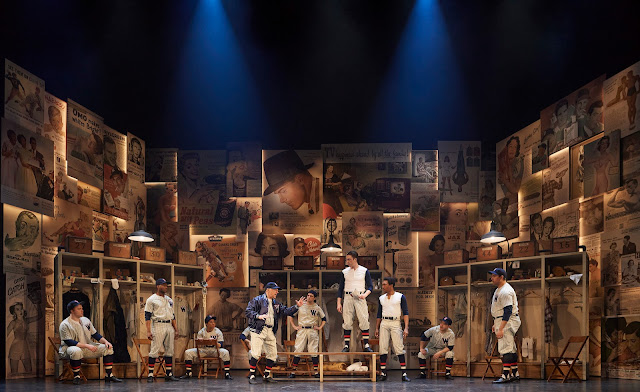
Jay Turvey with the Ballplayers in Damn Yankees, at the Shaw Festival. (Photo: Michael Cooper)

Richard Adler and Jerry Ross might have entered the pantheon of Broadway songwriters if fate hadn’t extinguished their star so fast. Adler was thirty-one and Ross twenty-eight when George Abbott commissioned them to write the score for The Pajama Game (1954), adapted by Abbott and Richard Bissell from Bissell’s novel 7-1/2 Cents, about the tensions between labor and management in a Midwestern pajama factory. It was a legendary show: Abbott and Jerome Robbins co-directed, a young Bob Fosse staged the dances, and it ran for three years. (A boisterous movie version in 1957, helmed by Abbott and Stanley Donen, captures the spirit of the original, with all but two members of the Broadway cast reprising their performances.) In 1955 lightning struck again for Adler and Ross with Damn Yankees. Adapted by Abbott and Douglass Wallop from Wallop’s book The Year the Yankees Lost the Pennant, Damn Yankees was as big a hit as The Pajama Game. But six months after its triumphant premiere, Ross died suddenly of lung disease. Adler never had another success, alone or with a collaborator, though his lovely score for the South Africa-set musical Kwamina, which he wrote for his wife, Sally Ann Howes, is ripe for rediscovery. (Its interracial love story was undoubtedly too controversial for 1961.)

Thursday, September 12, 2013

Little Stabs at Happiness: The World's End & You're Next

Martin Freeman, Paddy Considine, Simon Pegg, Nick Frost, and Eddie Marsan star in Edgar Wright's The World's End

The first weeks of September are a dozy, uninspiring time for moviegoers. Summer’s over, but fall’s not quite here yet; for serious movie geeks, most of the excitement is generated by the news from high-profile festivals (Telluride, Toronto); in the real world, something like Don’t Tell a Soul or The Exorcism of Emily Rose suddenly has a reasonably good chance to be one of the top box-office draws of its opening weekend. Given the kind of summer it’s been at the movies, it’s perfectly appropriate that a couple of the better popcorn movies still lingering around certain multiplexes in these post-dog days offer the charm of small-scale, ironic apocalypses. 

Wednesday, December 25, 2013

Serenity and Perversion: On Doris Lessing and Adore

Robin Wright and Naomi Watts in Adore

The death last month of the Nobel Prize-winning author Doris Lessing at the age of 94 drew a shower of obituaries and appreciations from across the English-speaking world. But few of those pieces talked about Adore, the movie French director Anne Fontaine and English screenwriter Christopher Hampton adapted this year from a story published in Lessing’s penultimate book, a collection of novellas entitled The Grandmothers. (It was published in 2003; Lessing’s final book, the novel/memoir Alfred & Emily, came out in 2008). As literary critics praised Lessing to the skies for her unabashed candor about female sexuality in novels like The Golden Notebook, credited as an influence to the second-wave feminist movement in the sixties, and for her revolutionary spirit, movie critics far and wide condemned Adore for its sexually transgressive subject: women who sleep with one another’s teenage sons. The movie people – largely male – who objected to Anne Fontaine’s lyrical and sensual depiction of what is, in essence, an incest story, didn’t acknowledge that the plot, tone, perspective and most of the dialogue came directly from Doris Lessing. And the literary people – often female – who eulogized Lessing didn’t rush to defend the movie. Why?

Thursday, October 12, 2017

Cells Within Cells, Interlinked: Blade Runner 2049

Ryan Gosling in Blade Runner 2049. (Photo: Stephen Vaughan)

Note: This review contains spoilers for Blade Runner 2049.

I have a . . . complicated relationship with Ridley Scott. I’m skeptical enough of his work, both old and new, that the prospect of a sequel to one of his better-loved films – directed by another filmmaker, to boot – was less than appetizing to me. I simply didn’t agree that the world needed more Blade Runner; Scott’s visually gorgeous 1982 tone poem was a sumptuous enough meal for me (if not a very nutritious one), whose working elements felt like they would be next to impossible to recreate. Learning that Denis Villeneuve, one of my favourite filmmakers, was the one being tapped for the sequel only served to complicate my feelings further. The casting of Ryan Gosling as the new blade-running protagonist boded well; the inclusion of Hollywood’s chief aging grumpypants, Harrison Ford, did not. It was nearly impossible to calibrate my expectations, so . . . I chose not to. I tried to ignore the marketing campaign for Blade Runner 2049 (except for the tie-in short films, which I thought were brilliant). I went to see it with very little idea of what I was in for.

Wednesday, August 9, 2017

Pink Floyd Redux: The Piper at The Gates of Dawn

Pink Floyd (left to right): Nick Mason, Syd Barrett, David Gilmour, Roger Waters, and Richard Wright.

Fifty years ago, Pink Floyd emerged from the underground music scene of London's Soho district and released their debut album, The Piper at The Gates of Dawn (Columbia/EMI). The band played the UFO club (pron. YOU-faux) under the steady guidance of Joe Boyd, the American owner of the venue, who said they “engrossed” the crowd every night, not by playing dance music or pop songs but adding a light show to complement their improvisational sets. It was a band trying to find their sound with a slightly flamboyant front man by the name of Roger “Syd” Barrett.

Listening again to this album I’m struck by its enthusiasm and promise, but it’s difficult to ignore the simple fact that this handsome lad from Cambridge, Barrett, who had taken his first LSD trip in 1965, eventually got lost in the shuffle because of his addiction. By the end of 1967, he was persona non grata in Pink Floyd since his habit made him too unreliable to the other members of the band. As Boyd reports in his autobiography, “One evening in May [1967] I ran into Syd and his girlfriend in Cambridge Circus . . . [He] was sprawled on the [curb], his velvet trousers torn and dirty, his eyes crazed. Lindsey told me he’d been taking acid for a week.” When the album was released and Pink Floyd had a gig at UFO, Boyd saw the band just before they went on stage: “Syd’s sparkling eyes had always been his most attractive feature but that night they were vacant, as if someone had reached inside his head and turned off a switch.”

Sunday, May 18, 2014

Blow Hard: Jude Law in Dom Hemingway


In Richard Shepard's incessantly verbose Dom Hemingway, Jude Law plays the title character, a British safecracker who has spent 12 years in prison for not ratting out his boss. Pumped up like a Cockney Jake LaMotta and with Popeye biceps to match, Hemingway is a boastful blowhard who in the opening scene gets progressively hard from the blow job he's receiving from a fellow prisoner. Hemingway, eager to be released so he can finally get the money owed him, addresses the camera while crowing about being – quite literally – the cock of the walk until he finally ejaculates. The stunt of watching Jude Law, who has built a career portraying mostly mild-mannered sorts, spitting invective at the same pace as his mounting erection is a clever joke. But Dom Hemingway can't sustain the cartoon intensity of its lead character because there's nothing behind the bluster. It's a one-note joke about potency and it dies with the money shot.

Friday, April 1, 2022

Movie Artists: The Worst Person in the World & Cyrano

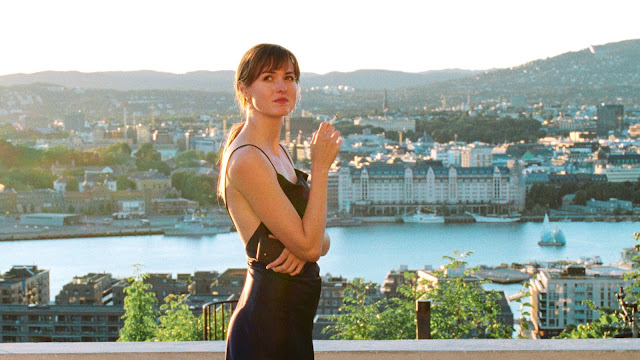
Renate Reinsve in The Worst Person in the World.

Socialists are quick to point out that we’ll still have problems after the revolution – they’ll just be more interesting. With our material conditions satisfied, we’ll have the time and means to engage more passions, take more adventures, and pursue more lovers. Norwegian director Joachim Trier’s latest film, The Worst Person in the World, gives us a tantalizing window into this world. Its vision is a society where young people can afford sleek, modernist flats, pursue fulfilling avocations, and indulge the varieties of self-expression – all while holding jobs in the service sector. Who needs heaven when you can have social democracy? With this picture, Trier brings his Oslo Trilogy to a poignant close. The series began in 2006 when he and co-writer Eskil Vogt released Reprise, a Joycean exploration of artistic ambitions between friends that introduced audiences to Anders Danielsen Lie. Lie’s become something like Trier’s muse: the actor’s appeared in each of the Oslo pictures – devastatingly so in the second, Oslo, August 31st (2011). There he portrays a heroin addict who journeys from rehab to fatal relapse in the course of a day. Along the way, Trier folded in elements of existentialism and phenomenology that created a haunting mood of angst. He deepened that philosophical exploration with Louder Than Bombs (2015), an American film that explored the death of a photojournalist through the fragmented consciousness of her kin.

Monday, February 15, 2016

A Classic and a Rarity: Fiddler on the Roof and Cabin in the Sky

Lori Wilner (left), Jessica Hecht and Danny Burstein in Fiddler on the Roof. (Photo: Joan Marcus)

I fell in love with Fiddler on the Roof when, at thirteen, I heard the original cast album; by the time I saw it on Broadway I knew the wonderful Jerry Bock-Sheldon Harnick score by heart and I’d read Joseph Stein’s libretto through several times. (Those were the days when Random House regularly published new playscripts in deluxe hardback copies furnished with production photos.) Zero Mostel had already been replaced in the role of Tevye by the distinguished Group Theatre alumnus Luther Adler; I caught it again on the road a few years later with Herschel Bernardi. In my senior year at college Norman Jewison’s movie version came out, with the robust, warm-toned Israeli actor Topol in the starring role. It managed not only to reproduce the glories of the stage version (including, of course, the Jerome Robbins choreography) but to make a link, in the final moments, to the next chapter of the story of the Jewish diaspora: the exiles from the Russian shtetls, borne away on a raft in the film’s most exquisite image, would be the first generation of Jewish-Americans.

In his magnificent new Broadway revival, Bartlett Sher tries to make the leap to the twenty-first century by bookending the show with his leading man, Danny Burstein, in a parka reading from a book about the Jews of Anatevka before – and after – he dons the hat and prayer shawl of Tevye the dairyman. This frame is meant to situate the story in the larger one about refugees that is still, of course, with us. But it’s too vague to work and frankly, why would you want it to? If you felt the need to imply that the narrative of Fiddler on the Roof is only one chapter in a broader story, then the direction you’d have to head in would lead to the Holocaust – and that would be a truly terrible idea. The subject matter of the musical is rich enough; it doesn’t need generalization. Its great virtue is its specificity.

Friday, August 19, 2016

Still Bourne: Paul Greengrass' Jason Bourne

Matt Damon in Jason Bourne.

Jason Bourne is the fifth installment of the espionage franchise and the third in which Matt Damon and director Paul Greengrass have teamed up (the fourth, a spin-off, saw Jeremy Renner in the lead). It's been an exhilarating partnership so far, producing the most taut chase scenes, desperate hand-to-hand struggles, and precision minimalist acting from an ever-expanding cast of characters. I'm happy to report that the latest film retains these features. Greengrass' action direction is uncanny, with several bravura sequences that will leave you slack-jawed. In one, Bourne races through the streets of Athens on a motorcycle in the middle of a full-scale popular uprising, replete with Molotov cocktails, tear gas, fire hoses, and pitched battles between rioters and armored police. It is a staggering, visceral piece of direction. Your sensory apparatus can hardly register the kinetic movement. The only thing I've ever seen that surpasses it is the final minutes of Alfonso Cuaron's Children of Men and perhaps Joe Wright’s Dunkirk sequence in Atonement. Damon continues his disciplined approach to the role; Tommy Lee Jones effortlessly steps into the shoes of the villain, nefarious CIA chief Robert Dewey; and Alicia Vikander gets the acting style of the franchise just right in the role of Heather Lee, Dewey’s protege.

But despite this craftsmanship and professionalism, Jason Bourne lacks the human conflict that lay at the core of the previous Damon films, a struggle that connected all of the movies’ elements into a tightly congealed ball. If you recall, the first movies trace the story of how Bourne--suffering from amnesia--comes to remember his past life as a CIA assassin even as he evades the Agency’s desperate attempts to eliminate him. His identity crisis was a moral crisis--he wanted to know the truth of his life so as to atone for the murders he committed. The problem was, he couldn’t escape being an assassin--he kept being forced to use his deadly abilities on the various black ops agents that came after him. Despite his desire to lead a quiet life, he had to keep killing, for the those agents would never have arisen if it weren’t for Bourne himself. He was the prototype, the first experiment in Dick Cheney’s 'dark side' operations. And so killing those agents and exposing their superiors was the only way to undo his painful legacy. That it fit in with his identity quest is what made the movies deeply compelling. This emotional weight lent a further urgency and excitement to the action sequences: the stakes were high.

Tuesday, March 27, 2012

Fighting Ageing Every Step of the Way: Ben Babchishin's Short Videos on Music and Ageing

Bill Bourne, in a scene from For the Record Featuring… Bill Bourne.

I first came across the filmmaker Ben Babchishin on the Internet. It’s complicated. Master folk muscian Bill Bourne was playing in town at The Pearl Company and I had agreed to go to see him. That day my wife was out of town, so when I got home from work I took her car to run a couple errands. I drove up to the used CD shop in town to pick up something I had ordered, and as I turned left I was t-boned by a teenaged girl who was late for work. “Don’t call the police,” she begged. It was her second accident in a month. As I looked at my wife’s car, the rear passenger door bent neatly in half, I was glad not to be hurt, but wondered how I would ever explain this. The car and I limped home; I spent 2 hours on the phone with insurance companies, and thought … I’m not going out tonight. Then I decided that music might be healing, and took my car to The Pearl Company. My ride there was tentative, every intersection a challenge … but by the end to the night, Bourne and his band had cheered me up. My wife’s car was still a mess when I got home.

I was taken by Bourne, bought his Bluesland CD, and found it enjoyable. I was searching for the name of his guitar player on the Internet when I discovered a DVD called For the Record Featuring … Bill Bourne. I contacted the site, and quickly had a reply from Ben Babchishin, the filmmaker. He offered to send me a copy. He asked me about other music I liked. He told me about another film he’d made for Bravo TV, Mae Moore & Lester Quitzau: In Their Own Backyard. When I told him that I knew about Quitzau and Moore he said he would send that film too. He told me about some of the roadblocks he encountered too. When he suggested to the producers at Bravo he wanted to do a documentary on Valdy, they had replied, “Unhunh … who’s Valdy?”

Monday, October 20, 2014

Double Stoppard: India Ink and The Real Thing

Rosemary Harris, Bhavesh Patel and Romola Garai in Indian Ink  (Photo by Joan Marcus)

Indian Ink is one of the few plays by the staggeringly prolific Tom Stoppard that never made it to New York in the aftermath of its West End run, so the Roundabout Theatre’s decision to mount it in its smallest (off-Broadway space), the Laura Pels Theatre, is a happy one for theatregoers. I can’t think why it didn’t open in Manhattan in the nineties (it was staged in London in 1995), especially since Arcadia, written two years earlier, was so successful there. Perhaps potential producers thought they were too similar – though that’s not generally a reason for withholding a new play that follows a well-received one. (Quite the opposite.) In Arcadia a pair of contemporary academics try to determine the events that occurred on an English country estate in 1809 where Lord Byron may or may not have been one of the house guests, while we see what really happened, the truth that the scholars can only guess at. In Indian Ink, an English professor named Eldon Pike annotates a new edition of the work of a poet, Flora Crewe, long dead, whose younger sister Eleanor – now an old woman – constitutes her only remaining family. Hopeful about following up with a biography, he searches for one of three paintings of his subject, two of them nudes, two of them done during the few months she spent in India, mostly in Jummapur. Among the people he contacts, aside from Eleanor, are the son of the Indian painter, Nirad Das, whom Flora befriended and posed for, and the son of the local Rajah who invited her to visit him in the course of her stay. Eleanor doesn’t approve of Pike’s long-term project and in her quiet way does what she can to quietly thwart his research. “Biography,” she argues, “is the worst possible excuse for getting people wrong.” And Stoppard confirms her analysis by – as in Arcadia – showing us what really happened to Flora in India, in a series of flashbacks that place one fragment of information on top of another until, gradually, we see it all. (We also discover chapters in Eleanor’s life that we hadn’t suspected, and that explain how she began as a Bohemian, like her sister, and metamorphosed into a conservative colonial.)

Monday, January 9, 2023

New from Criterion: HĂ´tel du Nord, Le Corbeau and Summertime

Jean-Pierre Aumont and Annabella in HĂ´tel du Nord (1938).

I look eagerly forward to the monthly announcements of the new Blu-Ray releases from Criterion and to viewing (or more often re-viewing) a handful of them in gleaming new prints. Here are three that came my way over the past few months. 

Wednesday, December 19, 2012

Lyricism, Two Ways: Children of Paradise and Umberto D.

The Blu-ray release of the gorgeous Criterion discs of Children of Paradise and Umberto D. highlight the end of one era and the beginning of another in European movies. Marcel CarnĂ©’s Children of Paradise (Les enfants du paradis), with a screenplay by CarnĂ©’s favorite collaborator, the poet Jacques PrĂ©vert, came out just as the Second World War was ending, and considering the restraints under which French filmmaking was confined – political, esthetic and financial – during the Occupation, it seems remarkable that these two men could have come up with a movie so lush and with such a broad narrative sweep. (It took two years to make.) Children of Paradise is a three-hour-and-ten-minute historical melodrama set in the Paris theatrical world of the 1820s and its subject is the line, easily blurred, between art and life. CarnĂ©’s bailiwick was the romantic-fatalistic vein of French movies in the 1930s, and though other directors worked it too – Julien Duvivier in PĂ©pĂ© le Moko and even occasionally Jean Renoir (especially in La bĂŞte humaine) – CarnĂ© was its undisputed master. That’s CarnĂ©’s Port of Shadows we see being unspooled in the movie house in the Dunkirk sequence of Atonement, while James McAvoy is wandering around behind the screen in a fever: Joe Wright, the director, is playing carefully against the romanticism of CarnĂ©’s movie, with its moody, doomed hero, to suggest that this kind of gesture is gone forever, that in the world of Dunkirk it’s become a mockery. CarnĂ© and PrĂ©vert reached the height of this irresistible style and mood in Daybreak (Le jour se lève), which came out just before the war. (Jean Gabin, the poster child for this genre, was the leading man in all four of these movies.) Children of Paradise, which has the good sense to slip it into a faraway historical period, is its last gasp.

Monday, February 4, 2013

Family Happiness: Tolstoy on the Rack

Ksenia Kutepova and Alexey Kolubkov star in Family Happiness” (Photo: A. Sergeev)

Whatever has secured the reputation of the Moscow Theatre-Atelier Piotr Fomenko as one of Russia’s best theatre companies certainly isn’t in evidence in Family Happiness, which I caught on the Boston leg of its American tour. The production, which premiered in Moscow in 2000 and is performed in Russian with English supertitles, is an adaptation (no playwright is listed) of Tolstoy’s beautiful novella tracking the arc of a marriage between a recently orphaned eighteen-year-old girl, Masha, and Sergey Mihailovich, her neighbor and guardian. The marriage begins in a kind of other-worldly bliss but reaches a point of crisis when, after they have begun to raise children, Sergey takes Masha to St. Petersburg and reacts with revulsion as she gets caught up in the social whirl that their provincial home has denied her. The story is about the way the cracks in a relationship that have been covered up by romantic optimism can suddenly appear, focusing the partners on incompatibilities they’re shocked to discover have been in place since the outset. Masha and Sergey’s marriage somehow endures the crisis and passes into a third, compromised phase that Masha (who is the narrator) sees as true “family happiness”:

That day ended the romance of our marriage: the old feeling became a precious irrecoverable remembrance; but a new feeling of love for my children and the father of my children laid the foundation of a new life and a quite different happiness; and that life and happiness have lasted to the present time.

Saturday, April 5, 2014

Time, Power and Song: Time After Time, The Seduction of Joe Tynan and Hair


It's still difficult, if not impossible, to comprehend that we lost our dear colleague and Critics at Large co-founder David Churchill a year ago today. For David was not only my best friend, he was also my counsel. If I tried to recall the number of times this past year I wanted to pick up the phone to get his advice on a piece, request an idea for one, or hear him come up with a brainchild for a series to run, I would quickly lose count. Never mind that every day I went to edit and post a piece, I would look at our homepage and be reminded that he was here and not here. 

I've been wanting to keep his presence on Critics at Large continuous despite mortality making that task next to impossible. Fortunately, his wife, Rose, lent me a box of his writing – both published and unpublished – that allowed me to at least try the impossible. And it was quite a trip dipping into the volume of his work and going all the way back to his film reviews from his university days. Perhaps the bonus was finding in the box the notebook he kept in the mid-Eighties. In it, I discovered handwritten comments he had compiled at a number of screenings we went to together. Sometimes he even had very precise notes to counter my own opinions on pictures we would ultimately disagree on when we finally reviewed them on the radio at CJRT-FM's On the Arts. Reading them today quickly stoked those moments on air when I heard those views for the first time. Reading his quickly scribbled assertions had an alchemical way of bringing his voice back into the present. 

Today I want to reach back to his university reviews where I found it bracing (and not terribly surprising) to discover that David's conversational voice was indeed as recognizable as it became years later on Critics at Large. Last week, Rose commented to me that David was all there right from the beginning. She was saying that he didn't grow into his voice. Judging by the pieces below, I would have to agree. To prove the point, I've decided to include film reviews first published in 1979 from the newspaper, one of the University of Toronto's journals at that time. David's temperament and wit are easily recognizable to anyone who knew him. Since I also want to treat these pieces as if they were copy he just e-mailed me this morning, they are presented as edited from their original source.

Kevin Courrier,
Editor-in-Chief.